

 journal menu


- 1. Introduction
- 2. Temperature dependent thermal mechanical properties of silicon and diamond
- 3. Transient thermal deformation modelling by FEA
- 4. Cryocooling and water cooling
- 5. Second-order correction
- 6. Summary and conclusion
- A1. Thermal conductivity versus temperature
- A2. Thermal expansion coefficient
- A3. Specific heat
- References


- 1. Introduction
- 2. Temperature dependent thermal mechanical properties of silicon and diamond
- 3. Transient thermal deformation modelling by FEA
- 4. Cryocooling and water cooling
- 5. Second-order correction
- 6. Summary and conclusion
- A1. Thermal conductivity versus temperature
- A2. Thermal expansion coefficient
- A3. Specific heat
- References
research papers
 | JOURNAL OF SYNCHROTRON RADIATION |
 access
Minimization of thermal deformation in crystal optics for high-repetition-rate FEL

aLCLS, SLAC National Accelerator Laboratory, 2575 Sand Hill Road, Menlo Park, CA 94025, USA
*Correspondence e-mail: [email protected]
Minimizing thermal deformation in X-ray crystal optics is crucial for preserving coherence and wavefront in high-repetition-rate free-electron lasers (FELs). This study presents two approaches to reduce pulse-by-pulse transient thermal deformation in diamond crystals used in cavity-based X-ray FELs (CBXFELs): (i) cryogenic cooling with liquid nitrogen (LN2), and (ii) second-order correction via focusing optics. We revisit the temperature-dependent thermal-mechanical properties of diamond and silicon, and implement a finite-element analysis method to accelerate convergence to a quasi-steady-state regime. Results show that LN2-cooled diamond crystals meet the stringent deformation requirement of less than 15 pm RMS for the pulse at the mJ scale at 1 MHz repetition frequency, and up to 1.5 mJ for 100 kHz. Second-order correction by using focusing elements within the cavity can reduce the impact of thermal deformation for both LN2 and water cooling.
Keywords: free-electron laser; X-ray crystal optics; pulse-by-pulse transient thermal deformation; liquid nitrogen cooling; second-order correction.
1. Introduction
Hard X-ray free-electron lasers (XFELs) operating under the self-amplified spontaneous emission (SASE) mode are quite monochromatic; the energy bandwidth Δeph/eph is of the order of ∼0.001 (Huang & Ruth, 2006 ). This level of monochromaticity of the SASE XFEL was sufficient for many early science applications but requires further monochromatization by crystal optics for spectroscopy and diffraction applications (Zhu et al., 2014). This leads to significant reduction in usable X-ray pulse energy and flux. Demands for higher spectral brightness from experiments calls for new XFEL concepts such as CBXFELs (cavity-based X-ray free-electron lasers) which also require the use of high-quality crystal-based optics (Rysov et al., 2019; Huang & Ruth, 2006; Kim et al., 2008; Marcus et al., 2020; Rauer et al., 2023; Margraf et al., 2023; Zhang et al., 2023). Single crystal silicon has been widely used in optics for storage-ring based synchrotron radiation facilities. To cope with the extreme high peak power of the XFEL, diamond crystal optics have become increasingly popular (Zhu et al., 2014). High-repetition-rate XFELs promise to deliver orders of magnitude higher average power (up to several hundreds of Watts) than the currently operating low-repetition-rate XFELs. To preserve the excellent beam properties such as brightness, coherence, and the extremely short pulse duration, thermal deformation of the optics needs to be minimized to an unprecedented level of a few tens of picometres in RMS figure error (Zhang et al., 2023). Therefore, active cooling of the crystal optics becomes mandatory. Compared with storage-ring based synchrotron radiation light sources, XFEL light sources deliver ultra-short pulses with variable repetition rates. The time structure of the XFEL and transient response of the crystal optics raise new challenges and questions in the application of crystal optics.
The relation between thermal deformation of X-ray optics and constant isotropic material properties can be expressed as (Zhang et al., 2014; Zhang, 2018)

where Δθ is the thermal slope error; ν, α, k are, respectively, Poisson's ratio, the thermal expansion coefficient, and thermal conductivity; fgeom is a dimensionless geometrical function depending on the optics and cooling geometry, and power distribution. This equation indicates that thermal deformation can be minimized in two ways: (i) optimizing the cooling design and geometrical shape of the optics (Zhang et al., 2013a; Zhang et al., 2015), and (ii) material selection (or operating temperature) to achieve good thermal mechanical properties: high thermal conductivity and low thermal expansion coefficient. For a crystal monochromator, liquid-nitrogen (LN2) cooling is the most effective way to limit thermal deformations. LN2-cooled silicon crystals have been widely used with great success at many synchrotron light sources (Marot et al., 1992; Rogers et al., 1995; Lee et al., 1995; Marot, 1995; also see the reviews by Bilderback et al., 2000; Mochizuki et al., 2001; Zhang et al., 2003; Chumakov et al., 2004). Numerous studies have been carried out to assess the performance limits of cryogenically cooled silicon monochromators both by finite-element analysis (FEA) modelling and experimental testing (Zhang, 1993; Lee et al., 2000, 2001; Tajiri et al., 2001; Zhang et al., 2003, 2013b; Chumakov et al., 2014; Huang et al., 2014).
Pulse-by-pulse transient thermal deformation in water-cooled diamond crystal optics under high-repetition-rate FEL has been studied (Bahns et al., 2023; Zhang et al., 2025). The CBXFEL system that serves as the background of this study is composed of four diamond crystals forming a 300 m-long round-trip cavity, with a round-trip time of 1 µs. The narrow bandwidth XFEL pulse recirculates as a seed in the cavity. The number of recirculation cycles of this seed is 2, 10, and 20 for a FEL repetition rate of 500, 100, and 50 kHz, determined by electron bunch repetition rate. The outcoupling crystal absorbs a fraction of output FEL power and thus is the most critical crystal in the cavity in terms of thermal deformation. To limit this thermal deformation to less than 20 pm for the wavefront preservation requirement, the FEL pulse energy should be limited to less than 100 µJ at 100 kHz repetition rate and 50 µJ at 500 kHz repetition rate. However, the LCLS, LCLS-II, and LCLS-II-HE FEL can deliver up to several mJ scale pulse energies. To transport and manipulate such high pulse energy FEL beams, the thermal deformation of the crystal should be significantly reduced.
This paper studies two methods to minimize the thermal deformation of the crystal for high-repetition-rate FEL: (i) LN2 cooling, (ii) second-order compensation by using focusing elements. First, we revisit temperature dependent material properties such as thermal conductivity, thermal expansion coefficient, and heat capacity of diamond and silicon crystals. We propose a simulation technique to accelerate the convergence of pulse-by-pulse transient analysis. Finally, we focus on the performance improvement of LN2 cooling, and second-order compensation by using focusing elements.
2. Temperature dependent thermal mechanical properties of silicon and diamond
Historically, silicon has been used in X-ray optics for both crystal monochromators and mirror substrates. However, synthetic HTHP single crystal diamond is increasingly being considered for crystal monochomators, especially for XFELs. The thermal conductivity k and thermal expansion coefficient α are two key material properties that affect the thermal deformation of X-ray optics. The thermal deformation increases with (1 + ν)a/k [equation (1)]. The thermal transient response of the X-ray optics, under pulse-by-pulse XFEL power load, also depends on heat capacity cp and density ρ. In addition, Young's modulus E also affects transient deformation and acoustic waves (Zhang et al., 2025). The thermal conductivity k, thermal expansion coefficient α, and heat capacity cp of the silicon and diamond are strongly temperature dependent. On the other hand, Young's modulus E, density ρ, and Poisson's ratio ν are quite constant in the temperature range 80 to 500 K.
2.1. Thermal conductivity
The thermal conductivity k versus temperature is depicted in Fig. 1 for type IIa single crystal diamond, natural silicon, and single-isotope silicon-28 (99.9%). Type IIa single crystal diamonds are the most chemically pure diamonds and have the highest thermal conductivity beside isotropically pure varieties. In the plots, the data represented by small circles for natural silicon and by small triangles for diamond IIa are the recommended values (Touloukian, Powell et al., 1970), and the data represented by small squares for single-isotope silicon-28 crystal are measured values (Ruf et al., 2000). The continuous lines are curve fit results of the data. The polynomials used for curve fitting are given in Appendix A1.
![[Figure 1]](art5006fig1thm.gif)
|
Figure 1
Thermal conductivity of natural silicon, single-isotope silicon-28 (99.9%), and diamond IIa. The continuous lines are curve fit results of the data represented by small squares, circles, and triangles. |
The maximum of thermal conductivity of single-isotope silicon-28 is significantly higher than that of natural silicon. At very low temperatures, heat transfer is mainly due to phonon boundary scattering, and the thermal conductivity k of the crystals is proportional to the temperature T3 according to the Debye theory (see, for example, Van Sciver, 1986; Ruf et al., 2000).
The thermal conductivity of the silicon and diamond crystal is strongly temperature dependent. The shape of the thermal conductivity versus temperature curve of the three crystals is similar: the thermal conductivity increases from zero with T3 at very low temperature, then continuously increases with temperature, reaching a peak of k = 5.2 W mm−1 K−1 at 25 K for natural silicon, k = 30 W mm−1 K−1 at 21 K for single-isotope silicon-28, and k = 12 W mm−1 K−1 at about 70 K for diamond IIa. The peak thermal conductivity values of the crystals are much higher than at room temperature, 124 times for single-isotope silicon-28, 36 times for natural silicon, and 5.2 times for diamond IIa. Above 50 K, the diamond IIa crystal offers the highest thermal conductivity. The superiority of diamond crystal at room temperature is undeniable. Below 50 K, the single-isotope silicon-28 gives the highest thermal conductivity; the peak value (k = 30 W mm−1 K−1) is 2.5 times that of the diamond IIa crystal, and 5.8 times that of the natural silicon crystal. As a perfect single crystal, the single-isotope silicon-28 could be an excellent candidate for monochromators cooled to low temperatures down to 20 K.
2.2. Thermal expansion coefficient
The thermal expansion coefficient α versus temperature is shown in Fig. 2 for (natural) silicon and diamond. In the graph, the data represented by small circles for silicon and by small triangles for diamond are the values recommended by Touloukian, Kirby et al. (1970). Natural silicon is composed of 92% silicon-28; the thermal expansion coefficient of the single-isotope silicon-28 and the natural silicon are not significantly different from each other. The continuous lines are curve fit results of the data. Curve-fitted polynomials are given in Appendix A2.
![[Figure 2]](art5006fig2thm.gif)
|
Figure 2
Thermal expansion coefficient α versus temperature of silicon and diamond. The continuous lines are curve fit results of the data represented by small circles and triangles. |
The thermal expansion coefficient α data (Touloukian, Kirby et al., 1970) are in the temperature ranges 20–1600 K for silicon and 25–1600 K for diamond. According to physical analysis (Van Sciver, 1986), the thermal expansion coefficient at low temperatures near zero K is far from linear and approaches absolute zero with zero slope. The silicon data (Touloukian, Kirby et al., 1970) show α = 0 at the two lowest temperatures T = 20 and 25 K. Below 20 K, the thermal expansion coefficient α of the silicon is naturally set to be zero. For diamond, the data from Touloukian, Kirby et al. (1970) at the lowest temperature 25 K are not zero. As the thermal expansion coefficient at low temperature approaches absolute zero with zero slope, the thermal expansion coefficient α of the diamond is therefore set to be zero below 5 K.
Like the thermal conductivity, the thermal expansion coefficient α is also strongly temperature dependent. The value of α is negative when temperature T is lower than 125 K for silicon, and lower than 111 K for diamond (can be checked with fitted formula in Appendix A). The thermal expansion coefficient of the diamond is very close to zero below 111 K. Above these temperatures the thermal expansion coefficient increases with temperature, especially for silicon.
The ratio of thermal expansion coefficient and thermal conductivity α/κ versus temperature for the silicon and the diamond is plotted in Fig. 3. In general, this figure of merit α/κ for thermal deformation [see equation (1), and Freund et al. (1990)] of the diamond is flat and approaches zero. Therefore, diamond crystal is the best material for crystal monochromators in terms of thermal deformation. However, at very low temperatures, the natural silicon (T < 36 K) and single-isotope silicon-28 (T < 45 K) are better than diamond. The ideal working temperature range of the silicon crystal is between 20 and 25 K. To cool down to this temperature range, appropriate coolant, for example liquid helium, must be used. From the cooling power limitation, and cost effectiveness point of view, LN2 cooling is much more accessible than liquid helium cooling. Therefore, LN2 cooled diamond crystal can be an excellent option for high heat load XFEL monochromators.
![[Figure 3]](art5006fig3thm.gif)
|
Figure 3
Ratio of thermal expansion coefficient and thermal conductivity α/κ versus temperature for the silicon and the diamond. |
2.3. Specific heat
To study the transient response of the monochromator crystal under pulse-by-pulse XFEL, the temperature dependent specific heat of the crystal is necessary in the transient analysis. Fig. 4 shows the specific heat cp versus temperature for silicon and diamond. In the plots, the data represented by small circles for silicon and by small triangles for diamond are the recommended values by Touloukian, Buyco & Matter (1970). Hu et al. (2002) compared the low-temperature specific heat of single-isotope silicon-28 crystal with that of natural silicon through experimentation. Results in the temperature range 1–140 K show that the enhancement (about 10%) of specific heat by isotope purification is much less than that of the thermal conductivity. No data on the specific heat for single-isotope silicon-28 at temperatures higher than 140 K was found in the literature. Therefore, the data presented here for natural silicon will also be used for single-isotope silicon-28 in the finite element modelling. The continuous lines are curve fit results of the data represented by the small circles and triangles. The curve-fitted polynomials are given in Appendix A3.
![[Figure 4]](art5006fig4thm.gif)
|
Figure 4
Specific heat cp versus temperature of the silicon and the diamond. The continuous lines are curve fit results of the data represented by small circles and triangles. |
The thermal diffusivity D can be calculated from the heat capacity, thermal conductivity, and density of the crystals as

where ρ is the density of the material (ρ = 2.3 g cm−3 for silicon, ρ = 3.52 g cm−3 for diamond). The thermal diffusivity at lower temperature is much larger than at room temperature with the combined effects of temperature dependence of the thermal conductivity and specific heat.
The thermal diffusivity can be used to estimate the thermal diffusion time τth. For example, in a length L, the thermal diffusion time is about

Table 1 gives this typical diffusion time for a 1 mm length of the three types of crystals at different temperatures. The thermal diffusivity of the three types of crystals at low temperature is much higher than at room temperature. Consequently, the thermal diffusion time in a length of 1 mm decreases from 11 ms at room temperature down to 0.29 ms at 77 K for natural silicon, from 6.8 ms to 0.12 ms for single-isotope silicon-28, and from 0.51 ms down to 0.0017 ms for diamond. The thermalization in the LN2 cooled crystals is much quicker than in the water-cooled crystals.
|
||||||||||||||||||||||||||||||||||||||||||||||||||||||||||
3. Transient thermal deformation modelling by FEA
Pulse-by-pulse transient simulation of the crystal under XFEL is compute-intensive since the mesh size should be small enough, around the micrometre scale, to be consistent with ns scale time increments. A small, thin crystal can lead to a reasonable number of elements such that the simulation of a transient response to a quasi-steady-state can be performed in about one day1. In this study, we continue to consider the same thin diamond crystal C1 for CBXFEL as studied by Zhang et al. (2025). The diamond crystal is modelled as a thin rectangular prism (5 mm × 5 mm × 0.05 mm), with the lower 2 mm held on both sides by copper cooling blocks with indium foil interfaces. A geometrical model of the half crystal is shown in Fig. 5. The same thermal and mechanical boundary conditions are used in this study as Zhang et al. (2025), unless otherwise indicated for pulse energy and repetition frequency.
![[Figure 5]](art5006fig5thm.gif)
|
Figure 5
Finite element geometrical model of a half diamond crystal, symmetry condition on the right edge plane. |
Other FEA parameters that are reused from Zhang et al. (2025) include: mesh size (down to 6 µm), time increments of mostly 1 ns, power loading pulse length of 1 ns, damping ratio of ζ = 0.5 (as we focus on temperature gradient related thermal deformation), and some constant material properties: density ρ = 2530 kg m−3, Young's modulus E = 1000 GPa, and Poisson's ratio ν = 0.1. However, temperature dependent thermal conductivity, thermal expansion coefficient, and specific heat capacity shown in Figs. 1, 2, and 4 will be used in this study. To quantify the thermal deformation, we will use the standard deviation (std) of the height error (vertical displacement Uy) along the beam footprint axis on the crystal surface.
3.1. Accelerate the convergence to the quasi steady-state
The shape of the transient response curve of the X-ray optics under pulse-by-pulse XFEL is typically marked by a sharp increase in temperature or thermal deformation with arrival of the pulse, then followed by an exponential decay shortly after the pulse. With an accumulation of pulses, the average temperature level and thermal deformation increase with time until a certain time or number of pulses. The response curve pattern then becomes repetitive and is considered `quasi steady-state'. From the previous study (Zhang et al., 2025) on the diamond crystal mentioned above, the time to reach this state is about 50 ms for temperature and 50 µs for thermal deformation. If the repetition rate is 1 MHz, 50 ms corresponds to 50000 pulses. The computing time for 169 XFEL pulses was 11 days. To reach quasi steady-state the computing time would be about ten years for temperature.
The previous study (Zhang et al., 2025) showed that both temperature and thermal deformation at any repetition rate varies with time and oscillates around the results for the transient response with average XFEL power (called the CW case). This is true starting from the first XFEL pulse to quasi steady-state. The optics performance at this latter state is essential for beamline operation. To accelerate the transient response simulation to reach this quasi steady-state, we propose starting the transient FEA simulation using the steady-state simulation results with average XFEL power (CW steady-state) as the initial conditions both for temperature and displacement. To directly compare with results of Zhang et al. (2025), temperature-independent, constant material properties are used only in this section (Section 3.1), as well as the same average power of 262 W. The relation between the average power Pav, pulse energy Qp, and repetition frequency frep is given by Pav = Qpfrep.
To quantify the thermal distortion of the crystal lattice plane, we use the thermal deformation of the crystal surface both in slope error and height error. The extinction length of the silicon and diamond crystal in our application (Bragg angle is about 45°) is around 10 µm (Shi et al., 2023; Boesenberg et al., 2019). The deformation of the crystal surface is directly related to the distortion of the top tenth micrometres crystal volume impacting the X-ray diffraction. Thermal deformation in slope error or height error is the relative surface deformation – differential surface shape with heat load and without heat load. This should be identical to the crystal plane thermal distortion within the extinction length.
For the CW case, the transient temperature and thermal deformation converge to the steady-state results in about 50 ms for temperature [Fig. 6(a)], and in about 50 µs for thermal deformation [Fig. 6(b)]. Pulse-by-pulse full transient simulation results using uniform room temperature as the initial condition (`From 1st pulse') follow and oscillate around the results of the CW transient. This means that, to reach quasi steady-state, such pulse-by-pulse transient simulation should be conducted to about 50 ms of XFEL pulses, or 50000 pulses in 1 MHz repetition frequency. When using CW steady-state results as the initial condition (`From CW SS'), pulse-by-pulse full transient simulation results converge quickly and vary around the results of the CW steady-state results. The convergence time is less than 10 µs. Therefore, using CW steady-state results as the initial condition, we can conduct the pulse-by-pulse full transient simulation for only a few XFEL pulses (Np) to reach quasi steady-state. The number of pulse Np can be calculated by Np = max(2, 10frep) where repetition frequency frep is in MHz units.
![[Figure 6]](art5006fig6thm.gif)
|
Figure 6
Pulse-by-pulse transient responses to the first XFEL pulses: (a) temperature at the centre of the footprint, (b) the standard deviation of the height error of the beam footprint on the diamond crystal over 2×FWHM length, 1 MHz repetition frequency, 0.262 mJ pulse energy. Two initial conditions were used in the simulation: (i) `From 1st pulse', where the crystal was at room temperature, (ii) `From CW SS', steady-state simulation results with average XFEL power. To guide the visualization, the results of steady-state and transient analyses with average power of 262 W (CW case) are also plotted in dashed lines. |
4. Cryocooling and water cooling
In the following sections, we will exclusively use `From CW SS' initial conditions, and temperature-dependent material properties both for LN2 and water cooling in all the pulse-by-pulse full transient simulations. The following beam parameters will be used: average XFEL beam power of 150 W, beam size of 100 µm FWHM, and X-ray photon energy of 9.831 keV which corresponds to diamond crystal (400) at a 45° Bragg angle. As mentioned by Tang et al. (2023) and Zhang et al. (2025), the majority of the FEL radiation spectrum is slightly switched out of the narrow reflection bandwidth of the diamond crystal for output; only a small portion of the spectrum within the crystal Bragg reflection width is recirculated to seed the next electron bunch. Therefore, the absorbed power by the 50 µm-thick diamond crystal at 45° is about 8.41 W.
We will use an effective convection cooling coefficient of hcv-eff = 0.01 W mm−2 K−1 on the crystal cooled surfaces as in Zhang et al. (2025). Two cooling fluids will be considered: LN2 at 77 K and water at 295 K. We will compare the performance of both cooling cases.
Temperature at the centre of the beam footprint, or maximum temperature in the crystal, versus time is shown in Fig. 7 for both water (H2O) and LN2 cooling, and for CW steady state. Two repetition times tper = 1, 10 µs were used for pulse-by-pulse transient analyses. The results from both water and LN2 cooling confirm that the steady-state (SS) case can be effectively used as the repetition time tends to zero, or repetition frequency tends to infinity, as explained by Zhang et al. (2025). With higher repetition frequency or smaller repetition time tper, the pulse energy is lower when keeping the same average power, the amplitude of the temperature oscillation around the results of the CW cases decreases. As expected, the temperature in the diamond crystal with LN2 cooling is lower than with water cooling. The sudden temperature increases with time before and after the XFEL pulse is higher with LN2 cooling than with water cooling, but the recovery time with LN2 cooling is shorter than with water cooling. All these behaviours are related to the material properties and are consistent with the discussion in Section 2.3. More quantitatively, we can calculate the temperature increase of the crystal related to the absorption of the XFEL pulse energy from the following equation,

where aabs is the absorption coefficient of the thin diamond crystal at 9.831 keV, which is equal to exp(− × 0.05/1.226) = 0.056; beam size in standard deviation σ = FWHM/2.35 = 0.04255 mm, crystal thickness t = 0.05 mm, density ρ = 2.53 × 10⁻⁶ kg mm−3; Tmin and Tmax are, respectively, the temperature at the centre of the footprint before and after the XFEL pulse. The 45° beam incidence was considered in equation (4) by the factor 1/sin(45) = . Table 2 compares the results of the sudden temperature increase determined by FEA and analytical calculations with equation (4). The estimates of the sudden temperature increase by equation (4) are in good agreement with the FEA results. The consistently lower temperatures calculated by equation (4) can be explained by the slightly variable in-depth power absorption in the diamond crystal which was considered in the FEA but averaged over the thickness of the crystal in equation (4).
|
||||||||||||||||||||||||||||||||||||||||||||||||||||||||||||
![[Figure 7]](art5006fig7thm.gif)
|
Figure 7
Temperature at the centre of the beam footprint versus time for repetition time tper = 1, 10 µs, for both water (H2O) and liquid nitrogen (LN2) cooling. Results from the CW steady-state (SS) are also plotted. A zoom plot of the water-cooling case is included. |
At low temperature, a sudden heat input or XFEL pulse induces a much higher temperature increase of the crystals than at room temperature. This is, as indicated by equation (4), because the specific heat cp (Fig. 4) at low temperatures is much lower than at room temperature. The temperature response just after the XFEL pulse might reach a higher peak with LN2 cooling than H2O cooling if the pulse energy is large enough. However, the thermal diffusion time at lower temperatures is much shorter than at room temperature due to much smaller thermal diffusion time (see Table 1). Therefore, thermal recovery is faster when the crystal is LN2 cooled than water cooled, despite higher instantaneous response just after the pulse.
Thermal deformation in terms of the standard deviation of the height error along the beam footprint centre axis over 2×FWHM length is shown in Fig. 8. As thermal deformation is related to temperature gradient or temperature variation in the crystal, the thermal deformation generally exhibits similar behaviour as temperature (Fig. 7): (i) pulse-by-pulse transient results oscillate around the CW steady-state cases with smaller repetition time being closer to the CW case, for both water and LN2 cooling cases; (ii) thermal deformation is mostly lower with LN2 cooling than with water cooling; (iii) the sudden thermal deformation increases with time before and after the XFEL pulse is higher with LN2 cooling than with water cooling, but the recovery time of the LN2 cooling case is much shorter than the water cooling case. Point (iii) in thermal deformation is much more pronounced than in temperature. In fact, the peak thermal deformation in height error of the crystal cooled by LN2 can be higher than water cooling just after the XFEL pulse. This peak is due to the higher temperature raise related to the lower heat capacity of diamond crystal at LN2 temperature than at room temperature.
![[Figure 8]](art5006fig8thm.gif)
|
Figure 8
Standard deviation of height error along the beam footprint centre axis over 2×FWHM length versus time for repetition time tper = 1, 10 µs, for both water (H2O) and liquid nitrogen (LN2) cooling. Results from CW steady-state (SS) are also plotted. A zoom plot for the case of LN2 is included. |
The short pulse FEL power absorption leads to a sudden spike in temperature and thermal deformation. To quantify in detail these observations, Table 3 compares results of the temperature at the centre of the beam footprint on the crystal surface Tc and the thermal deformation in terms of the standard deviation of height error along the beam footprint centre axis over 2×FWHM length std at three key moments: just after XFEL pulse power loading, at first-turn time 1 µs, and at period-end time tper. With repetition times tper = 10, 50 µs, the thermal deformation with LN2 cooling just after the XFEL pulse can be higher than with water cooling. However, the recovery in thermal deformation with LN2 cooling is much quicker than with water cooling. For the case of tper = 10 µs, with LN2 cooling the height error std from a peak value of 742 pm is reduced by a factor of 63 to 11.8 pm at the first-turn time of 1 µs, and by a factor of 1.5 × 10⁵ to 0.005 pm at the period-end time 10 µs. With water cooling the height error std from the peak value of 735 pm is reduced only by a factor of 2.1 to 356 pm at the first-turn time of 1 µs, and by a factor of 10 to 72.9 pm at the period-end time 10 µs. Compared with water cooling, thermal deformation with LN2 cooling is reduced by a factor of about 90 in the CW steady state case. Yet, in the pulse-by-pulse transient case, the LN2 cooling can lead to higher thermal deformation than water cooling just after the XFEL pulse. As the recovery time with LN2 cooling is much quicker than with water cooling, it is better to increase the first-turn time to maximize the benefits of LN2 cooling. That means a longer round-trip cavity. The higher the pulse energy, the longer the recovery time. Basically, when the temperature of the diamond crystal is below 200 K, the thermal properties become attractive for reducing thermal deformation.
|
|||||||||||||||||||||||||||||||||||||||||||||||||||||||||||||||||||||||||||||||||||||||||||||||||||||
For wavefront preservation requirements, the thermal deformation of the crystal in terms of standard deviation of height error should be smaller than 15 pm (Zhang et al., 2023; Zhang et al., 2025). In Table 3, the height errors smaller than these values are in bold. These results show that an LN2 cooled diamond crystal provides satisfactory performance in a 300 m round trip CBXFEL for repetition times of 10 µs or shorter and up to 150 W average XFEL power.
5. Second-order correction
The cross-sectional profile of the power load on the crystal is a Gaussian distribution. This power profile leads to a thermal deformation shape that is nearly spherical. A focusing element within the cavity, for instance compound refractive lenses as shown by Fig. 1 of Zhang et al. (2025), can partially compensate for the effects of this spherically shaped thermal deformation. This spherical shaped compensation of the thermal deformed crystal is the so-called second-order correction. The vertical displacement Uy of the crystal along the beam footprint, the best fit polynomial P2, is shown in Fig. 9 for the case of water cooling, repetition time tper = 10 µs: Fig. 9(a) for the results at first-turn time 1 µs after the XFEL pulse, and Fig. 9(b) for the results at period end time. The value of the residual, i.e. the difference between fit and FEA results, is indicated in Fig. 9, as well as the coefficient a = 1/2Rfit in front of THE x2 term in the P2 polynomial fit. These results show that the second order correction can reduce the thermal deformation by a factor greater than 20.
![[Figure 9]](art5006fig9thm.gif)
|
Figure 9
Vertical displacement Uy along the beam footprint and the best fit polynomial P2 for the case of water cooling, repetition time tper = 10 µs: (a) the results at 1st turn time 1 µs after the XFEL pulse; (b) for the results at period end time 10 µs. |
For each time step, we can carry out this fitting operation and calculate the standard deviation of the residual. Results are plotted in Fig. 10 for both H2O and LN2 cooling, and for the cases of two repetition times tper = 1, 10 µs. In general, LN2 cooling leads to a lower thermal deformation than H2O cooling 1 µs after the XFEL pulse, and second order correction reduces thermal deformation by a factor greater than 10. To quantify these effects, Table 4 compares results of the thermal deformation in terms of standard deviation of height error or residual along the beam footprint centre axis over 2×FWHM length at three key moments: just after XFEL pulse power loading, at first-turn time 1 µs, and at period-end time tper. The reduction factor freduction by second order correction is also given in Table 4.
|
||||||||||||||||||||||||||||||||||||||||||||||||||||||||||||||||||||||||||||||||||||||||||||||||||||||||||||||||||||||||||
![[Figure 10]](art5006fig10thm.gif)
|
Figure 10
(a) Vertical displacement Uy along the beam footprint centre axis over FWHM length and second order polynomial fit at 1 µs after XFEL pulse; (b) the higher order deformation residual, i.e. the difference between fit and FEA results for the case of either water or LN2 and repetition time tper = 10 µs. |
For the diamond crystal in the 300 m round trip CBXFEL and 150 W average power, results in Fig. 10 and Table 4 all show that water cooling combined with second order correction can provide comparably acceptable performance results to LN2 cooling without second order correction: thermal deformation of the crystal is below the requirement (∼15 pm) for wavefront preservation for repetition time tper ≤ 10 µs. When repetition time tper ≥ 50 µs, the thermal deformation of the diamond crystal with a 150 W average power FEL is well above the requirement for wavefront preservation, including LN2 cooling with or without second order correction. In the repetition time and pulse energy, the turning point for acceptable performance is around tper ≃ 20 µs and Qp ≃ 3 mJ.
The second order correction coefficient in terms of radius of curvature Rfit is plotted in Fig. 11 for the case of tper = 10 µs and water cooling. The radius Rfit varies with time. It is necessary to make this shape correction when the recirculating FEL in the cavity hits the first diamond crystal C1 in the 300 m round trip CBXFEL. The corresponding time is at 1, 2,…, 10 µs after the arrival of the newly generated XFEL pulse. Rfit varies from −7.33 to −23.7 m. The negative sign means that the thermal deformation shape is convex or defocusing. To make this second order correction effective, the focusing element in the cavity should be able to provide a variable compensation focusing capability of 7.33 to 23.7 m in radius of curvature with a time resolution better than 1 µs to adjust the focusing range. Engineering challenges for such compensation using a dynamic focusing system are: (i) better than 1 µs time resolution for both shape detection and focusing optics actuation; (ii) accuracy of both detection and actuation should provide much better than 10 pm height error on the crystal. It is conceivable that a fixed focal length wavefront curvature compensation optics can be introduced within the cavity, e.g. to both partially compensate for an Rfit of −10 to −15 m, and to stabilize the beam orbit within the cavity at the same time (Margraf et al., 2023). As an example, we use such optics for a fixed second order compensation Rfit = −14 m for the case of water cooling and repetition time tper = 10 µs; results are compared with unfit and dynamically best fit as shown in Fig. 12. It is clear that a fixed focal length optics has partial wavefront curvature compensation effects.
![[Figure 11]](art5006fig11thm.gif)
|
Figure 11
Second order correction coefficient in radius of curvature for the case of water cooling and repetition time tper = 10 µs. |
![[Figure 12]](art5006fig12thm.gif)
|
Figure 12
Thermal deformation in std height error for the case of water cooling and repetition time tper = 10 µs. |
6. Summary and conclusion
In this paper, we have revisited temperature dependent thermal mechanical properties of diamond crystal and presented the proposed polynomial form data fitting in the Appendices. We proposed a method to accelerate convergence of pulse-by-pulse transient simulation using FEA results in the CW steady-state case as an initial condition. The convergence time is less than 10 µs, compared with 50 ms in temperature and 50 µs in thermal deformation starting from first pulse. Therefore, by using CW steady-state results as an initial condition, we can conduct the pulse-by-pulse full transient simulation for only a few XFEL pulses to reach quasi steady-state.
Concerning the temperature and thermal deformation of the crystal under CW average power, LN2 cooling reduces the temperature from about 410 K to roughly 130 K (see Fig. 7), and reduces the thermal deformation of the diamond crystal by a factor of about 80 (see Fig. 8), compared with water cooling. The difference between water and LN2 cooling in the case of pulse-by-pulse response is more complex than for the CW case. Immediately after a pulse, the amplitude of crystal temperature increases on the beam footprint with LN2 cooling can be higher than with water cooling, because of low specific heat of the diamond crystal at cryo-temperature than at room temperature. The thermal deformation of the crystal is proportional to the temperature gradient or temperature variation. The amplitude of the thermal deformation increases in the LN2 cooling case are also higher than in the water-cooling case. During FEL seeds recirculating in the cavity, the temperature of the crystal with LN2 cooling decreases much faster than with water cooling thanks to the much higher thermal diffusivity. Furthermore, the thermal expansion coefficient of the crystal tends towards zero at LN2 temperatures. Therefore, the thermal deformation of the crystal with LN2 cooling decreases much faster than with water cooling and reaches nearly zero; for instance, the standard deviation of the height error (std) reaches 0.1 pm at 1 µs repetition time and 0.01 pm at 10 µs repetition time, for 150 W average FEL power (see Fig. 10). Results show that LN2-cooled diamond crystals meet the stringent deformation requirement of less than 15 pm RMS for the pulse energy much larger than 0.15 mJ (probably 1 mJ) for 1 MHz repetition frequency, and up to 1.5 mJ for 100 kHz. The thermal deformation of an LN2 cooled diamond crystal is no longer a limiting factor for supporting high repetition FELs up to 300 kHz.
Second order correction by using focusing elements in the cavity can, indeed, reduce the thermal deformation for both LN2 and water cooling. However, dynamically adjustable focusing at better than 1 µs time resolution in the cavity is not trivial and challenging to engineer.
APPENDIX A
Data fit equations for diamond, natural and single isotope silicon
As explained in Section 2, thermal conductivity, thermal expansion coefficient and specific heat are temperature dependent. Data from references have been fitted by equations and fitted results have been plotted in Figs. 1, 2, and 4 for diamond crystal, natural silicon and single-isotope silicon-28. In our FEA simulations, we used these material properties calculated by fitted equations.
A1. Thermal conductivity versus temperature
For natural silicon:




For single-isotope silicon-28:




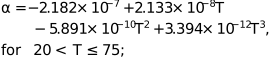
For diamond IIa:




the thermal conductivity k in units of W mm−1 K−1, temperature T in K.












Footnotes
1A Windows workstation (Intel Xeon CPU E5-2687 W v4 @ 3.00 GHz, 12 cores, 160 GB RAM, 8 TB HD).
Acknowledgements
The following funding is acknowledged: US Department of Energy, Office of Science, Office of Basic Energy Sciences (Contract No. DE-AC02-76SF00515).
References
 Bahns, I., Rauer, P., Rossbach, J. & Sinn, H. (2023). J. Synchrotron Rad. 30, 1–10.
Web of Science
CrossRef
IUCr Journals
Google Scholar
Bahns, I., Rauer, P., Rossbach, J. & Sinn, H. (2023). J. Synchrotron Rad. 30, 1–10.
Web of Science
CrossRef
IUCr Journals
Google Scholar
Bilderback, D. H., Freund, A. K., Knapp, G. S. & Mills, D. M. (2000). J. Synchrotron Rad. 7, 53–60.
Web of Science
CrossRef
CAS
IUCr Journals
Google Scholar
Boesenberg, U., Samoylova, L., Roth, T., Sinn, H., Terentev, S., Blank, V., Rüffer, R. & Madsen, A. (2019). AIP Conf. Proc. 2054, 060011.
Google Scholar
Chumakov, A., Rüffer, R., Leupold, O., Celse, J.-P., Martel, K., Rossat, M. & Lee, W.-K. (2004). J. Synchrotron Rad. 11, 132–141.
Web of Science
CrossRef
CAS
IUCr Journals
Google Scholar
Chumakov, A. I., Sergeev, I., Celse, J.-P., Rüffer, R., Lesourd, M., Zhang, L. & Sánchez del Río, M. (2014). J. Synchrotron Rad. 21, 315–324.
Web of Science
CrossRef
CAS
IUCr Journals
Google Scholar
Freund, A. K., de Bergevin, F., Marot, G., Riekel, C., Susini, J., Zhang, L. & Ziegler, E. (1990). Opt. Eng. 29, 928–941.
CAS
Google Scholar
Hu, Q., Noda, T., Suzuki, H., Hirano, T. & Numazawa, T. (2002). Phys. Lett. A 299, 656–659.
CrossRef
CAS
Google Scholar
Huang, R., Bilderback, D. H. & Finkelstein, K. (2014). J. Synchrotron Rad. 21, 366–375.
Web of Science
CrossRef
CAS
IUCr Journals
Google Scholar
Huang, Z. & Ruth, R. (2006). Phys. Rev. Lett. 96, 144801.
CrossRef
PubMed
Google Scholar
Kim, K. J., Shvyd'ko, Y. & Reiche, S. (2008). Phys. Rev. Lett. 100, 244802.
Web of Science
CrossRef
PubMed
Google Scholar
Lee, W. K., Mills, D. M., Assoufid, L., Blasdell, R. C., Fernandez, P. B., Rogers, C. S. & Smither, R. K. (1995). Opt. Eng. 34, 418–425.
CrossRef
Web of Science
Google Scholar
Lee, W.-K., Fernandez, P. & Mills, D. M. (2000). J. Synchrotron Rad. 7, 12–17.
Web of Science
CrossRef
CAS
IUCr Journals
Google Scholar
Lee, W.-K., Fezzaa, K., Fernandez, P., Tajiri, G. & Mills, D. M. (2001). J. Synchrotron Rad. 8, 22–25.
Web of Science
CrossRef
CAS
IUCr Journals
Google Scholar
Marcus, G., Halavanau, A., Huang, Z., Krzywinski, J., MacArthur, J., Margraf, R., Raubenheimer, T. & Zhu, D. (2020). Phys. Rev. Lett. 125, 254801.
Web of Science
CrossRef
PubMed
Google Scholar
Margraf, R., Robles, R., Halavanau, A., Kryzywinski, J., Li, K., MacArthur, J., Osaka, O., Sakdinawat, A., Sato, T., Sun, Y. W., Tamasaku, K., Huang, Z. R., Marcus, G. & Zhu, D. L. (2023). Nat. Photon. 17, 878–882.
Web of Science
CrossRef
CAS
Google Scholar
Marot, G. (1995). Opt. Eng. 34, 426–431.
CrossRef
CAS
Web of Science
Google Scholar
Marot, G., Rossat, M., Freund, A., Joksch, S., Kawata, H., Zhang, L., Ziegler, E., Berman, L., Chapman, D., Hastings, J. B. & Iarocci, M. (1992). Rev. Sci. Instrum. 63, 477–480.
CrossRef
CAS
Web of Science
Google Scholar
Mochizuki, T., Kohmura, Y., Awaji, A., Suzuki, Y., Baron, A., Tamasaku, K., Yabashi, M., Yamazaki, H. & Ishikawa, T. (2001). Nucl. Instrum. Methods Phys. Res. A 467–468, 647–649.
CrossRef
CAS
Google Scholar
Rauer, P., Decking, W., Lipka, D., Thoden, D., Wohlenberg, T., Bahns, I., Brueggmann, U., Casalbuoni, S., Di Felice, M., Dommach, M., Grünert, J., Karabekyan, S., Koch, A., La Civita, D., Rio, B., Samoylova, L., Sinn, H., Vannoni, M., Youngman, C., Hillert, W. & Rossbach, J. (2023). Phys. Rev. Accel. Beams 26, 020701.
CrossRef
Google Scholar
Rogers, C. S., Mills, D. M., Lee, W. K., Knapp, G. S., Holmberg, J., Freund, A., Wulff, M., Rossat, M., Hanfland, M. & Yamaoka, H. (1995). Rev. Sci. Instrum. 66, 2494–2499.
Google Scholar
Ruf, T., Henn, R. W., Asen-Palmer, M., Gmelin, E., Cardona, M., Pohl, H., Devyatych, G. G. & Sennikov, P. G. (2000). Solid State Communications, 115, 243–247.
CrossRef
Google Scholar
Rysov, R., Roseker, W., Walther, M. & Grübel, G. (2019). J. Synchrotron Rad. 26, 1052–1057.
Web of Science
CrossRef
CAS
IUCr Journals
Google Scholar
Shi, X., Qiao, Z., Pradhan, P., Liu, P., Assoufid, L., Kim, K.-J. & Shvyd'ko, Y. (2023). J. Synchrotron Rad. 30, 1100–1107.
Web of Science
CrossRef
IUCr Journals
Google Scholar
Tajiri, G., Lee, W.-K., Fernandez, P., Mills, D. M., Assoufid, L. & Amirouche, F. (2001). J. Synchrotron Rad. 8, 1140–1148.
Web of Science
CrossRef
CAS
IUCr Journals
Google Scholar
Tang, J., Zhang, Z., Morgan, J., Hemsing, E. & Huang, Z. (2023). Phys. Rev. Lett. 131, 055001.
Web of Science
CrossRef
PubMed
Google Scholar
Touloukian, Y. S., Buyco, E. H. (1970). Thermophysical Properties of Matter, Vol. 4, pp. 204–207; Vol. 5, pp. 4–7. New York, Washington: IFI/Plenum.
Google Scholar
Touloukian, Y. S., Kirby, R. K., Taylor, R. E., Lee, T. Y. R. (1970). Thermophysical Properties of Matter, Vol.13, pp. 19–23, 154–155. New York, Washington: IFI/Plenum.
Google Scholar
Touloukian, Y. S., Powell, R. W., Ho, C. Y., Klemens, P. G. (1970). Thermophysical Properties of Matter, Vol. 1, pp. 326–339; Vol. 2, pp. 9–12. New York, Washington: IFI/Plenum.
Google Scholar
Van Sciver, S. W. (1986). Helium Cryogenics, pp. 17–34. New York, London: Plenum Press.
Google Scholar
Zhang, L. (1993). Proc. SPIE 1997, 223–235.
CrossRef
CAS
Google Scholar
Zhang, L. (2018). 6th International Diffraction Limited Storage Ring (DLSR) Workshop, 29–31 October 2018, Berkeley, CA, USA.
Google Scholar
Zhang, L., Barrett, R., Cloetens, P., Detlefs, C. & Sanchez del Rio, M. (2014). J. Synchrotron Rad. 21, 507–517.
Web of Science
CrossRef
CAS
IUCr Journals
Google Scholar
Zhang, L., Barrett, R., Friedrich, K., Glatzel, P., Mairs, T., Marion, P., Monaco, G., Morawe, C. & Weng, T. (2013a). J. Phys. Conf. Ser. 425, 052029.
CrossRef
Google Scholar
Zhang, L., Cocco, D., Kelez, N., Morton, D. S., Srinivasan, V. & Stefan, P. M. (2015). J. Synchrotron Rad. 22, 1170–1181.
Web of Science
CrossRef
IUCr Journals
Google Scholar
Zhang, L., Hastings, J., Huang, Z., Tang, J. & Zhu, D. (2025). J. Synchrotron Rad. 32, 57–71.
CrossRef
CAS
IUCr Journals
Google Scholar
Zhang, L., Lee, W.-K., Wulff, M. & Eybert, L. (2003). J. Synchrotron Rad. 10, 313–319.
Web of Science
CrossRef
CAS
IUCr Journals
Google Scholar
Zhang, L., Sánchez del Río, M., Monaco, G., Detlefs, C., Roth, T., Chumakov, A. I. & Glatzel, P. (2013b). J. Synchrotron Rad. 20, 567–580.
Web of Science
CrossRef
CAS
IUCr Journals
Google Scholar
Zhang, L., Seaberg, M. & Yavaş, H. (2023). J. Synchrotron Rad. 30, 686–694.
Web of Science
CrossRef
CAS
IUCr Journals
Google Scholar
Zhu, D., Feng, Y., Stoupin, S., Terentyev, S., Lemke, H., Fritz, D., Chollet, M., Glownia, J. M., Alonso-Mori, R., Sikorski, M., Song, S., van Driel, T., Williams, G., Messerschmidt, M., Boutet, S., Blank, V., Shvyd'ko, Y. & Robert, R. (2014). Rev. Sci. Instrum. 85, 063106.
CrossRef
PubMed
Google Scholar
This is an open-access article distributed under the terms of the Creative Commons Attribution (CC-BY) Licence, which permits unrestricted use, distribution, and reproduction in any medium, provided the original authors and source are cited.
| JOURNAL OF SYNCHROTRON RADIATION |


