


 menu
menu


issue contents
September 2026 issue
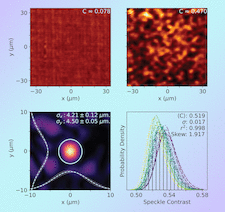
Cover illustration: Evaluation of X-ray speckle intensity and characteristics for wavefront sensing at a high-repetition-rate X-ray free-electron laser, see Guest et al. (pages 1255–1268). Top, a comparison of average pulse intensity before (left) and after (right) insertion of the solid attenuator; bottom, left to right, mean shift-corrected spatial autocorrelation of the speckle intensity, and pulse-indexed probability density of the speckle contrast and skew normal fit of the ensemble probability density.
scientific comment


Open  access
access
Orion, the first BSL-4 synchrotron-based research complex, advances pathogen research by integrating cutting-edge, multi-scale imaging to enhance the understanding of infectious diseases and inform global health policies.
research papers
Open access
access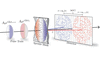
We demonstrate a fast, robust and sensor-free approach to X-ray speckle tracking that enables shot-to-shot wavefront characterization at high-repetition-rate X-ray free-electron lasers. Our measurements reveal a hierarchy of wavefront fluctuations indicative of instabilities in the accelerator and beamline optics at the European XFEL.
Open access
access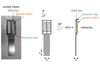
A simple fixed-target protein serial crystallography method combining a grease matrix with a large-area support film enables stable sample handling, low sample consumption, and high-resolution room-temperature structure determination.
Open access
access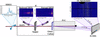
We demonstrate a single-shot hard X-ray spectrometer based on small-angle scattering from glassy carbon that is insensitive to X-ray free-electron laser beam-dependent spatial and spectral variations. Comparison with established X-ray Thomson scattering diagnostics using stochastic correlation X-ray spectroscopy demonstrates full-bandwidth coverage with millielectronvolt-scale spectral resolution, enabling reliable single-shot spectroscopic measurements.
Open access
access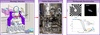
A beamline-direction cross-vessel metrology method and error analysis for ptychography setup at HEPS ID09 is proposed and implemented. A 12.3 nm reconstruction resolution of ptychography demonstrates the validity of metrology.
Open access
access
This paper presents a proposal of kHz-level fast polarization switching of undulator radiation with magnetic field modulation using electromagnetic coils at Hefei Advanced Light Facility.


Open access
access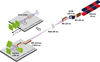
A pre-installation virtual commissioning platform for the Korea Light Source ID10 hard X-ray nanoprobe couples browser-based Monte Carlo ray tracing, EPICS/Bluesky control and a multilingual natural-language agent (98.2% accuracy in Korean, English and Japanese) under a zero-change hardware transition principle, producing commissioning design inputs ahead of 2029 first light.
Open access
access
The effectiveness and versatility of diamond refractive optics for high-energy X-rays (> 40 keV) is presented in applications to focusing, collimation, and beam expansion, along with design and implementation details.
Open access
access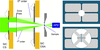
Silicon carbide detectors are monolithically integrated into order-sorting apertures and center stops for in situ soft X-ray beam diagnostics in STXM. Functionalized components enable simultaneous monitoring of incident beam intensity and the transverse position at sample-relevant locations without degrading optical performance.
Open access
access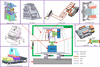
A water-cooling nano multilayer Kirkpatrick–Baez mirrors system has been implemented at ID23 HEPS. The focal spot size of 13.39 nm × 15.15 nm (H × V) at a photon energy of 21.8 keV demonstrates the system's performance.
Open access
access
GoniOwl, a lightweight convolutional neural network integrated into the EPICS control system, detects sample-pin presence from beamline camera images with >99% accuracy and fail-safe uncertainty handling, offering a transferable approach to vision-based collision prevention on synchrotron beamlines.
Open access
access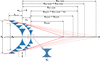
This paper presents a novel kinoform refractive lens and utilizes the beam propagation method to simulate the focusing performance of the lens. The results demonstrate that this lens not only enhances the gain and reduces the FWHM but also reduces the lens length.
Open access
access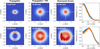
This article proposes a new calculation method and framework for simulating a pink X-ray beam, significantly improving computational efficiency. By comparing it with the experimental data from the beamline, the simulation method is consistent with the actual situation.
Open access
access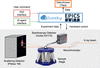
A minimal, agent-agnostic AI-assisted orchestration framework for beamline operation that leverages Osprey, a production-ready framework for deploying agentic AI in large-scale, safety-critical control-system environments, deployed at Advanced Light Source beamline 5.3.1, is introduced.
Open access
access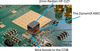
This paper presents the first results from the DynamiX X-ray imaging detector developed by the UK's Science and Technology Facilities Council for a new generation of photon light sources. Operating at a continuous frame rate of 534 kHz and with a per-pixel per-frame dynamic range of roughly five orders of magnitude, this work is the first step in delivering a transformative new imaging technology.
Open access
access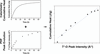
Synchrotron in situ high-energy X-ray total scattering/pair distribution function (PDF) analysis quantifies the time-resolved structural evolution of high and low calcium alkali-activated binders, with PDF peak evolution tracking reaction progress and correlating with calorimetry (R2 > 0.97). The measurements resolve distinct medium-range ordering in the primary gels, demonstrating the sensitivity of synchrotron PDF for probing disordered cementitious phases.
Open access
access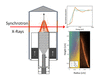
For the first time an iron metal flame has been mapped by in situ X-ray absorption spectroscopy. Strong gradients in oxidation state and phase composition across the metallic core and the flame front were found with FeO peaking at the visible flame front and Fe3O4 forming further beyond.
Open access
access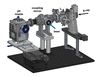
A new setup for femtosecond resolution X-ray absorption spectroscopy with energy ranging from 2 to 15 keV is established.
Open access
access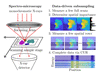
Data-driven sparse acquisition in spectro-microscopy reduces acquisition time and radiation dose while preserving information.
Open access
access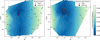
A Bayesian optimization technique is used to tune the FEFF and FDMNES packages and to improve matching between theoretical and experimental spectra. The tests were performed on monometallic Ni, Fe and Pd K-edge XANES spectra using several different spectrum similarity metrics.
Open access
access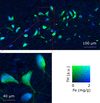
This paper presents the development and commissioning of ASCANIO, an innovative multichannel backscattering X-ray spectrometer, including extensive testing on a synchrotron beamline, with highlights of the main results achieved.
Open access
access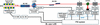
Nonlinear scanning of a compact channel-cut monochromator synchronized with an undulator-gap movement system enables fast high-flux X-ray absorption fine structure measurements.
Open access
access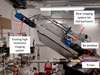
Third-harmonic spectral monitoring with an existing bent-crystal spectrometer provides single-shot bandwidth diagnostics and real-time machine tuning for tender X-ray free-electron laser operation, and can be made non-invasive when combined with a suitable beam-sampling grating.
Open access
access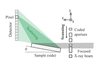
We introduce a method combining structured illumination with grazing-incidence X-ray scattering and computational imaging to resolve local structural details. Demonstrated on an organic semiconductor thin film, this method captures local features without sample rotation, enabling detailed analysis of material properties critical for advanced material design.
Open access
access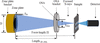
A real-time correction method for sample drift in STXM based on Fourier transform image registration
This study proposes an online drift-correction method for scanning transmission X-ray microscopy that integrates Fourier-transform image registration with laser-interferometer feedback, suppressing sample drift in a 100-image stack scan from over 1 mm to below 120 nm and thereby eliminating redundant scan area while markedly enhancing experimental throughput.
Open access
access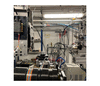
A 4D X-ray computed tomography experimental campaign was carried out on a porous carbonate rock to investigate the link between initial porosity and deformation modes. This paper presents the experiment and the methods used to explore this relationship.
Open access
access
The capabilities of a U-Net convolutional neural network for masking artifacts in time-resolved X-ray diffraction measurements of battery materials are demonstrated.
beamlines
Open access
access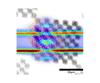
The diagnostics and laser infrastructure of the Soft X-ray Port (SXP) at the European X-ray Free Electron Laser are presented.
Open access
access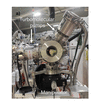
A new endstation for soft X-ray absorption spectroscopy in liquid environments has been installed at the BACH beamline of Elettra Sincrotrone Trieste. The setup includes upgraded and newly developed cells for a range of soft-X-ray experiments at solid/liquid interfaces, including studies on battery materials.
Open access
access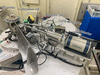
The Japanese synchrotron facility SPring-8 has recently relaunched BL15XU as a high-energy X-ray beamline for materials science research. A comprehensive description of the technical details and science cases is presented.
Open access
access
The feasibility of performing time-resolved small-angle X-ray scattering measurements with picosecond temporal resolution on the FemtoMAX beamline at the MAX IV Laboratory in Sweden is demonstrated.
Open access
access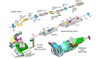
Beamline I16 at Diamond Light Source is a versatile X-ray scattering instrument that combines tunable X-ray energy and polarization, flexible diffraction geometries, and advanced sample environments for studies of electronic, magnetic, and structural phenomena.
computer programs
Open access
access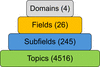
This paper validates the OpenAlex model for real-time topic classification of synchrotron proposals. The proposed live service architecture incorporates user verification, providing a scalable solution for introducing enhanced topic metadata into scientific workflows without sacrificing precision.
Open access
access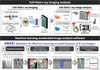
SMAXI is a fully open-source, GPU-accelerated software platform that integrates state-of-the-art machine learning and large language model techniques into a unified workflow for X-ray image analysis. SMAXI simplifies high-throughput data processing workflows and overcomes manual image analysis bottlenecks.
teaching and education
Open access
access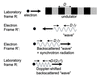
Explaining synchrotron radiation properties often requires using the speed of light with respect to a moving object like a detector, which may not be the invariant c. This surprising fact also leads to a rarely explored link between relativity and quantum mechanics.

