


 menu
menu

issue contents
CryoEM in the fast lane of structural biology
Editors: Richard Henderson , S. Samar Hasnain , Sriram Subramaniam and Werner Kühlbrandt
A collection of articles celebrating ten years of frontier cryoEM papers in IUCrJ.
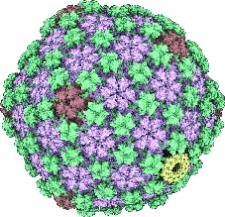
editorial


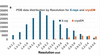
Single-particle cryoEM has made visualization of biological molecules and their complexes at high resolution possible without the need for crystallization. The last decade has seen a rapid growth in the number of structures determined by cryoEM; for membrane proteins, the total number of cryoEM structures has exceeded that determined by crystallography.
scientific commentaries

In this issue of IUCrJ, Subramaniam, Kühlbrandt & Henderson present an overview of the remarkable progress that has been made in electron cryo-microscopy and electron cryo-tomography.
lead article
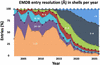
The increasing democratization and implementation of electron cryo-microscopy appears poised to drive a new revolution in digital structural biology.
topical reviews


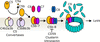
Advances in cryo-electron microscopy have enabled molecular insights into the assembly and regulation of the complement membrane attack complex.
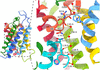
Recent advances in single-particle cryo-electron microscopy have enabled a deeper understanding of the structural diversity and higher-order organization of aquaporin complexes. These insights have important implications for disease biology and drug discovery.
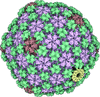
Two recent cryogenic electron microscopy (cryoEM) structures provide a unique opportunity to compare a bacteriophage and a bacteriocin targeted at the same host. CryoEM reveals the most detailed view of contractile injection systems interacting with Clostridioides difficile.
research letters

Single-particle cryo-EM will soon equal the number of yearly entries in the Protein Data Bank from structures determined by X-ray crystallography. Considering the growing outreach of cryo-EM, it is timely to remind users of and define typical terms important for understanding the underlying fundamental physical concepts and key basics of single-particle cryo-EM and image processing, which are particularly relevant for the expanding cryo-EM community, including for newcomers and scientists joining from related fields.
research papers
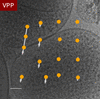
We use sub-2 Å single-particle analysis and analytical contrast transfer function modeling to show that the Volta phase plate (VPP) boosts low-frequency signal relevant for cryo-electron tomography (cryo-ET) tilt-series alignment, improving contrast and alignment robustness in thick, crowded samples. Despite reduced subtomogram averaging resolution, these results establish the VPP's value for cryo-ET in thick, dense specimens, where tilt-series alignment is challenging and moderate-resolution information can still provide valuable biological insights.
EMDB references: PP7 virus-like-particle without VPP (full dataset), EMD-75881; PP7 virus-like-particle with VPP (full dataset), EMD-75882; PP7 virus-like-particle with VPP (partial dataset), EMD-75890; 80S ribosome without VPP (full dataset), EMD-75895; 80S ribosome without VPP (partial dataset), EMD-75896; 80S ribosome with VPP (full dataset), EMD-75897; 70S ribosome without VPP (full dataset), EMD-75898; 70S ribosome without VPP (partial dataset), EMD-75899; 70S ribosome with VPP (full dataset), EMD-75900; apoferritin without VPP, EMD-75265; apoferritin with VPP, EMD-75263

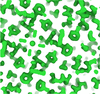
An atomic resolution of 1.24 Å was achieved on an upgraded 200 kV electron microscope featuring a cold field emission gun, a high-resolution objective lens polepiece and an energy filter. These components transform the instrument into a cost-effective single-particle cryo-EM platform with performance comparable to that of significantly more expensive 300 kV systems.
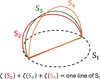
We present a compact mathematical framework for ab initio single-particle 3D reconstruction that reformulates the inverse problem in polar Fourier coordinates, enabling direct orientation recovery from extremely noisy 2D projection images without explicit 3D density reconstruction.
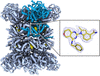
Our studies show that cryo-EM structure-guided optimization to eliminate the off-target liability of CB-5083 yields a potent and selective inhibitor of the AAA ATPase VCP/p97, a cancer target.

Download citation

Download citation
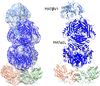
High-resolution cryoEM structures of MAT enzyme complexes help to explain why MATα1 selectively forms a stable complex with MATβV1 but not with MATβV2, despite sharing high sequence and structural identity with MATα2.
Open  access
access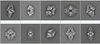
We introduce AlignPCA-2D, a PCA-space Euclidean alignment method for rapid and interpretable 2D classification of cryo-EM particle images. The approach preserves essential structural variability while greatly reducing computational cost, offering a lightweight alternative to existing large-scale cryo-EM classification pipelines.
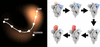
Analysis of SARS-CoV-2 spike protein heterogeneity using cryo-EM data reveals cooperativity between receptor-binding domains.
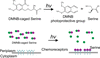
We present an integrated sample preparation workflow that combines photocaged ligand activation and controlled triggering, coupled with rapid vitrification to enable time-resolved cryoET studies on bacterial chemotaxis at millisecond timescales.
Open access
access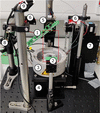
We describe a new method to prepare grids for cryoEM on the sub-millisecond timescale.

Post-acquisition super resolution (PASR) is a pre-processing step which can be utilized to exceed the resolution limit of already-acquired data if the limit is reached. It is designed to be as minimally invasive to all general single particle workflows as possible, allowing users to choose which suite they prefer.
EMDB reference: apoferritin PASR-on-ASR, EMD-65822
PDB reference: apoferritin PASR-on-ASR, 9wal
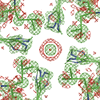
New tools implemented in CCTBX and Phenix allow the calculation of variable-resolution maps through a sum of finite-resolution atomic images expressed as analytic functions of all atomic parameters, along with their associated local resolution.

