


 menu
menu

issue contents
Early Career Scientists in Structural Science
This special issue, a collaboration between The German Young Crystallographers and IUCr Journals, celebrates the achievements of early-career researchers across the broad and interdisciplinary field of crystallography. The issue highlights the essential contributions of work from emerging scientists to this field.
Articles cover all areas of crystallography, including chemical and structural crystallography, macromolecular crystallography, powder diffraction, synchrotron and neutron methods, electron crystallography, materials science, instrumentation, quantum crystallography, and computational or data-driven approaches.

invited articles


Download citation


Download citation
Open  access
access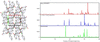
Considering its low occurrence in the Cambridge Structural Database, is the amide–pyridyl synthon easy to form, and what structural factors affects its interaction energy and its subsequent formation?
CCDC reference: 2433098
Download citation
Download citation
Open access
access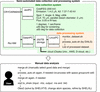
A semi-automated MicroED data collection and processing system was established and shown to be suitable for the structural investigation of submicrometer-scale biogenic crystals.
Download citation
Download citation
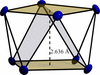
A homopolyatomic bismuth cluster compound, Bi8[AlBr4]2 was successfully synthesized through a one-pot reaction in a Lewis acidic ionic liquid (LAIL) reaction media, and its crystal structure was characterized via single-crystal X-ray diffraction. The electronic structure investigation reveals that the compound exhibits semiconducting behavior with a direct band gap of 1.51 eV.
CCDC reference: 2563714
Download citation
Download citation
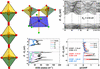
A new heteroanionic rare-earth chlorosilicate, Pr3Cl5[SiO4], was synthesized by a self-flux-assisted high-temperature reaction. Single-crystal X-ray diffraction shows that it crystallizes in the orthorhombic space group Pnma and contains orientationally disordered discrete [SiO4]4− tetrahedra within a three-dimensional Pr–Cl/O framework. Electronic structure calculations indicate a wide indirect band gap of ∼4.53 eV, with bonding dominated by strong Si—O interactions.
CCDC reference: 2565032
Download citation
Download citation
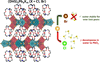
The structure of a disordered porous metal halide semiconductor, namely, (DHS)2Pb5Cl14 (DHS is double-protonated [2.2.2]cryptand), is reported, along with the evaluation of its water stability and its correlation with the composition of the inorganic part.
CCDC reference: 2558390
Download citation
Download citation
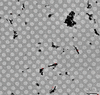
The title compound, diaquabis{2-formyl-6-methoxy-4-[(E)-2-phenyldiazen-1-yl]phenolato-κ2O1,O2}iron(II), [Fe(C14H11N2O3)2(H2O)2], comprises two bidentate ligands derived from 2-methoxy-4-(phenyldiazenyl)-6-formylphenol and two coordinated water molecules. The crystal structure was determined at 79 K using the MicroED method (λ = 0.02508 Å).
CCDC reference: 2552645
Download citation
Download citation
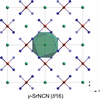
γ-SrNCN was synthesized from a mixture of strontium subnitride (Sr2N) and tetracyanoethylene (C6N4) at 38 (3) GPa in a laser-heated diamond anvil cell. The new polymorph crystallizes in the space group I4/mcm (No. 140), where the Sr2+ and NCN2− packing can be derived from the CsCl (B2) structure type.
CCDC reference: 2560951
Download citation
Download citation
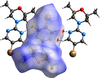
The title compound, C10H14N3OBr, crystallizes in the monoclinic system (space group P21/c, Z = 4) with the molecule exhibiting approximate CS point-group symmetry.
CCDC reference: 2561790
Download citation
Download citation
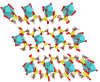
An aluminium hydroxide methanesulfonate salt, Al(OH)(CH3SO3)2, crystallizes with one-dimensional chains of AlO6 connected via hydrogen bonding.
CCDC reference: 2541524
Download citation
Download citation
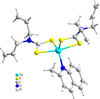
The crystal structure of the title compound, the heteroleptic complex [Zn(C7H10NS2)2(C10H9N)] reveals supramolecular dimers established by π–π interactions between adjacent quinaldine units with a centroid–centroid distance of 3.672 (2) Å. The compound crystallizes in the triclinic crystal system, space group P1, with the ZnII atom exhibiting a trigonal–bipyramidal geometry.
CCDC reference: 2556564
Open access
access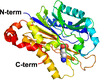
H. pylori carbon–nitrogen hydrolase was produced and crystallized, and its 2.1 Å resolution structure is reported.
PDB reference: carbon–nitrogen hydrolase from Helicobacter pylori G27, 6mg6
Open access
access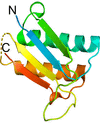
The production, crystallization and 1.8 Å resolution crystal structure of macrophage migratory inhibitory factor from P. vivax are reported.
PDB reference: P. vivax MIF, 9b0m


