 | Acta Crystallographica Section E Acta Crystallographica Section E CRYSTALLOGRAPHIC COMMUNICATIONS |


 journal menu


organic compounds
| CRYSTALLOGRAPHIC COMMUNICATIONS |
 access
4-Anilino-1-benzylpiperidine-4-carbonitrile

aDepartment of Chemistry, Louisiana State University, Baton Rouge, LA 70803-1804, USA
*Correspondence e-mail: [email protected]
The title molecule, C19H21N3, an important precursor in the synthesis of porphyrin–fentanyl conjugates, has its piperidine ring in the chair conformation, with endocyclic torsion-angle magnitudes in the range 53.26 (8)–60.63 (9)°. The C≡N group is axial, while the CH2Ph and NHPh groups are equatorial. The NH group does not engage in strong hydrogen bonding, but forms an intermolecular N—H⋯N interaction.
Related literature
For background literature, see: Barth et al. (2005![[Barth, R. F., Coderre, J. A., Vicente, M. G. H. & Blue, T. E. (2005). Clin. Cancer Res. 11, 3987-4002.]](../../../../../../logos/arrows/e_arr.gif "Barth, R. F., Coderre, J. A., Vicente, M. G. H. & Blue, T. E. (2005). Clin. Cancer Res. 11, 3987-4002.") ); Deguchi et al. (2004); Henriksen et al. (2005); Terasaki et al. (2003); Vicente, (2001). For a related structure, see: Brine et al. (1994).
); Deguchi et al. (2004); Henriksen et al. (2005); Terasaki et al. (2003); Vicente, (2001). For a related structure, see: Brine et al. (1994).
![[Scheme 1]](om2222scheme1.gif)
Experimental
Crystal data
|
Data collection
|
Refinement
|
| |||||||||||||||||
 .
. Data collection: COLLECT (Nonius, 2000); cell refinement: DENZO and SCALEPACK (Otwinowski & Minor, 1997); data reduction: DENZO and SCALEPACK; program(s) used to solve structure: SIR97 (Altomare et al., 1999); program(s) used to refine structure: SHELXL97 (Sheldrick, 2008); molecular graphics: ORTEP-3 for Windows (Farrugia, 1997); software used to prepare material for publication: SHELXL97.
Supporting information
contains datablocks global, I. DOI: 10.1107/S1600536808009136/om2222sup1.cif
Structure factors: contains datablock I. DOI: 10.1107/S1600536808009136/om2222Isup2.hkl
The title compound was prepared in 89.5% yield from N-benzyl-4-piperidone, using an optimized procedure from that previously published (Henriksen et al., 2005), as follows. To a 100 ml round-bottom flask under an argon atmosphere were added N-benzyl-4-piperidone (1.89 g, 10 mmol), aniline (3.7 g, 40 mmol), KCN (2.6 g, 40 mmol) and dry dichloromethane (40 ml). The reaction mixture was cooled to 0° C and stirred under argon for 20 minutes. Acetic acid (1.8 g, 30 mmol) was added to the reaction mixture over a period of 10 minutes and the final mixture heated at 50° C for 24 h. After cooling to room temperature the reaction mixture was poured into crushed ice (50 g), neutralized with 25% aqueous NaOH and the pH of the mixture was adjusted to about 10 using 40% aqueous K2CO3. The organic phase was collected and the water layer was extracted with dichloromethane (2 x 25 ml). The organic extracts were dried over anhydrous sodium bicarbonate and concentrated under reduced pressure to give a yellow solid. The yellow crystals were purified by re-crystallization from dichloromethane/hexane to give 2.6 g (89.5%) yield of colorless crystals. Spectroscopic analysis, 1H NMR (250 MHz, CDCl3): 1.92 (td, J1= 3.6 Hz, J2 = 10.8 Hz, 2H, CH2), 2.29–2.53 (m, 4H, CH2), 2.79–2.85 (m, 2H, CH2), 3.56 (s, 2H, CH2Ph), 3.64 (s, 1H, NH), 6.88–6.95 (m, 3H, ArH), 7.20–7.33 (m, 7H, ArH). 13C NMR (CDCl3): 36.09, 49.27, 59.06, 62.58, 117.78, 120.93, 127.26, 128.96, 129.00, 129.31, 134.02, 138.00, 143.29. MS MALDI-TOF m/z 290.9 (M+).
H atoms on C were placed in idealized positions with C—H distances 0.95 - 0.99 Å and thereafter treated as riding. Coordinates of the N—H hydrogen atom were refined. Uiso for H was assigned as 1.2 times Ueq of the attached atoms.
1-Benzyl-4-phenylamino-4-piperidinecarbonitrile is an important precursor in the synthesis of porphyrin-fentanyl conjugates that might be used as sensitizers in photodynamic therapy (PDT) (Vicente, 2001) and/or in boron neutron capture therapy (BNCT) (Barth et al., 2005) of brain tumors. One of the obstacles for treating brain tumors using chemotherapy is the presence of the blood brain barrier (BBB), which protects the central nervous system from drugs and endogenous molecules (Terasaki et al., 2003). Porphyrin-fentanyl conjugates could potentially cross the BBB due to the affinity of fentanyl derivatives for the opioid receptors highly expressed in the BBB (Deguchi et al., 2004), and thus selectively accumulate within brain tumors.
The structure of the title compound is shown in Fig 1. The piperidine ring is in the chair conformation, with the C≡N group axial and the CH2Ph and NHPh groups equatorial. The conformation of the CH2Ph group with respect to the piperidine is described by torsion angles C5—N1—C6—C7 - 168.52 (6) and N1—C6—C7—C8 62.28 (10)°. The conformation of the NHPh group with respect to the piperidine is described by torsion angles C2—C3—N2—C13 179.19 (8) and C3—N2—C13—C18 172.56 (8)°. The pyramidal nature of N1 can be seen by the near-tetrahedral C—N1—C angles, which all fall within the narrow range 110.18 (6) - 110.76 (7)°, such that N1 lies 0.465 (1) Å from the plane defined by C1, C5, and C6.
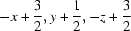
Despite the presence of both a potential hydrogen-bond donor and potential hydrogen-bond acceptors, the compound exhibits no strong hydrogen bonding, nor any short C—H···N interactions. The nearest distance of the N—H group to a hydrogen-bond acceptor is to nitrile N3i (at i = 3/2 - x, 1/2 + y, 3/2 - z), having N2···N3i distance 3.5044 (12) Å, H2N··· N3i distance 2.756 (13) Å, and angle about H2N 148.2 (11)°.
For background literature, see: Barth et al. (2005); Deguchi et al. (2004); Henriksen et al. (2005); Terasaki et al. (2003); Vicente, (2001). For a related structure, see: Brine et al. (1994).
Data collection: COLLECT (Nonius, 2000); cell DENZO and SCALEPACK (Otwinowski & Minor, 1997); data reduction: DENZO and SCALEPACK (Otwinowski & Minor, 1997); program(s) used to solve structure: SIR97 (Altomare et al., 1999); program(s) used to refine structure: SHELXL97 (Sheldrick, 2008); molecular graphics: ORTEP-3 for Windows (Farrugia, 1997); software used to prepare material for publication: SHELXL97 (Sheldrick, 2008).
![[Figure 1]](./om2222fig1thm.gif)
| C19H21N3 | F(000) = 624 |
| Mr = 291.39 | Dx = 1.240 Mg m−3 |
| Monoclinic, P21/n | Mo Kα radiation, λ = 0.71073 Å |
| Hall symbol: -P 2yn | Cell parameters from 5228 reflections |
| a = 9.7718 (13) Å | θ = 2.5–35.0° |
| b = 10.0415 (14) Å | µ = 0.07 mm−1 |
| c = 15.9519 (15) Å | T = 90 K |
| β = 94.532 (9)° | Fragment, colorless |
| V = 1560.4 (3) Å3 | 0.37 × 0.25 × 0.23 mm |
| Z = 4 |
| Nonius KappaCCD diffractometer with an Oxford Cryosystems Cryostream cooler | 5189 reflections with I > 2σ(I) |
| Radiation source: fine-focus sealed tube | Rint = 0.025 |
| Graphite monochromator | θmax = 35.0°, θmin = 2.5° |
| ω scans with κ offsets | h = −15→15 |
| 24180 measured reflections | k = −12→16 |
| 6842 independent reflections | l = −25→25 |
| Refinement on F2 | Secondary atom site location: difference Fourier map |
| Least-squares matrix: full | Hydrogen site location: inferred from neighbouring sites |
| R[F2 > 2σ(F2)] = 0.044 | H atoms treated by a mixture of independent and constrained refinement |
| wR(F2) = 0.124 | w = 1/[σ2(Fo2) + (0.0605P)2 + 0.3181P] where P = (Fo2 + 2Fc2)/3 |
| S = 1.04 | (Δ/σ)max = 0.001 |
| 6842 reflections | Δρmax = 0.49 e Å−3 |
| 203 parameters | Δρmin = −0.27 e Å−3 |
| 0 restraints | Extinction correction: SHELXL97 (Sheldrick, 2008), Fc*=kFc[1+0.001xFc2λ3/sin(2θ)]-1/4 |
| Primary atom site location: structure-invariant direct methods | Extinction coefficient: 0.0081 (18) |
| C19H21N3 | V = 1560.4 (3) Å3 |
| Mr = 291.39 | Z = 4 |
| Monoclinic, P21/n | Mo Kα radiation |
| a = 9.7718 (13) Å | µ = 0.07 mm−1 |
| b = 10.0415 (14) Å | T = 90 K |
| c = 15.9519 (15) Å | 0.37 × 0.25 × 0.23 mm |
| β = 94.532 (9)° |
| Nonius KappaCCD diffractometer with an Oxford Cryosystems Cryostream cooler | 5189 reflections with I > 2σ(I) |
| 24180 measured reflections | Rint = 0.025 |
| 6842 independent reflections |
| R[F2 > 2σ(F2)] = 0.044 | 0 restraints |
| wR(F2) = 0.124 | H atoms treated by a mixture of independent and constrained refinement |
| S = 1.04 | Δρmax = 0.49 e Å−3 |
| 6842 reflections | Δρmin = −0.27 e Å−3 |
| 203 parameters |
Geometry. All e.s.d.'s (except the e.s.d. in the dihedral angle between two l.s. planes) are estimated using the full covariance matrix. The cell e.s.d.'s are taken into account individually in the estimation of e.s.d.'s in distances, angles and torsion angles; correlations between e.s.d.'s in cell parameters are only used when they are defined by crystal symmetry. An approximate (isotropic) treatment of cell e.s.d.'s is used for estimating e.s.d.'s involving l.s. planes. |
Refinement. Refinement of F2 against ALL reflections. The weighted R-factor wR and goodness of fit S are based on F2, conventional R-factors R are based on F, with F set to zero for negative F2. The threshold expression of F2 > σ(F2) is used only for calculating R-factors(gt) etc. and is not relevant to the choice of reflections for refinement. R-factors based on F2 are statistically about twice as large as those based on F, and R- factors based on ALL data will be even larger. |
| x | y | z | Uiso*/Ueq | ||
| N1 | 0.43216 (7) | 0.37118 (8) | 0.73394 (4) | 0.01247 (13) | |
| N2 | 0.68233 (8) | 0.66885 (8) | 0.63306 (4) | 0.01659 (14) | |
| H2N | 0.6447 (13) | 0.7350 (14) | 0.6548 (8) | 0.020* | |
| N3 | 0.86941 (8) | 0.40176 (9) | 0.70892 (5) | 0.01981 (15) | |
| C1 | 0.53227 (8) | 0.44146 (9) | 0.79097 (4) | 0.01280 (14) | |
| H1A | 0.6124 | 0.3830 | 0.8050 | 0.015* | |
| H1B | 0.4903 | 0.4628 | 0.8438 | 0.015* | |
| C2 | 0.57970 (8) | 0.56932 (9) | 0.75123 (5) | 0.01372 (14) | |
| H2A | 0.6475 | 0.6144 | 0.7910 | 0.016* | |
| H2B | 0.5002 | 0.6298 | 0.7403 | 0.016* | |
| C3 | 0.64507 (8) | 0.54198 (8) | 0.66810 (5) | 0.01146 (13) | |
| C4 | 0.54095 (8) | 0.45965 (9) | 0.61165 (5) | 0.01336 (14) | |
| H4A | 0.4602 | 0.5158 | 0.5947 | 0.016* | |
| H4B | 0.5837 | 0.4328 | 0.5600 | 0.016* | |
| C5 | 0.49370 (8) | 0.33556 (9) | 0.65622 (5) | 0.01364 (15) | |
| H5A | 0.4256 | 0.2869 | 0.6185 | 0.016* | |
| H5B | 0.5731 | 0.2759 | 0.6695 | 0.016* | |
| C6 | 0.38149 (8) | 0.25204 (9) | 0.77503 (5) | 0.01443 (14) | |
| H6A | 0.4604 | 0.1982 | 0.7983 | 0.017* | |
| H6B | 0.3273 | 0.1971 | 0.7329 | 0.017* | |
| C7 | 0.29300 (8) | 0.28909 (9) | 0.84504 (5) | 0.01256 (14) | |
| C8 | 0.17137 (8) | 0.35979 (9) | 0.82626 (5) | 0.01463 (15) | |
| H8 | 0.1458 | 0.3852 | 0.7698 | 0.018* | |
| C9 | 0.08730 (9) | 0.39339 (9) | 0.88947 (5) | 0.01645 (16) | |
| H9 | 0.0047 | 0.4414 | 0.8760 | 0.020* | |
| C10 | 0.12395 (9) | 0.35679 (10) | 0.97276 (5) | 0.01752 (16) | |
| H10 | 0.0655 | 0.3777 | 1.0157 | 0.021* | |
| C11 | 0.24640 (10) | 0.28969 (9) | 0.99214 (5) | 0.01758 (16) | |
| H11 | 0.2730 | 0.2665 | 1.0488 | 0.021* | |
| C12 | 0.33101 (9) | 0.25597 (9) | 0.92851 (5) | 0.01539 (15) | |
| H12 | 0.4149 | 0.2102 | 0.9423 | 0.018* | |
| C13 | 0.74564 (8) | 0.68867 (8) | 0.55887 (5) | 0.01178 (14) | |
| C14 | 0.80105 (8) | 0.58537 (8) | 0.51281 (5) | 0.01315 (14) | |
| H14 | 0.7935 | 0.4957 | 0.5308 | 0.016* | |
| C15 | 0.86740 (8) | 0.61438 (9) | 0.44045 (5) | 0.01405 (14) | |
| H15 | 0.9037 | 0.5437 | 0.4094 | 0.017* | |
| C16 | 0.88109 (8) | 0.74472 (9) | 0.41323 (5) | 0.01466 (15) | |
| H16 | 0.9273 | 0.7636 | 0.3644 | 0.018* | |
| C17 | 0.82588 (8) | 0.84752 (9) | 0.45882 (5) | 0.01452 (15) | |
| H17 | 0.8344 | 0.9371 | 0.4408 | 0.017* | |
| C18 | 0.75859 (8) | 0.82007 (9) | 0.53034 (5) | 0.01298 (14) | |
| H18 | 0.7208 | 0.8911 | 0.5604 | 0.016* | |
| C19 | 0.77255 (8) | 0.46283 (9) | 0.68964 (5) | 0.01285 (14) |
| U11 | U22 | U33 | U12 | U13 | U23 | |
| N1 | 0.0132 (3) | 0.0145 (3) | 0.0100 (2) | −0.0015 (2) | 0.0032 (2) | −0.0008 (2) |
| N2 | 0.0258 (4) | 0.0095 (3) | 0.0161 (3) | 0.0039 (3) | 0.0115 (3) | 0.0025 (2) |
| N3 | 0.0166 (3) | 0.0209 (4) | 0.0217 (3) | 0.0027 (3) | 0.0001 (2) | 0.0017 (3) |
| C1 | 0.0158 (3) | 0.0133 (3) | 0.0096 (3) | −0.0012 (3) | 0.0027 (2) | 0.0001 (3) |
| C2 | 0.0178 (3) | 0.0127 (3) | 0.0113 (3) | 0.0002 (3) | 0.0056 (2) | −0.0002 (3) |
| C3 | 0.0131 (3) | 0.0106 (3) | 0.0111 (3) | 0.0017 (3) | 0.0034 (2) | 0.0015 (2) |
| C4 | 0.0125 (3) | 0.0182 (4) | 0.0095 (3) | 0.0011 (3) | 0.0016 (2) | 0.0012 (3) |
| C5 | 0.0137 (3) | 0.0168 (4) | 0.0106 (3) | −0.0015 (3) | 0.0024 (2) | −0.0024 (3) |
| C6 | 0.0155 (3) | 0.0131 (3) | 0.0152 (3) | −0.0009 (3) | 0.0050 (2) | −0.0007 (3) |
| C7 | 0.0133 (3) | 0.0121 (3) | 0.0126 (3) | −0.0022 (3) | 0.0032 (2) | −0.0003 (3) |
| C8 | 0.0135 (3) | 0.0170 (4) | 0.0134 (3) | −0.0017 (3) | 0.0016 (2) | −0.0013 (3) |
| C9 | 0.0132 (3) | 0.0178 (4) | 0.0187 (3) | −0.0017 (3) | 0.0036 (3) | −0.0033 (3) |
| C10 | 0.0200 (4) | 0.0168 (4) | 0.0167 (3) | −0.0048 (3) | 0.0080 (3) | −0.0025 (3) |
| C11 | 0.0250 (4) | 0.0146 (4) | 0.0136 (3) | −0.0030 (3) | 0.0046 (3) | 0.0016 (3) |
| C12 | 0.0183 (3) | 0.0130 (4) | 0.0151 (3) | −0.0003 (3) | 0.0024 (3) | 0.0021 (3) |
| C13 | 0.0125 (3) | 0.0117 (3) | 0.0114 (3) | 0.0011 (3) | 0.0027 (2) | 0.0014 (2) |
| C14 | 0.0157 (3) | 0.0109 (3) | 0.0134 (3) | 0.0010 (3) | 0.0042 (2) | 0.0012 (3) |
| C15 | 0.0148 (3) | 0.0150 (4) | 0.0128 (3) | 0.0007 (3) | 0.0038 (2) | −0.0007 (3) |
| C16 | 0.0150 (3) | 0.0163 (4) | 0.0131 (3) | 0.0002 (3) | 0.0038 (2) | 0.0022 (3) |
| C17 | 0.0152 (3) | 0.0132 (4) | 0.0154 (3) | 0.0002 (3) | 0.0032 (2) | 0.0039 (3) |
| C18 | 0.0141 (3) | 0.0115 (3) | 0.0135 (3) | 0.0012 (3) | 0.0027 (2) | 0.0009 (3) |
| C19 | 0.0139 (3) | 0.0126 (3) | 0.0123 (3) | −0.0011 (3) | 0.0023 (2) | 0.0003 (3) |
| N1—C1 | 1.4636 (10) | C7—C12 | 1.3940 (11) |
| N1—C5 | 1.4644 (10) | C7—C8 | 1.3964 (12) |
| N1—C6 | 1.4688 (11) | C8—C9 | 1.3915 (11) |
| N2—C13 | 1.3924 (10) | C8—H8 | 0.9500 |
| N2—C3 | 1.4491 (11) | C9—C10 | 1.3977 (12) |
| N2—H2N | 0.847 (14) | C9—H9 | 0.9500 |
| N3—C19 | 1.1492 (11) | C10—C11 | 1.3867 (13) |
| C1—C2 | 1.5203 (12) | C10—H10 | 0.9500 |
| C1—H1A | 0.9900 | C11—C12 | 1.4004 (12) |
| C1—H1B | 0.9900 | C11—H11 | 0.9500 |
| C2—C3 | 1.5414 (11) | C12—H12 | 0.9500 |
| C2—H2A | 0.9900 | C13—C14 | 1.4042 (11) |
| C2—H2B | 0.9900 | C13—C18 | 1.4047 (12) |
| C3—C19 | 1.4946 (11) | C14—C15 | 1.3986 (11) |
| C3—C4 | 1.5443 (11) | C14—H14 | 0.9500 |
| C4—C5 | 1.5242 (12) | C15—C16 | 1.3887 (12) |
| C4—H4A | 0.9900 | C15—H15 | 0.9500 |
| C4—H4B | 0.9900 | C16—C17 | 1.3955 (12) |
| C5—H5A | 0.9900 | C16—H16 | 0.9500 |
| C5—H5B | 0.9900 | C17—C18 | 1.3888 (11) |
| C6—C7 | 1.5119 (11) | C17—H17 | 0.9500 |
| C6—H6A | 0.9900 | C18—H18 | 0.9500 |
| C6—H6B | 0.9900 | ||
| C1—N1—C5 | 110.18 (6) | C7—C6—H6B | 109.4 |
| C1—N1—C6 | 110.34 (6) | H6A—C6—H6B | 108.0 |
| C5—N1—C6 | 110.76 (7) | C12—C7—C8 | 118.96 (7) |
| C13—N2—C3 | 126.55 (7) | C12—C7—C6 | 121.47 (7) |
| C13—N2—H2N | 118.2 (9) | C8—C7—C6 | 119.57 (7) |
| C3—N2—H2N | 113.6 (9) | C9—C8—C7 | 120.60 (7) |
| N1—C1—C2 | 111.03 (6) | C9—C8—H8 | 119.7 |
| N1—C1—H1A | 109.4 | C7—C8—H8 | 119.7 |
| C2—C1—H1A | 109.4 | C8—C9—C10 | 120.23 (8) |
| N1—C1—H1B | 109.4 | C8—C9—H9 | 119.9 |
| C2—C1—H1B | 109.4 | C10—C9—H9 | 119.9 |
| H1A—C1—H1B | 108.0 | C11—C10—C9 | 119.43 (8) |
| C1—C2—C3 | 111.66 (7) | C11—C10—H10 | 120.3 |
| C1—C2—H2A | 109.3 | C9—C10—H10 | 120.3 |
| C3—C2—H2A | 109.3 | C10—C11—C12 | 120.29 (8) |
| C1—C2—H2B | 109.3 | C10—C11—H11 | 119.9 |
| C3—C2—H2B | 109.3 | C12—C11—H11 | 119.9 |
| H2A—C2—H2B | 108.0 | C7—C12—C11 | 120.44 (8) |
| N2—C3—C19 | 109.02 (7) | C7—C12—H12 | 119.8 |
| N2—C3—C2 | 108.01 (7) | C11—C12—H12 | 119.8 |
| C19—C3—C2 | 106.94 (6) | N2—C13—C14 | 123.69 (7) |
| N2—C3—C4 | 114.82 (6) | N2—C13—C18 | 117.84 (7) |
| C19—C3—C4 | 110.37 (7) | C14—C13—C18 | 118.43 (7) |
| C2—C3—C4 | 107.35 (6) | C15—C14—C13 | 120.06 (8) |
| C5—C4—C3 | 112.06 (6) | C15—C14—H14 | 120.0 |
| C5—C4—H4A | 109.2 | C13—C14—H14 | 120.0 |
| C3—C4—H4A | 109.2 | C16—C15—C14 | 121.12 (8) |
| C5—C4—H4B | 109.2 | C16—C15—H15 | 119.4 |
| C3—C4—H4B | 109.2 | C14—C15—H15 | 119.4 |
| H4A—C4—H4B | 107.9 | C15—C16—C17 | 118.91 (7) |
| N1—C5—C4 | 110.80 (7) | C15—C16—H16 | 120.5 |
| N1—C5—H5A | 109.5 | C17—C16—H16 | 120.5 |
| C4—C5—H5A | 109.5 | C18—C17—C16 | 120.59 (8) |
| N1—C5—H5B | 109.5 | C18—C17—H17 | 119.7 |
| C4—C5—H5B | 109.5 | C16—C17—H17 | 119.7 |
| H5A—C5—H5B | 108.1 | C17—C18—C13 | 120.88 (8) |
| N1—C6—C7 | 111.21 (7) | C17—C18—H18 | 119.6 |
| N1—C6—H6A | 109.4 | C13—C18—H18 | 119.6 |
| C7—C6—H6A | 109.4 | N3—C19—C3 | 177.73 (8) |
| N1—C6—H6B | 109.4 | ||
| C5—N1—C1—C2 | 60.63 (9) | C12—C7—C8—C9 | −1.83 (13) |
| C6—N1—C1—C2 | −176.75 (6) | C6—C7—C8—C9 | 179.10 (8) |
| N1—C1—C2—C3 | −58.68 (9) | C7—C8—C9—C10 | 0.10 (13) |
| C13—N2—C3—C19 | 63.33 (10) | C8—C9—C10—C11 | 1.61 (14) |
| C13—N2—C3—C2 | 179.19 (8) | C9—C10—C11—C12 | −1.57 (14) |
| C13—N2—C3—C4 | −61.08 (11) | C8—C7—C12—C11 | 1.86 (13) |
| C1—C2—C3—N2 | 177.84 (6) | C6—C7—C12—C11 | −179.09 (8) |
| C1—C2—C3—C19 | −64.94 (8) | C10—C11—C12—C7 | −0.17 (14) |
| C1—C2—C3—C4 | 53.51 (8) | C3—N2—C13—C14 | −9.65 (13) |
| N2—C3—C4—C5 | −173.35 (7) | C3—N2—C13—C18 | 172.56 (8) |
| C19—C3—C4—C5 | 62.96 (8) | N2—C13—C14—C15 | −177.68 (8) |
| C2—C3—C4—C5 | −53.26 (8) | C18—C13—C14—C15 | 0.09 (12) |
| C1—N1—C5—C4 | −59.98 (8) | C13—C14—C15—C16 | 0.65 (12) |
| C6—N1—C5—C4 | 177.65 (6) | C14—C15—C16—C17 | −0.77 (12) |
| C3—C4—C5—N1 | 57.77 (8) | C15—C16—C17—C18 | 0.15 (12) |
| C1—N1—C6—C7 | 69.20 (8) | C16—C17—C18—C13 | 0.59 (12) |
| C5—N1—C6—C7 | −168.52 (6) | N2—C13—C18—C17 | 177.20 (7) |
| N1—C6—C7—C12 | −116.76 (9) | C14—C13—C18—C17 | −0.70 (12) |
| N1—C6—C7—C8 | 62.28 (10) |
| D—H···A | D—H | H···A | D···A | D—H···A |
| N2—H2N···N3i | 0.847 (14) | 2.756 (13) | 3.5044 (12) | 148.2 (11) |
| Symmetry code: (i) −x+3/2, y+1/2, −z+3/2. |
Experimental details
| Crystal data | |
| Chemical formula | C19H21N3 |
| Mr | 291.39 |
| Crystal system, space group | Monoclinic, P21/n |
| Temperature (K) | 90 |
| a, b, c (Å) | 9.7718 (13), 10.0415 (14), 15.9519 (15) |
| β (°) | 94.532 (9) |
| V (Å3) | 1560.4 (3) |
| Z | 4 |
| Radiation type | Mo Kα |
| µ (mm−1) | 0.07 |
| Crystal size (mm) | 0.37 × 0.25 × 0.23 |
| Data collection | |
| Diffractometer | Nonius KappaCCD diffractometer with an Oxford Cryosystems Cryostream cooler |
| Absorption correction | – |
| No. of measured, independent and observed [I > 2σ(I)] reflections | 24180, 6842, 5189 |
| Rint | 0.025 |
| (sin θ/λ)max (Å−1) | 0.807 |
| Refinement | |
| R[F2 > 2σ(F2)], wR(F2), S | 0.044, 0.124, 1.04 |
| No. of reflections | 6842 |
| No. of parameters | 203 |
| H-atom treatment | H atoms treated by a mixture of independent and constrained refinement |
| Δρmax, Δρmin (e Å−3) | 0.49, −0.27 |
Computer programs: COLLECT (Nonius, 2000), DENZO and SCALEPACK (Otwinowski & Minor, 1997), SIR97 (Altomare et al., 1999), SHELXL97 (Sheldrick, 2008), ORTEP-3 for Windows (Farrugia, 1997).
| D—H···A | D—H | H···A | D···A | D—H···A |
| N2—H2N···N3i | 0.847 (14) | 2.756 (13) | 3.5044 (12) | 148.2 (11) |
| Symmetry code: (i) −x+3/2, y+1/2, −z+3/2. |
Footnotes
‡Deceased 13 December 2007.
Acknowledgements
The purchase of the diffractometer was made possible by grant No. LEQSF(1999–2000)-ENH-TR-13, administered by the Louisiana Board of Regents.
References
 Altomare, A., Burla, M. C., Camalli, M., Cascarano, G. L., Giacovazzo, C., Guagliardi, A., Moliterni, A. G. G., Polidori, G. & Spagna, R. (1999). J. Appl. Cryst. 32, 115–119. Web of Science CrossRef CAS IUCr Journals Google Scholar
Barth, R. F., Coderre, J. A., Vicente, M. G. H. & Blue, T. E. (2005). Clin. Cancer Res. 11, 3987–4002. Web of Science CrossRef PubMed CAS Google Scholar
Brine, G. A., Stark, P. A., Carroll, F. I. & Singh, P. (1994). J. Heterocycl. Chem. 31, 513–520. CrossRef CAS Google Scholar
Deguchi, Y., Naito, Y., Ohtsuki, S., Miyakawa, Y., Morimoto, K., Hosoya, K.-I., Sakurada, S. & Terasaki, T. (2004). J. Pharmacol. Exp. Ther. 310, 177–184. Web of Science CrossRef PubMed CAS Google Scholar
Farrugia, L. J. (1997). J. Appl. Cryst. 30, 565. CrossRef IUCr Journals Google Scholar
Henriksen, G., Platzer, S., Marton, J., Hauser, A., Berthele, A., Schwaiger, M., Marinelli, L., Lavecchia, A., Novellino, E. & Wester, H.-J. (2005). J. Med. Chem. 48, 7720–7732. Web of Science CrossRef PubMed CAS Google Scholar
Nonius (2000). COLLECT. Nonius BV, Delft, The Netherlands. Google Scholar
Otwinowski, Z. & Minor, W. (1997). Methods in Enzymology, Vol. 276, Macromolecular Crystallography, Part A, edited by C. W. Carter Jr & R. M. Sweet, pp. 307–326. New York: Academic Press. Google Scholar
Sheldrick, G. M. (2008). Acta Cryst. A64, 112–122. Web of Science CrossRef CAS IUCr Journals Google Scholar
Terasaki, T., Ohtsuki, S., Hori, S., Takanaga, H., Nakashima, E. & Hosoya, K. (2003). Drug Discovery Today, 8, 944–954. Web of Science CrossRef PubMed CAS Google Scholar
Vicente, M. G. H. (2001). Curr. Med. Chem. Anti-Cancer Agents, 1, 175–194. CrossRef PubMed CAS Google Scholar
This is an open-access article distributed under the terms of the Creative Commons Attribution (CC-BY) Licence, which permits unrestricted use, distribution, and reproduction in any medium, provided the original authors and source are cited.
| CRYSTALLOGRAPHIC COMMUNICATIONS |


1-Benzyl-4-phenylamino-4-piperidinecarbonitrile is an important precursor in the synthesis of porphyrin-fentanyl conjugates that might be used as sensitizers in photodynamic therapy (PDT) (Vicente, 2001) and/or in boron neutron capture therapy (BNCT) (Barth et al., 2005) of brain tumors. One of the obstacles for treating brain tumors using chemotherapy is the presence of the blood brain barrier (BBB), which protects the central nervous system from drugs and endogenous molecules (Terasaki et al., 2003). Porphyrin-fentanyl conjugates could potentially cross the BBB due to the affinity of fentanyl derivatives for the opioid receptors highly expressed in the BBB (Deguchi et al., 2004), and thus selectively accumulate within brain tumors.
The structure of the title compound is shown in Fig 1. The piperidine ring is in the chair conformation, with the C≡N group axial and the CH2Ph and NHPh groups equatorial. The conformation of the CH2Ph group with respect to the piperidine is described by torsion angles C5—N1—C6—C7 - 168.52 (6) and N1—C6—C7—C8 62.28 (10)°. The conformation of the NHPh group with respect to the piperidine is described by torsion angles C2—C3—N2—C13 179.19 (8) and C3—N2—C13—C18 172.56 (8)°. The pyramidal nature of N1 can be seen by the near-tetrahedral C—N1—C angles, which all fall within the narrow range 110.18 (6) - 110.76 (7)°, such that N1 lies 0.465 (1) Å from the plane defined by C1, C5, and C6.
Despite the presence of both a potential hydrogen-bond donor and potential hydrogen-bond acceptors, the compound exhibits no strong hydrogen bonding, nor any short C—H···N interactions. The nearest distance of the N—H group to a hydrogen-bond acceptor is to nitrile N3i (at i = 3/2 - x, 1/2 + y, 3/2 - z), having N2···N3i distance 3.5044 (12) Å, H2N··· N3i distance 2.756 (13) Å, and angle about H2N 148.2 (11)°.