journal menu


issue contents
 | STRUCTURAL SCIENCE CRYSTAL ENGINEERING MATERIALS |
ISSN: 2052-5206
Magnetic structures
Edited by Juan Manuel Perez-Mato, Branton J. Campbell and Vasile O. Garlea
editorial


Free 
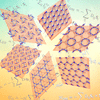
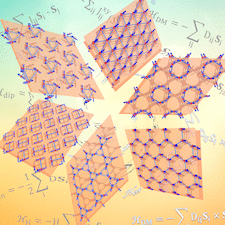
The virtual special issue on Magnetic Structures is introduced. The articles included here were originally published in recent regular issues of Acta Crystallographica Section B.
guidelines
Free
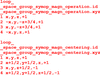
Guidelines for the publication of magnetic structures are reported by the IUCr Commission on Magnetic Structures.
invited articles
Open access
access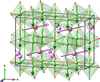
Different examples are described on how to follow the recently published guidelines [Perez-Mato et al. (2024). Acta Cryst. B80, 219–234] when reporting a commensurate magnetic structure.
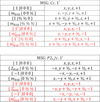
The mathematical structure, description and classification of magnetic space groups are briefly reviewed, with special emphasis on the new unified (UNI) magnetic space-group symbols.
Open access
access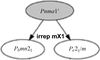
After reviewing the historical unjustified antagonism between the application of magnetic symmetry groups and representation analysis in the investigation of magnetic structures, we highlight the progress achieved in recent years by moving beyond this entrenched divide and applying both concepts together in a complementary manner.
Open access
access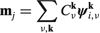
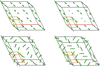
The online software server SARAh—webRepresentational Analysis is introduced. The new suite of web apps carries out a range of calculations based on representation theory for the modelling of possible magnetic structures, their refinement from neutron scattering data and the analysis of other problems in condensed matter.
Summary of the tools provided by the Bilbao Crystallographic Server for the analysis and determination of magnetic structures.

Open access
access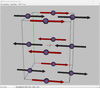
Possible commensurate magnetic structures from neutron powder diffraction data are explored via the Bilbao Crystallographic Server tool k-SUBGROUPSMAG called from within GSAS-II, which allows easy survey of the results and selection of the best magnetic structure model.
Open access
access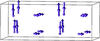
The magnetic option of the crystallographic program JANA2020 is a specific tool for solution, analysis, and description of modulated and non-modulated magnetic structures.
Open access
access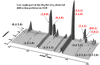
A description of the FullProf Suite of programs for magnetic structure determination is given. Different types of magnetic structure factors are discussed, and links to examples and tutorials for using the programs are provided.
Open access
access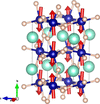
The magnetic structure of LuCrO3 has G-type antiferromagnetic ordering, with Cr3+ moments approximately aligned along the b axis, and a subtle canting along c. The Néel temperature increases from 112.6 K to 116.0 K upon pressure (up to 1.45 GPa).
Open access
access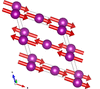
The magnetic and crystal structures of manganese and nickel monoxides have been analysed for possible multi-k solutions and compared with high-resolution neutron diffraction data.
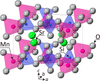
Magnetic structure study on the noncentrosymmetric magnet Sr2MnSi2O7 using irreducible representation and magnetic space group analyses based on data from neutron diffraction, and magnetometry measurements
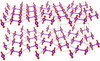
Magnetic metal–organic frameworks are candidate materials for investigating two-dimensional phenomena. The magnetic structures of deuterated formate Co(DCOO)2·2D2O has been studied by neutron powder diffraction.
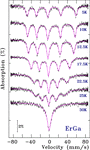
The magnetic structure of the intermetallic compound ErGa as a function of temperature has been determined using a combination of high-resolution neutron powder diffraction and 166Er Mössbauer spectroscopy. ErGa orders as a b-axis ferromagnet at 32 K and undergoes a spin-reorientation at 16 K to yield a canted ferromagnetic structure with the magnetic moments in the bc plane below 16 K.

Download citation


Download citation
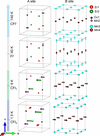
We show that the interplay of multiple magnetic sublattices in Er2CuMnMn4O12 leads to four magnetic phase transitions characterized by the onset of ferrimagnetic order, spin-reorientation, spin canting, and the polarization of Er ions. While we elucidate numerous features of this complex magnetic system, the exact nature of the low-temperature coupling between erbium and manganese, and the origin of a k = (0, 0, ½) modulation, remain intriguing topics for future studies.
Open access
access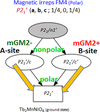
A comparative description is presented of the symmetry and the magnetic structures found in the family of double perovskites A2MnB′O6 (mainly B′ = Co and some Ni compounds for comparative purposes).
Download citation
Download citation
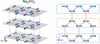
Two-dimensional honeycomb materials as candidates for Kitaev quantum spin liquids are examined, focusing on their single-k zigzag magnetic structures and the derived multi-k variants. A comprehensive overview of these systems is provided, offering detailed crystallographic insights and highlighting their role in advancing both theoretical and experimental research.
Download citation
Download citation
Open access
access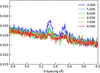
Using neutron powder diffraction, the successive magnetic structures in multiferroic candidate GdCrO3 have been determined, including a complex incommensurate phase below 2.3 K. The symmetry analysis uses a combination of little group formalism and superspace group approach highlighting the strength of each method and the results are reported using the latest IUCr guidelines.
Download citation
Download citation
Open access
access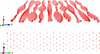
A rare complex incommensurate magnetic structure, an amplitude-modulated structure which itself is modulated, was determined in the Ho-based i-MAX phase (Mo2/3Ho1/3)2GaC. It represents a particularly distinctive case of a 2-k magnetic structure with no symmetry relation between the propagation vectors.
CCDC reference: 2402463