

 journal menu


issue contents
February 2026 issue
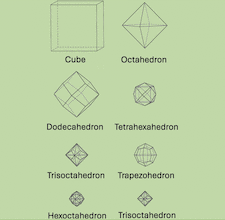
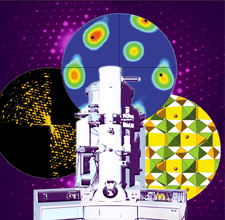
Cover illustration: Common crystal shapes of cubic crystals enclosed by families of symmetrically equivalent planes are generated using the CRYSP software. See Xing-Zhong Li [(2026), Acta Cryst. B82, 14–21].
editorial


Open  access
access
The newest three members of the Editorial Board of Acta Crystallographica Section B are introduced.
current research in crystal growth and related characterization
Open access
access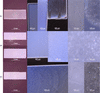
High-purity MgO substrate crystals grown by the optical floating zone technique are demonstrated, which can serve as a foundation for the development of novel device concepts based on epitaxially grown thin films.
Open access
access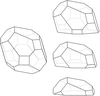
CRYSP is a software tool for the construction and visualization of crystal shapes in both natural habits and on planar substrates. It also supports morphologies associated with non-crystallographic point groups.
research papers

Download citation


Download citation
Open access
access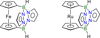
The ferrocene Fc(BHpz)2 and the ruthenocene Rc(BHpz)2 belong to the same order–disorder (OD) polytype family and feature a complex stacking disorder, with different ordered and disordered domains in the same crystal.
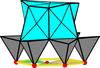
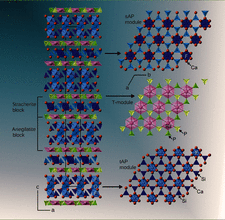
Novel methods for the computer modelling of oxide network structures are introduced by reference to known mica structures. These permit the prediction of crystal structures at intermediate temperatures or pressures by interpolation.
Download citation
Download citation
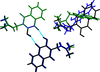
A new polymorph of lapachol differs only in the stacking of identical layers from two previously reported forms.
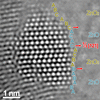
Rupture of peroxide O22− bonds in ZnO2 during thermal decomposition creates a local charge imbalance. This induces a shear displacement of the {111} planes, wherein the formation of stacking faults changes O-atom coordination from tri- to tetracoordination. Their subsequence development changes the stacking sequence of the {111} planes from the ABC to the AB style, transiting to the hexagonal ZnO structure.
Download citation
Download citation
Open access
access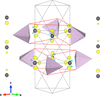
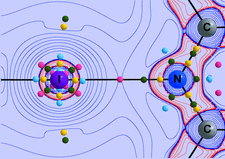
In lacunary apatite structure-type Pb4Na(PO4)3, residual density attributable to the deformed 6s2 electron cloud is found in the vicinity of A2-site Pb2+ on regular A2 triangle normal to c. Systematic comparison on the size of the A2 triangle with other apatite-type compounds indicates limited stereochemical activity of the orbital.
CCDC reference: 2513045
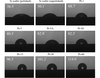
The tunable synthesis of sea-urchin-like platinum nanoparticles via fluoride-assisted galvanic replacement is demonstrated, revealing how nanospike morphology directly influences crystallinity, surface wettability, and surface-enhanced Raman scattering (SERS) performance. By tuning the reaction time, the morphology of Pt nanoparticles can be controlled to enhance SERS and optical performance, thereby, advancing plasmonic sensing and antireflective surfaces.
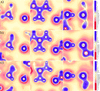
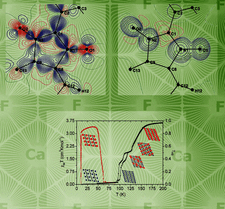
Electron density distribution in the intermolecular space of (R)-3-quinuclidinol under external pressure is studied in relation to the deformation of hydrogen bonds, hydrostatic compressibility, macroscopic elastic and piezoelectric properties.
Download citation
Download citation
Open access
access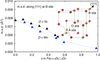
Structures of Fe2.992O4 (magnetite), Fe3–x–yMnx□yO4 (x ≤ 0.980) and Fe3–x–yNix□yO4 (x ≤ 0.513, □ denotes point defects) are examined at room temperature. The observed disappearance of peculiarly large mean-square displacement at the B site along the 3 axis in [111] is interpreted as a disappearance of phonons interact with electrons in the high-temperature phase of magnetite.
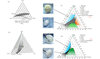
The phase equilibria in the LiB3O5–NaF–Li2Mo4O13 and LiB3O5–NaF–Li4Mo5O17 systems were studied. The presence of NaF results in an increase in the viscosity of borate systems that contain LiB3O5. The weight yield percentage of LiB3O5 can reach up to 60%.