

 journal menu


issue contents
February 2004 issue
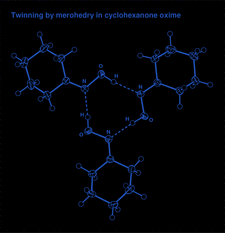
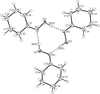
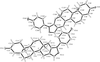
Cover illustration: The three independent residues of cyclohexanone oxime linked by hydrogen bonds into a trimeric structure. . See Lutz, Spek, Dabirian, van Walree & Jenneskens [Acta Cryst. (2004), C60, o127-o127].
inorganic compounds


Download citation


Download citation
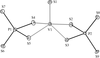
The crystal structure of the title compound, prepared by reacting a mixture of K2S3, VP, P4S3 and S, consists of discrete [VS(PS4)2]4− anions, which are stacked along the direction of the crystallographic b axis and separated by K+ cations. In the anion, the V atom is connected to five S atoms within a square pyramid. The VS5 group shares common edges with two bidentate [PS4] tetrahedra.
Download citation
Download citation
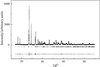
The crystal structure of a new indium holmium germanate, In1.06Ho0.94Ge2O7, belonging to the thortveitite structure type, is reported. The In3+ and Ho3+ cations occupy the same octahedral site, forming an hexagonal arrangement on the ab plane. In their turn, the hexagonal arrangements of (In/Ho)O6 octahedral layers are held together by sheets of isolated diortho groups comprised of double tetrahedra sharing a common vertex.
Download citation
Download citation
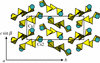
Cs2Cr4O13 contains a [Cr4O13]2− anion with a zigzag-like structure, built from four corner-linked CrO4 tetrahedra, and has a structure type previously unknown among alkali tetrachromates.
Download citation
Download citation
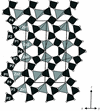
Single crystals of the high-temperature modification of zinc catena-polyphosphate, β-Zn(PO3)2, were grown from a melt and quenched from 1093 K to room temperature. The structure is built of corrugated (PO3)∞ polyphosphate chains linked by slightly distorted [ZnO4] tetrahedra into a three-dimensional network.
metal-organic compounds
Download citation
Download citation
Download citation
Download citation
Download citation
Download citation
Download citation
Download citation
Download citation
Download citation
Download citation
Download citation
Download citation
Download citation
Download citation
Download citation
Download citation
Download citation
Download citation
Download citation
Download citation
Download citation
Download citation
Download citation
Download citation
Download citation
Download citation
Download citation
Download citation
Download citation
Download citation
Download citation
Download citation
Download citation
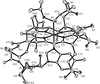
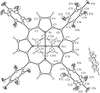
The diisopropylphosphite ligand coordinates to the CoIII atom via its P atom. The crystal structure is isomorphous with that of other cobalamins that adopt packing type II, with a Co—P bond length [2.227 (1) Å] similar to that found in other phosphitocobalamins.
Download citation
Download citation
Download citation
Download citation
Download citation
Download citation
organic compounds
Download citation
Download citation
Download citation
Download citation
Download citation
Download citation
Download citation
Download citation
Download citation
Download citation
Download citation
Download citation
Download citation
Download citation
Download citation
Download citation
Download citation
Download citation
Download citation
Download citation
Download citation
Download citation
Download citation
Download citation
Download citation
Download citation
Download citation
Download citation
Download citation
Download citation
Download citation
Download citation
Download citation
Download citation
Download citation
Download citation
Download citation
Download citation
Download citation
Download citation