


 journal menu


issue contents
August 2016 issue
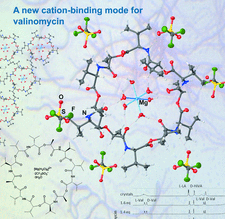
Cover illustration: The crystal structure of a valinomycin complex with an encapsulated [Mg(H2O)6]2+ ion as an independent structural unit is described. The new cation-binding mode exhibited by valinomycin, a cyclic dodecadepsipeptide, occurs via hydrogen bonds from the coordinated water molecules of the hexahydrate cation, instead of via direct links to the cation. The interaction of the [Mg(H2O)6]2+ ion with the cyclic polypeptide has important implications for the study of metal binding with biological models under physiological (aqueous) conditions. See Fujita, Kazerouni & Bacsa [Acta Cryst. (2016), C72, 627-633].
research papers


Download citation


Download citation
A novel heterotrinuclear CuII–NiII–CuII complex based on 2,2′-[propane-1,3-diylbis(nitrilomethanylylidene)]diphenol (H2L) has been assembled by the reaction of the `ligand complex' [CuL] with Ni(OAc)2·4H2O in the presence of dicyanamide. The structure and the solid-state thermal and photoluminescence behaviours of the complex are discussed.
CCDC reference: 933082
Download citation

Download citation
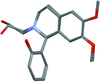
In the crystal structure of 2-(2-hydroxyethyl)-1-(2-hydroxyphenyl)-6,7-dimethoxy-1,2,3,4-tetrahydroisoquinoline, the asymmetric unit contains two molecules related by a pseudo-translation and the molecules show slightly different conformations.
CCDC reference: 1489810
Download citation
Download citation
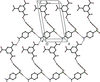
Crystallization of (4-fluorophenyl)pyrazole with 2,4,6-trinitrophenol gives a salt, but a similar crystallization of 4-amino-N-(3,4-dimethyl-1,2-oxazol-5-yl)benzenesulfonamide with 3,5-dinitrobenzoic acid gives a 1:1 cocrystal containing neutral molecules. The ionic components in the salt form a three-dimensional hydrogen-bonded structure and the neutral components in the cocrystal form complex hydrogen-bonded bilayers.
Download citation
Download citation
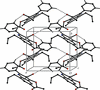
The reactions of two 3-(2-allylanilino)-3-phenylacrylate esters with acetic anhydride and with strong acids give a number of products, most of them unexpected. The structures of two of the crystalline examples of the unexpected products, namely 3-acetyl-8-allyl-6-methyl-2-phenylquinolin-4-yl acetate and (2RS)-2,8-dimethyl-4-phenyl-1,2-dihydro-6H-pyrrolo[3,2,1-ij]quinolin-6-one, are reported.
Download citation
Download citation
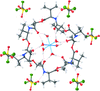
The crystal structure of a valinomycin complex with an encapsulated [Mg(H2O)6]2+ ion as an independent structural unit is described. The new cation-binding mode exhibited by valinomycin, a cyclic dodecadepsipeptide, occurs via hydrogen bonds from the coordinated water molecules of the hexahydrate cation, instead of via direct links to the cation. The interaction of the [Mg(H2O)6]2+ ion with the cyclic polypeptide has important implications for the study of metal binding with biological models under physiological (aqueous) conditions.
CCDC reference: 1489496
Download citation
Download citation
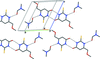
One cocrystal structure of 6-propyl-2-thiouracil and two cocrystal structures of the structurally related compound 6-methoxymethyl-2-thiouracil with coformers containing the 2,4-diaminopyrimidine substructure are presented, as well as four solvates of 6-methoxymethyl-2-thiouracil. In the cocrystal structures of 6-methoxymethyl-2-thiouracil, the triply hydrogen-bonded N—H⋯O/N/S synthon is observed accompanied by a conformational change of the side chain compared to the solvate structures, while for 6-propyl-2-thiouracil, a doubly hydrogen-bonded interaction is observed instead.
Download citation
Download citation
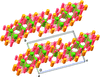
The crystal structure of Sr7V4Te12O41 exhibits a one-dimensional latticework along the a axis comprised of paired Sr3Te3Ox units, namely Sr6Te6O2x+1, with corner-shared TeO4 polyhedra. The Sr6Te6O2x+1 latticework is helical and is layered in the b-axis direction against sheets of corner-shared VO4 tetrahedra, and is linked in the c-axis direction via individual corner-shared SrO8 square prisms.
CCDC reference: 1475298
Download citation
Download citation
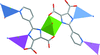
A novel two-dimensional CuII/CuI coordination polymer, with a (2,3)-connected topological network, was assembled from 2-(pyridin-3-yl)-1H-imidazole-4,5-dicarboxylate. Susceptibility measurements indicate weak ferromagnetic coupling.
CCDC reference: 1494068