


 journal menu


issue contents
January 2018 issue
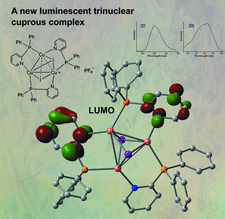
Cover illustration: In the ionic trinuclear Cu3I2 complex [Cu3I2(Ph2PPy)3]PF6, three ![[mu]](/logos/entities/mu_rmgif.gif) 2-bridging Ph2PPy ligands strengthen the cluster core. A TD-DFT study demonstrates that the observed yellow phosphorescence should be derived from the emissive 3(X+M)LCT excited state. See Zhu, Song, Chai, Shen, Wei & Qin [Acta Cryst. (2018), C74, 62-68].
2-bridging Ph2PPy ligands strengthen the cluster core. A TD-DFT study demonstrates that the observed yellow phosphorescence should be derived from the emissive 3(X+M)LCT excited state. See Zhu, Song, Chai, Shen, Wei & Qin [Acta Cryst. (2018), C74, 62-68].
research papers


Download citation


Download citation
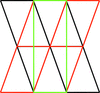
A new polymorph of 5-fluorosalicylic acid has been investigated. The packing basis for the pseudo-orthorhombic twinning is analysed, as are the structure-determining O—H⋯F hydrogen bonds.
CCDC reference: 1587780
Download citation
Download citation
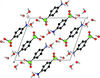
Sulfanilic acid dihydrate can be crystallized at 273 K. All H atoms attached to N and O atoms find an acceptor in suitable geometries and the packing is highly efficient; nevertheless, the compound undergoes fast desolvation under ambient conditions.
CCDC reference: 1587239
Download citation
Download citation
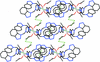
Two new ZnII coordination complexes with the asymmetric multidentate ligand 1-(1H-benzotriazol-1-ylmethyl)-2-propyl-1H-imidazole have been synthesized and structurally characterized by single-crystal X-ray diffraction. The complexes were investigated by fluorescence and thermal analyses.
Download citation
Download citation
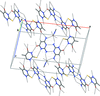
Six cocrystal structures of 5-methyl-2-thiouracil are presented whereby the mixed ADA–DAD N—H⋯S/N—H⋯N/N—H⋯O synthon was formed successfully with the coformers 2,4-diaminopyrimidine, 2,4-diamino-6-phenyl-1,3,5-triazine and melamine, respectively. In addition, one cocrystal with 2,4-diaminopyrimidine containing an  (8) N—H⋯O/N—H⋯N interaction and two isomorphous solvated cocrystals with 6-amino-3H-isocytosine containing an (8) N—H⋯S/N—H⋯O interaction are reported.
(8) N—H⋯O/N—H⋯N interaction and two isomorphous solvated cocrystals with 6-amino-3H-isocytosine containing an (8) N—H⋯S/N—H⋯O interaction are reported.
Download citation
Download citation
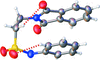
2-Ethyl, 4-nitro and 4-methoxy substituents have an effect on the packing and intermolecular interactions of N-phenyl-2-phthalimidoethanesulfonamide.
Download citation
Download citation
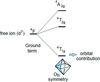
A variable-temperature magnetic study of a CoII complex incorporating 2,6-diamino-7H-purin-1-ium, 4,4′-oxydibenzoate and water ligands between 2 and 300 K reveals an orbital contribution to the magnetic moment and a weak antiferromagnetic interaction between the CoII centres as the temperature decreases.
CCDC reference: 1587307
Download citation
Download citation
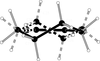
Four variously substituted N-(3-benzoyl-4,5,6,7-tetrahydrobenzo[b]thiophen-2-yl)benzamides exhibit very similar molecular conformations, but with conformational disorder in three of them. The supramolecular assembly, involving C—H⋯O and C—H⋯π hydrogen bonds and π–π stacking interactions, ranges from finite zero-dimensional aggregates, via two types of chain, to complex sheets.
Download citation
Download citation
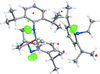
The structure resulting from a rare cocrystallization of three stereoisomers, i.e. RR, SS, and meso, of a diamine has been used to compare seven methods for molecular crystal-volume estimation.
CCDC reference: 930538
Download citation
Download citation
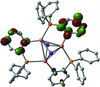
In the ionic trinuclear Cu3I2 complex [Cu3I2(Ph2PPy)3]PF6, three μ2-bridging Ph2PPy ligands strengthen the cluster core. A TD–DFT study demonstrates that the observed yellow phosphorescence should be derived from the emissive 3(X+M)LCT excited state.
CCDC reference: 1588813
Download citation
Download citation
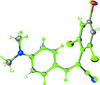
The crystal structures of the energetically similar Z and E isomers of 3-[4-(dimethylamino)phenyl]-2-(2,4,6-tribromophenyl)acrylonitrile differ in the nature of their strong intermolecular nonbonding interactions, which are Br⋯N in the case of the Z isomer and Br⋯Br for the E isomer.
Download citation
Download citation
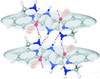
Molecular salts were formed by proton transfer from naphthalene-1,5-disulfonic acid to a pyridyl bis-urea macrocycle. Two DMSO-solvated salts displaying two distinct conformations of the macrocycle were obtained upon slow cooling of DMSO–acetonitrile solutions from two temperatures (363 and 393 K).
Download citation
Download citation

The synthesis and crystal structures of a series of (E)-5-(arylideneamino)-1-tert-butyl-1H-pyrrole-3-carbonitriles and their respective reduced products are presented. Interestingly, C—H⋯Cl interactions seem to help in the construction of the supramolecular structure of the precursors, while in the corresponding reduced compounds, these interactions appear less important compared with the observed (N,C)—H⋯N hydrogen bonds.
Download citation
Download citation
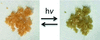
A two-dimensional cadmium(II) coordination polymer has been prepared using the ligand N,N′-bis(pyridin-4-ylmethyl)naphthalene-1,8:4,5-bis(dicarboximide). The product shows reversible photochromic behaviour and photocontrolled tunable luminescence properties.
CCDC reference: 1811683
Download citation
Download citation
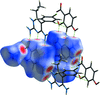
The cocrystal structure of an antimalarial drug is reported along with a study of the electrostatic properties on the basis of transferred multipolar parameters from an electron-density database.
CCDC reference: 1810824
Download citation
Download citation
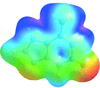
The structure of isoguaninium chloride displays two kinds of molecular tapes parallel to (010) and (50 ). The tapes are formed by dimers of isoguaninium cations interacting with chloride anions.
). The tapes are formed by dimers of isoguaninium cations interacting with chloride anions.CCDC reference: 1569459