


 journal menu


issue contents
October 2018 issue
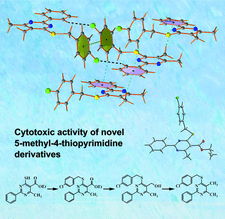
Cover illustration: The cytotoxicities of 4-thiopyrimidine derivatives obtained from ethyl 4-methyl-2-phenyl-6-sulfanylpyrimidine-5-carboxylate were examined against Human umbilical vein endothelial cells (HUVEC) and HeLa, K562 and CFPAC cancer cell lines. The presence of hydroxymethyl and methyl groups offers an interesting new insight into the structures and behaviour of these derivatives. See Stolarczyk, Bryndal, Matera-Witkiewicz, Lis, Królewska-Golinska, Cieslak, Kazmierczak-Baranska & Cieplik [Acta Cryst. (2018), C74, 1138-1145].
research papers


Download citation


Download citation
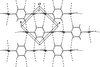
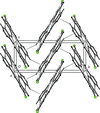
An unpredicted fourfold screw N—H⋯O hydrogen bond C(4) motif in the primary dicarboxamide trans-cyclohexane-1,4-dicarboxamide was investigated by single-crystal X-ray diffraction and IR and Raman spectroscopies. Based on the results, a structural model is proposed which helps to rationalize the unusual fourfold screw molecular arrangement.
CCDC reference: 1586317
Download citation
Download citation
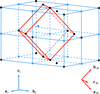
The crystal structure of the M phase, (MnxZn1–x)2V2O7 (0.75 < x < 0.913), can be described as a distortion of the thortveitite-type crystal structure of β-Mn2V2O7. The distortions which give rise to the M phase from the β-Mn2V2O7 prototype are noticeably less pronounced than the distortions introduced when β-Mn2V2O7 transforms at low temperature to α-Mn2V2O7. A twofold superstructure in the diffraction patterns of crystals of the M phase used for single-crystal X-ray diffraction work arises from twinning by reticular pseudomerohedry.
Download citation
Download citation
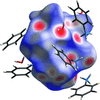
The heteropolyoxometalate compound (C6H8N)5[HAs2Mo6O26(H2O)]·3H2O contains a new [HAs2Mo6O26(H2O)]5− polyanion. Crystallographic analysis provided an understanding of the architecture and structural features of the complex crystal lattice and Hirshfeld surface analysis shed more light on the intermolecular interactions occurring in the crystal.
CCDC reference: 1821620
Download citation
Download citation
The structures of eight Schiff bases derived from various salicylaldehydes are reported: five of them are new and three are re-investigations of previously reported examples. Of the eight, six adopt the phenol–imine constitution and the other two adopt the keto–amine form; two of the phenol–imine examples exhibit conformational disorder.
Download citation
Download citation
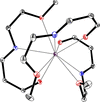
Structures of 2-{[(2-methoxyphenyl)imino]methyl}phenoxide complexes of rare-earth metals are controlled by steric congestion influenced by the rare-earth ionic radius, leading to three different coordination modes of the ligand.
Download citation
Download citation
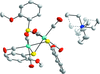
The structures of two dinuclear ReI complexes are reported, one with a 2,2′-sulfanediyldi(ethanethiolate) bridging ligand and the other with three 2-methoxybenzenethiolate bridging ligands. Two mononuclear ReI complexes have also been characterized by spectral methods.
Download citation
Download citation
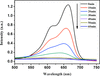
A cobalt(II) compound, prepared by the reaction of Co(NO3)2·6H2O with biphenyl-4,4′-diyldicarboxylic acid and bis[4-(2-methyl-1H-imidazol-1-yl)phenyl] ether in a mixture of H2O and dimethylformamide, possesses an achiral two-dimensional layer based on opposite-handed helical chains and exhibits highly photocatalytic degradation activity for the degradation of methylene blue at room temperature.
CCDC reference: 1865686
Download citation
Download citation
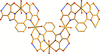
A new CdII coordination polymer based on 2,2′-(1,2-phenylene)bis(1H-imidazole-4,5-dicarboxylic acid) has been prepared and structurally characterized. The polymer exhibits a one-dimensional structure, in which H2Phbidc4− anions coordinate to CdII ions in an octadentate mode.
CCDC reference: 1866134
Download citation
Download citation
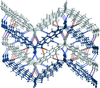
Poly[(μ2-formato)[μ2-4-(pyridin-4-yl)benzoato]zinc(II)] contains two independent structural units in the asymmetric unit, forming two similar two-dimensional (2D) layer structures. These similar 2D layers are arranged alternately and are linked with each other by dense C—H⋯O hydrogen bonds to generate a three-dimensional supramolecular framework.
CCDC reference: 1864567
Download citation
Download citation
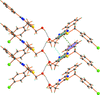
The cytotoxicities of 4-thiopyrimidine derivatives obtained from ethyl 4-methyl-2-phenyl-6-sulfanylpyrimidine-5-carboxylate were examined against Human umbilical vein endothelial cells (HUVEC) and HeLa, K562 and CFPAC cancer cell lines. The presence of hydroxymethyl and methyl groups offers an interesting new insight into the structures and behaviour of these derivatives.
Download citation
Download citation
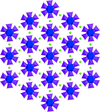
Two one-dimensional alkali-metal germanophosphates (GePOs), namely, HRb3Ge2(HPO4)6 and CsGe(HPO4)2(OH), have been prepared by the solvothermal method. The former shows one-dimensional (1D) [Ge(HPO4)6]∞ chains along the c axis and the latter shows 1D [Ge(HPO4)4(OH)2]∞ chains.
Download citation
Download citation
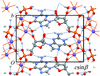
It was found that the structure of disodium guanosine 5′-monophosphate tetrahydrate differs markedly from that of the heptahydrate, but greatly resembles that of disodium deoxyguanosine 5′-monophosphate tetrahydrate.
CCDC reference: 1826037
Download citation
Download citation
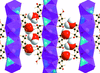
The crystal structures of four isostructural citrate salts, LiMHC6H5O7 (M = Li, Na, K and Rb), have been solved and refined using laboratory powder X-ray diffraction data and optimized using density functional techniques.
Download citation
Download citation
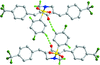
Four 3,5-bis(arylidene)-N-benzenesulfonyl-4-piperidone derivatives were synthesized and their structures were confirmed by single-crystal X-ray diffraction. Preliminary evaluations were conducted on their anti-inflammatory activity by evaluating their inhibitory effects on LPS-induced IL-6 and TNF-α secretion.