


 journal menu


issue contents
July 2020 issue
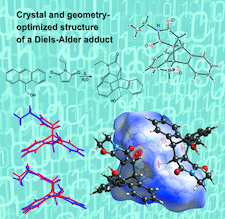
Cover illustration: Computational calculations of an anthracene-based Diels-Alder adduct predicting density functional theory (DFT) optimized geometries in the gas phase are compared in terms of accuracy relative to the solid-state crystal structure and computational cost. See Hillman, Tanski & Roberts [Acta Cryst. (2020), C76, 666-673].
research papers


Download citation


Download citation
Open  access
access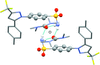
Six isostructural crystalline solvates of celecoxib are reported and the intermolecular interactions involving the solvent molecules are described.
Download citation
Download citation
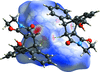
Computational calculations of an anthracene-based Diels–Alder adduct predicting density functional theory (DFT) optimized geometries in the gas phase are compared in terms of accuracy relative to the solid-state crystal structure and computational cost.
CCDC reference: 1583410
Download citation
Download citation
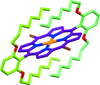
In the structure of {10,20-bis[2,6-bis(octyloxy)phenyl]-5,15-dibromoporphinato}copper(II), the appended octyloxy groups project over both faces of the porphyrin in a self-wrapped assembly.
CCDC reference: 1956625
Download citation
Download citation

Methanol- and temperature-induced dissolution–recrystallization structural transformation (DRST) was observed among two novel CuII complexes. This is first time that the combination of X-ray crystallography, mass spectrometry and density functional theory (DFT) theoretical calculations has been used to describe the fragmentation and recombination of a mononuclear CuII complex at 60 °C in methanol to obtain a binuclear copper(II) complex.
Download citation
Download citation
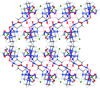
Reactivity studies of [CoCl2(tren)]Cl and [CoCl2(trien)]Cl towards different amino acids indicate a stronger reactivity and thus greater affinity for cobalt(III) complexes towards basic amino acids.
Download citation
Download citation
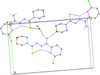
The crystal structures of four new picolinohydrazonamide derivatives of biological interest were determined by X-ray diffraction at 100 K. Synthesis, NMR characterization of the derivatives and their antibacterial and anti-yeast activities are presented.
Download citation
Download citation
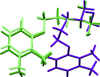
Crystal structure analyses illustrate the conformational properties of 2-amino-N-(dimethylphenoxyethyl)propan-1-ol derivatives due to different positions of a methyl substituent in the aromatic ring and the presence of a 2-picolinate anion. The change of the methyl-group position influences the geometry of the –O—C—C– linker with respect to the aromatic ring.
Download citation
Download citation
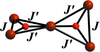
A new ionic pentanuclear FeIII cluster was synthesized using microvial synthesis methods. Magnetic studies reveal that the complex displays dominant antiferromagnetic intracluster interactions between FeIII ions through μ3-oxide bridges.
CCDC reference: 2012343
Download citation
Download citation
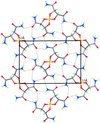
The spiroborate anions [B(TarNH2)2]− {TarNH2 is [CH(O)(CONH2)]2} self-assemble via intermolecular amide hydrogen bonds to form a preserved two-dimensional layer in several tetraalkylammonium salts, [NR4]+ (R = Et, Pr and Bu), as well as in its sparteinium salt. The cation layers show various degrees of solvation in order to match the metric repeat, which is around 10 × 15 Å per two anions.
Download citation
Download citation
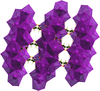
The crystal structures of a new polymorph of dipotassium hydrogen citrate and potassium rubidium hydrogen citrate have been solved and refined using laboratory powder X-ray diffraction data, and optimized using density functional techniques.