


 journal menu


issue contents
June 2022 issue
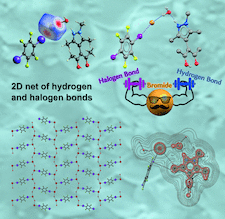
Cover illustration: In the cocrystal of the hydrobromide of a substituted pyrazole with tetrafluorodiidobenzene, the bromide anion engages in both hydrogen and halogen bonds. See van Terwingen, Ebel & Englert [Acta Cryst. (2022), C78, 324–331].
scientific commentaries


Open  access
access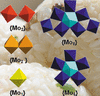
Molybdenum `Blues', `Browns' and the recently discovered `Reds' are unquestionably some of the most impressive nanoscale architectures in POM chemistry. In this context, Al-Sayed et al. (2022) recently made a significant contribution, reporting a new binding mode of an organic hybridization reagent in mixed-valence polyoxomolybdates.
research papers

Download citation


Download citation
Open access
access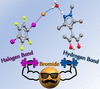
In the cocrystal of the hydrobromide of a substituted pyrazole with tetrafluorodiidobenzene, the bromide anion engages in both hydrogen and halogen bonds.
Download citation
Download citation
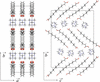
The structure of the 1:1 adduct of hexamethylenetetramine and tridecanedioic acid (HMT–C13) has been investigated. An order–disorder phase transition and a phase co-existence phenomenon are analysed as a function of temperature.
Download citation
Download citation
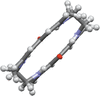
A Schiff base derived from ethylenediamine and heptane-2,4,6-trione shows two different planes, is essentially nonplanar and exhibits a `step-stool' conformation. The nonplanar nature plays an important role in metal coordination, which leads to partial hydrolysis of the ring structure.
CCDC reference: 2166693
Download citation
Download citation
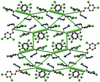
Three X-ray crystal structures of miconazole are compared: the pure solvent-free form, the ethanol monosolvate form and the hemihydrate form. The hydrogen bonds are characterized and their role in the crystal architectures is considered from a geometric point of view and then by Hirshfeld surface and the energy framework approaches.
Download citation
Download citation
Open access
access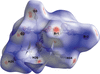
The crystal structures of two rhenium(I) complexes were determined and inter- and intramolecular interactions were confirmed with solid-state NMR spectroscopy.
Download citation
Download citation
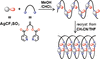
Reaction of silver(I) trifluoromethanesulfonate with a fluorescent ligand, namely, 2-methylidene-1,3-bis(nicotinoyloxy)propane, yielded two kinds of one-dimensional sinusoidal and helical coordination polymers based on a change of solvent medium, because the flexible ligand can adopt various conformations both in solution and in the solid state.
Download citation
Download citation
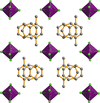
In-plane rotation of planar polyatomic molecules in crystals can be turned on and off under temperature control. This discovery provides a new idea for the development of phase-transition functional materials.