journal menu


issue contents
February 2026 issue
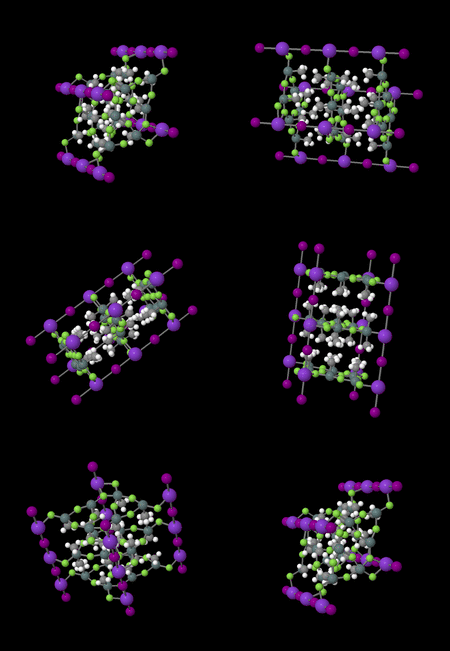
Cover illustration: An interesting host–guest compound is formed, based on a hexagonal host framework of Sn(CH3)2F2, with ‘rods’ of KI as guests. The resulting composition (Me2SnF2)6·KI, is obtained in a reproducible manner. The structure features distorted {Me2SnF4/2} octahedra that share corners via bridging fluorine atoms to produce a layered arrangement. See: Vages, Gieschen, Neue & Reuter [Acta Cryst. (2026). E82, 163–167].
research communications


Download citation


Download citation
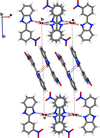
The crystal structure of the title compound has been redetermined in the triclinic centrosymmetric space group P1. The benzene ring and the benzimidazole group are almost coplanar, with N—C—C—C torsion of 2.2 (3) and 5.9 (4)° in the two independent molecules in the unit cell. The crystal structure features N—H⋯O and O—H⋯N hydrogen bonds and offset π–π stacking interactions.
CCDC reference: 2432049
Download citation
Download citation
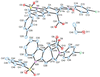
The asymmetric unit of the title compound contains two crystallographically independent molecules and an ethanol solvent molecule. In the crystal, O—H⋯O and C—H⋯O hydrogen bonds link the molecules into a three-dimensional architecture, enclosing R44(23) ring motifs. C—H⋯π(ring) interactions and the π–π stacking between the centroids of the parallel rings help to consolidate the packing.
CCDC reference: 2518350
Download citation
Download citation
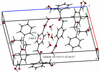
The crystal structure of the title compound N-hydroxy-4-{2-[(2-hydroxyethyl)(phenyl)amino]-2-oxoethyl}benzamide monohydrate (HPOB·H2O) is reported.
CCDC reference: 2513447
Download citation
Download citation
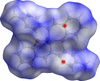
The title compound, [C28H24N2O2Pd], contains an N,O-bidentate ligand and features a square-planar PdII atom coordinated to two chelating ligands. In the crystal, the molecules are linked through weak C—H⋯π interactions.
CCDC reference: 2286186
Download citation
Download citation
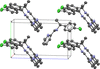
Both title compounds crystallize in Sohnke space groups. The ligand crystallizes in P21, and the complex in P212121, with the PdII atom in a slightly distorted square-planar environment.
Download citation
Download citation
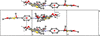
The crystal structure of tris[4-(3,4-dimethoxythiophen-2-yl)phenyl]amine (DMOT-TPA) was determined by X-ray diffraction. The central nitrogen atom is non-pyramidal, with the three para-phenylene rings in a propeller arrangement. The thiophene rings are twisted by ca. 25–29° relative to the phenylene rings, forming a distorted π-conjugated framework. In the crystal, C—H⋯π interactions link molecules into two-dimensional sheets and a three-dimensional network.
CCDC reference: 2520149
Download citation
Download citation
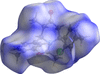
In the title compound, the crystal packing features C—H⋯Cl hydrogen bonds, which form R22(12) graph-set motifs.
CCDC reference: 2184416
Download citation
Download citation
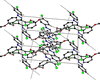
The crystal structures and Hirshfeld surface analyses of two similar azo compounds are reported. In the first, the molecules form layers parallel to the (010) plane through C—H⋯π and C—Cl⋯π interactions and van der Waals interactions between these layers consolidate the packing. In the other, the molecules are connected by C—H⋯O and C—H⋯Cl hydrogen bonds, forming a three-dimensional network. C—Cl⋯π interactions also contribute to the packing.
Download citation
Download citation
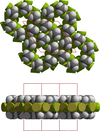
In the solid state, hexakis[dimethyltin(IV) difluoride] potassium iodide, (Me2SnF2)6·KI, consists of planar layers of corner-linked {Me2SnF4/2} octahedra in a snub hexagonal tiling (sr{3,6}) arrangement, which leads to the formation of hexagonal pores in which potassium cations are located. The latter are linearly connected to iodide anions perpendicular to the layers.
CCDC reference: 2521792
Download citation
Download citation
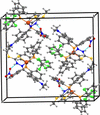
In the title compound, the carbon tetrachloride solvent molecule is presumed to have originated as an impurity in the chloroform solvent used. In the extended structure, the cation and anion are linked by an N—H⋯O hydrogen bond. Along with electrostatic forces, C—H⋯N, C—H⋯S and C—H⋯O hydrogen bonds help to consolidate the crystal packing.
CCDC reference: 2482415
Download citation
Download citation
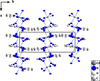
The title compound, [Cd(N3)2(C10H9N3)]n, was prepared solvothermally and characterized crystallographically. In the crystal, adjacent polymeric chains are linked into layers via N—H⋯N hydrogen bonds.
CCDC reference: 2522304
Download citation
Download citation
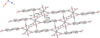
The MnII ions in the title compound are bridged by the H2dondc2− (H2dondc2− is 1,5-dihydroxynaphthalene-2,6-dicarboxylate) ligand to form a one-dimensional chain. The chains are further connected by π–π interactions, forming a three-dimensional network.
CCDC reference: 2523005
Download citation
Download citation
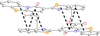
Two short intramolecular S⋯O=C contacts and one intramolecular ‘weak' C—H⋯O=C hydrogen bond cause most of the molecule to be approximately planar. The main secondary interactions are a ‘weak' hydrogen bond, stacked pairs of molecules and a C—H⋯π contact.
CCDC reference: 2521548
Download citation
Download citation
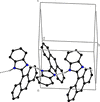
The benzimidazole and anthracene moieties in the title compound contains are oriented at a dihedral angle of 46.00 (2)°. In the crystal, N—H⋯N hydrogen bonds link the molecules into infinite chains along the b-axis direction. In addition, C—H⋯π interactions contribute to the consolidation of the packing.
CCDC reference: 2518388
Download citation
Download citation
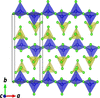
The reaction of ZnCl2 with PCl5 in a 1:1 molar ratio at 623 K produced single crystals of ZnPCl7, which crystallizes in the orthorhombic space group Ama2. Its extended structure features isolated [PCl4]+ tetrahedra and one-dimensional chains of corner-sharing ZnCl2Cl2/2 tetrahedra.
CCDC reference: 2521177
Download citation
Download citation
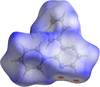
In a second monoclinic polymorph of 2,3-diphenylpyrazine, pairwise C—H⋯N hydrogen bonds link the molecules into centrosymmetric dimers and aromatic π–π stacking interactions between the pyrazine rings of adjacent molecules and C—H⋯π interactions help to consolidatate the packing.
CCDC reference: 2524118
Download citation
Download citation
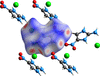
Single crystals of 2-amino-4-nitroimidazole hydrochloride were synthesized by slow evaporation and characterized by X-ray diffraction. The crystal structure features a planar imidazolium cation and a chloride anion, forming a three-dimensional supramolecular network via N—H⋯Cl and N—H⋯O hydrogen bonds.
CCDC reference: 2517048
Download citation
Download citation
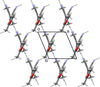
The crysstal structure of an unexpected product of the Knoevenagel condensation between 2,6-dimethyl-γ-pyrone and cyanoacetic acid in the presence of acetic anhydride and piperidine as catalyst is reported and a mechanism for the reaction is proposed.
CCDC reference: 2524654
Download citation
Download citation
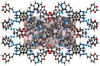
The main supramolecular motif in the packing of the title compound is the formation of N—H⋯N and C—H⋯N hydrogen-bonded chains extending parallel to [001].
CCDC reference: 2512372
Download citation
Download citation
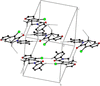
The asymmetric unit of the title compound contains two molecules. In the crystal, C—H⋯O and C—H⋯Cl hydrogen bonds link the molecules into two-dimensional networks, enclosing R33(19), R22(18) and R22(14) ring motifs. C—H⋯π interactions help to consolidate the packing.
CCDC reference: 2525040
Download citation
Download citation
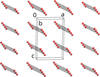
The monoclinic and orthorhombic polymorphs of 2,6-dimethylphenol are constituted of very similar hydrogen-bonded chains, but the packing of the chains differs significantly.
Download citation
Download citation
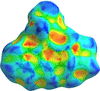
The title compound contains an almost planar anthracene ring system. In the crystal, intermolecular bifurcated C—H⋯O hydrogen bonds link the molecules into infinite chains along the a-axis direction and π–π stacking interactions between the benzene rings of adjacent molecules help to consolidate the three-dimensional architecture.
CCDC reference: 2524759
Download citation
Download citation
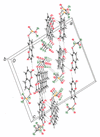
The title compound, 2-oxo-2H-chromen-7-yl-trifluoromethanesulfonate, crystallizes as closely associated pairs across an inversion center, these dyads then forming steps in a staircase packing arrangement in the direction of the b axis. Efficient crystal packing is assisted by a dense network of C—H⋯O intermolecular contacts.
CCDC reference: 2525434
Download citation
Download citation
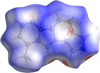
The extended structure of a pyrazolo[3,4-a]carbazole features {N—H}2⋯N hydrogen bonds, which generate [010] chains.
CCDC reference: 2524177
education and outreach
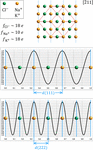
A one-dimensional graphical Fourier analysis is proposed as a teaching approach to visualize the cosine and sine coefficients of structure factors and to provide a visual illustration of the relationship between atomic arrangement, symmetry and diffraction patterns.