menu
menu


issue contents
June 2026 issue
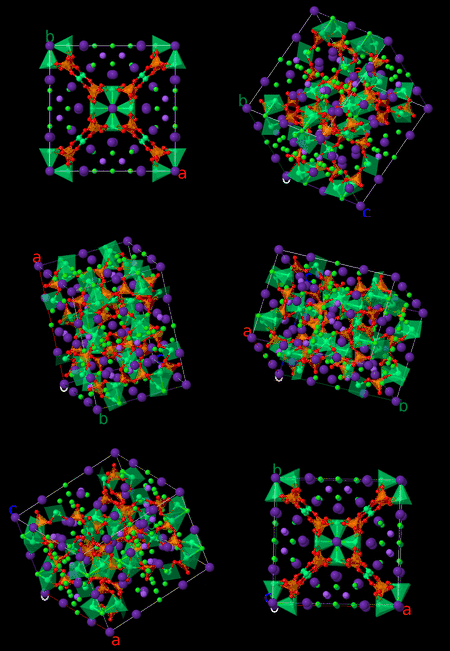
Cover illustration: The new salt-inclusion solid (SIS) nonarubidium disodium hexacopper(II) tetrakis(pyrophosphate) heptachloride, Rb9Na2Cu6(P2O7)4Cl7, has been synthesized by employing a high-temperature RbCl/NaCl eutectic flux. It is a member of the series of salt-templated phosphates and arsenates, A2M3(X2O7)2·(salt) [where A = K, Rb, Cs; M = Mn, Cu; X = P, As] commonly known as CU-2 materials. The structure exhibits rarely seen corner-sharing Na4Cl8 units. See: Luviano, Williams, Liurukara, Dayeh, Cox & Ranmohotti [Acta Cryst. (2026). E82, 551–556].
early career research


Download citation


Download citation
The title compound, diaquabis{2-formyl-6-methoxy-4-[(E)-2-phenyldiazen-1-yl]phenolato-κ2O1,O2}iron(II), [Fe(C14H11N2O3)2(H2O)2], comprises two bidentate ligands derived from 2-methoxy-4-(phenyldiazenyl)-6-formylphenol and two coordinated water molecules. The crystal structure was determined at 79 K using the MicroED method (λ = 0.02508 Å).
CCDC reference: 2552645
research communications
Download citation
Download citation
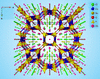
The title compound, Rb9Na2Cu6(P2O7)4Cl7, is another member of the series of salt-templated phosphates and arsenates, A2M3(X2O7)2·(salt) [where A = K, Rb, Cs; M = Mn, Cu; X = P, As] commonly known as CU-2 materials. The structure exhibits rarely seen corner-sharing Na4Cl8 units.
CCDC reference: 2548269
Download citation
Download citation
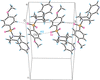
The crystal structures of (S)-3-{1-[(4-chlorophenyl)sulfonyl]piperidin-2-yl}pyridine, (S)-3-[1-(4-methylphenyl)piperidin-2-yl]pyridine, (S)-3-{1-[(4-methoxyphenyl)sulfonyl]piperidin-2-yl}pyridine and (S)-3-{1-[(3,4-dimethylphenyl)sulfonyl]piperidin-2-yl}pyridine are compared. The similarities in the spatial structures of the molecules are explained, particularly the mutual arrangement of the pyridine and piperidine rings, as well as the positioning of the arylsulfonyl group relative to the piperidine ring.
Download citation
Download citation
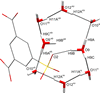
The title compound crystallizes in the triclinic space group P![[\overline 1]](/e/issues/2026/06/00/ox2020/teximages/ox2020fi1.svg) . The structure, containing one oxonium ion and a hydrogen-bonded water cluster with eight molecules, forms an R86(16) ring motif through intermolecular hydrogen bonding.
. The structure, containing one oxonium ion and a hydrogen-bonded water cluster with eight molecules, forms an R86(16) ring motif through intermolecular hydrogen bonding.
. The structure, containing one oxonium ion and a hydrogen-bonded water cluster with eight molecules, forms an R86(16) ring motif through intermolecular hydrogen bonding.CCDC reference: 2548048
Download citation
Download citation
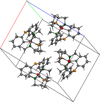
The title compound, (2-phenoxyphenyl-κC1)(tetrahydrofuran-κO)(N,N,N′,N′-tetramethylethylenediamine-κ2N,N′)lithium, [Li(C12H9O)(C6H16N2)(C4H8O)] or [(2-phenoxyphenyl)lithium(THF)(TMEDA)] is a monomeric lithium complex in which tetrahydrofuran (THF) and N,N,N′,N′-tetramethylethylenediamine (TMEDA) play essential roles in stabilizing the lithium ion and promoting a monomeric aggregate. For comparison, diphenyl ether was also redetermined at 100 K.
Download citation
Download citation
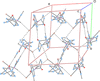
There are two crystallographically independent molecules in the asymmetric unit of the title compound in which the cyclohexene and pyrrole rings are in boat and envelope conformations, respectively. In the crystal, C—H⋯O and N—H⋯Se hydrogen bonds link the molecules into [100] chains. C—H⋯π(ring) interactions help to consolidate the packing.
CCDC reference: 2549118
Download citation
Download citation
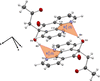
The title compound was synthesized by reacting phendione with acetone in ethanol under microwave irradiation. An intramolecular C=O⋯π interaction supports the molecular conformation. In the crystal, inversion dimers linked by pairwise, bifurcated O—H⋯(N,N) hydrogen bonds are seen and the dimers are further linked by weak C—H⋯N and C—H⋯O hydrogen bonds and aromatic π–π stacking interactions.
CCDC reference: 2549869
Download citation
Download citation
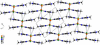
The crystal structures of [(CuCl)2(C6H8N2)4] (1) and [(CuBr)2(C6H8N2)4] (2) are isotypic and consists of dinuclear complexes, in which each copper cation is tetrahedrally coordinated by two μ-1,1 bridging halide anions and two terminally coordinated 2,6-dimethylpyrazine ligands.
Download citation
Download citation
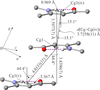
The title compound displays a strong intramolecular N—H⋯O interaction resulting in a six-membered hydrogen-bridged ring. An intermolecular O—H⋯O hydrogen bond leads to a helix formation. The Hirshfeld surface analysis of intermolecular interactions is presented.
CCDC reference: 1818233
Download citation
Download citation
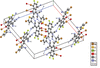
In the crystal, the nearly planar title molecules are held together by a Br⋯O halogen bond and a C—H⋯N interaction.
CCDC reference: 2543339
Download citation
Download citation
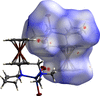
The title transition-metal complexes rac-1 and rac-2 exhibit some differences in terms of the bond lengths as well as the bond angles. Furthermore, not only the space groups, P21/n for rac-1 and P212121 for rac-2, but also the crystal packings differ from each other, which can be seen in different configurations of the pyrrolidine substituents.
Download citation
Download citation
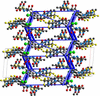
The crystal structure of saflufenacil is reported for the first time, revealing an almost perpendicular arrangement of the pyrimidine and benzene rings and a two-dimensional hydrogen-bonded network that is quantitatively characterized by Hirshfeld surface and energy framework analyses.
CCDC reference: 2551133
Download citation
Download citation
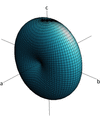
The crystal structures of two hydrous mixed alkali orthomolybdates [Na3K(MoO4)2(H2O)9 and NaK(MoO4)(H2O)] are presented, including a discussion of structural similarities with related phases.
Download citation
Download citation
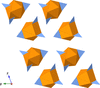
Tetraaquatrinitratoerbium/neodymium(0.359/0.641) dihydrate exhibits structural features, including a network of water molecules and extensive hydrogen bonding between layers, that are isomorphous with other light lanthanide crystal structures.
CCDC reference: 2551502
Download citation
Download citation
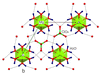
A new magnesium perchlorate hexahydrate phase, Mg(ClO4)2·6H2O, was obtained from the mixed solvents of water and acetamide. The structure crystallizes in the hexagonal space group P63mc and is isostructural with previously reported M(ClO4)2·6H2O (M = Zn, Ni, Fe) phases. The Mg site is half occupied, indicating positional disorder of the metal cation. Prolonged crystallization leads to the formation of larger crystals consistent with an expanded unit cell, suggesting the formation of a disorder-related superstructure.
CCDC reference: 2489227
Download citation
Download citation
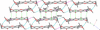
The title compound consists of a xanthone fused ring system with hydroxy, methoxy and 3-methylbutenyl substituents. In the crystal, the molecules are linked by C—H⋯O, C—H⋯π and C—O⋯π interactions.
CCDC reference: 2553254
Download citation
Download citation
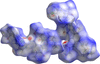
The crystal structure of sunvozertinib has been solved and refined using synchrotron X-ray powder diffraction data, and optimized using density functional theory techniques.
Download citation
Download citation
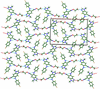
The crystal structure of binimetinib (Form A) has been solved and refined using synchrotron X-ray powder diffraction data, and optimized using density functional theory techniques
Download citation
Download citation
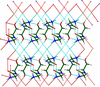
The crystal structure of midodrine hydrochloride Form A has been solved and refined using synchrotron X-ray powder diffraction data, and optimized using density functional theory techniques.
Download citation
Download citation
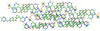
The crystal structure of avutometinib has been solved and refined using synchrotron X-ray powder diffraction data, and optimized using density functional theory techniques.
Download citation
Download citation
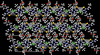
The synthesis, crystal structure and Hirshfeld analysis of the HgII complex with two molecules of (E)-2-[1-(benzo[d][1,3]dioxol-5-yl)ethylidene]-N-ethylhydrazine-1-carbothioamide, acting as κS-donors, and two chlorido ligands are reported. For the first time, the structural N—H⋯Cl intramolecular interactions for TSC–mercury(II) complexes are addressed as a chelate-like coordination environment with S(6) graph-set motifs.
CCDC reference: 2552717
Download citation
Download citation
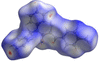
The thiazine ring exhibits a screw-boat conformation and is significantly folded along the S⋯N axis. In the crystal, molecules pack in wave-like layers parallel to the bc plane aided by C—H⋯π(ring) interactions.
CCDC reference: 2551702
Download citation
Download citation
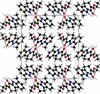
In the extended structure of the title compound, N—H⋯O hydrogen bonds connect the molecules into [100] chains and weak C—H⋯O interactions and pairwise C—H⋯π interactions consolidate the packing.
CCDC reference: 1540675
Download citation
Download citation
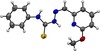
In the title compound, the molecular conformation is supported by two intramolecular N—H⋯N hydrogen bonds. In the extended structure, N—H⋯O hydrogen bonds link the molecules into [011] chains.
CCDC reference: 2535197
Download citation
Download citation
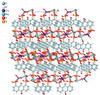
A NaI–CuII mixed-metal three-dimensional coordination polymer based on anthraquinone-1,8-disulfonate has been synthesized and characterized by single-crystal X-ray diffraction, infrared spectroscopy and thermogravimetric analysis. The complex exhibits a three-dimensional pillar-layered coordination framework with rich hydrogen-bonding motifs in the solid state.
CCDC reference: 2533984
Download citation
Download citation
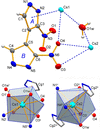
A series of late alkali metal salts introduce electron-depleted nitropyrazolate anions as common N-ligands for K+ and Rb+, but π-ligands for softer Lewis acid Cs+.
Download citation
Download citation
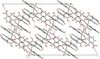
A tetranuclear copper(II) complex assembled from 1,10-phenanthroline and 3-nitrophthalate ligands features carboxylate-bridged metal centres and supramolecular stabilization via hydrogen bonding and aromatic π–π stacking interactions.
CCDC reference: 2554327
Download citation
Download citation
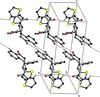
In the crystal, pairs of molecules are connected by C—H⋯O hydrogen interactions, generating R22(10) ring motifs. Pairs of molecules are further linked by C—H⋯O interactions, forming ribbons propagating along the a-axis direction. C—H⋯π interactions between these ribbons create layers parallel to the (001) plane. van der Waals interactions between the layers maintain the cohesion of the crystal structure.
CCDC reference: 2554568
Download citation
Download citation
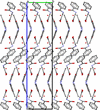
In the title salt, the crystal structure features N—H⋯O and O—H⋯O hydrogen-bonding interactions, which link the components into infinite chains and generate an extended supramolecular network.
CCDC reference: 2552915
Download citation
Download citation
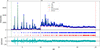
The crystal structure of levosimendan Form I has been solved and refined using synchrotron X-ray powder diffraction data, and optimized using density functional theory techniques.
Download citation
Download citation
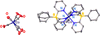
The reaction of hydrogen phenyltris(pyridin-2-yl)borate (TpyH), triethylamine, and Co(CO)4I gives a mixed-valent salt [Tpy2Co][Co(CO)4], consisting of a homoleptic cobalt(III) complex and a cobalt(–I) counter-ion. [Tpy2Co][Co(CO)4] represents the first mixed-valent tris(pyridin-2-yl)borate complex.
CCDC reference: 2547200
Download citation
Download citation
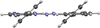
The title compound crystallizes in the monoclinic space group P21/c. The primary intermolecular interactions are π–π stacking with the molecules organized in one-dimensional π-stacks along the a-axis direction and two-dimensional ribbons parallel to the bc plane.
CCDC reference: 2544774
Download citation
Download citation
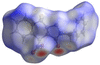
The asymmetric unit of the title compound consists of a benzyl moiety bonded to the nitrogen atom of a 1H-benzo[f]isoindole-4-carboxylic acid group. In the crystal, O—H⋯O and C—H⋯O hydrogen bonds link the molecules into infinite double-chains along the a-axis direction. π–π stacking interactions and C—H⋯π(ring) interactions help to consolidate the packing.
CCDC reference: 2486562
Download citation
Download citation
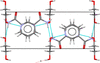
The asymmetric unit of the title solvate consists of one nicotinamide molecule and half of an ethylene glycol molecule, which is completed by crystallographic inversion symmetry. The dihedral angle between the acetamide group and the pyridine ring is 21.9 (8)°. In the crystal, the components are linked by N—H⋯O and O—H⋯N hydrogen bonds into (102) sheets and weak offset π–π stacking is also observed.
CCDC reference: 2477351
Download citation
Download citation
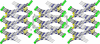
In the crystal of the title compound, N—H⋯N hydrogen bonds connect molecules together, forming ribbons connected along the c-axis direction. The actual packing between these ribbons is a result of Br—Br repulsion (steric and/or electrostatic) and they form a zipper-like pattern that obstructs each other's path.
CCDC reference: 2555626
Download citation
Download citation
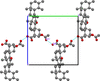
The title compound crystallizes in the orthorhombic space group P21212 and exhibits a rigid pentacyclic framework with eleven stereogenic centres. The cyclohexane rings adopt near-ideal chair conformations with minimal steric strain. The crystal packing is governed by O—H⋯O hydrogen bonds, forming zigzag chains along the [100] direction and extending into a three-dimensional network and is further consolidated by van der Waals interactions.
CCDC reference: 2555762
Download citation
Download citation
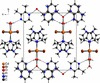
In the crystal structure of CdBr2(2,3-dimethylpyrazine)(H2O)-2,3-dimethylpyrazine-solvate hemihydrate, the cadmium cations are linked by pairs of μ-1,1 bridging bromide anions into chains that are linked by intermolecular hydrogen bonding to the water and the 2,3-dimethylpyrazine solvate molecules.
CCDC reference: 2555772
Download citation
Download citation
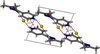
A novel covalently modified isoniazid salt {4-[N′-(propan-2-ylidene)hydrazinecarbonyl]pyridin-1-ium chloride}, C9H12N3O+·Cl−, was synthesized using a slow diffusion layering technique under ambient conditions. The crystal structure features prominent N—H⋯Cl hydrogen bonds, indicating strong intermolecular interactions between the chloride ion and the modified isoniazid framework.
CCDC reference: 2488835
Download citation
Download citation
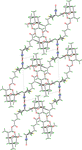
In the title biotin-conjugated dihydroartemisinin (DHA) derivative, the molecule retains the essential endoperoxide bridge and links the C-10 position of DHA to the pentanoate chain of biotin via an ester bond. This structure determination provides a valuable blueprint for the rational design of hybrid antimalarial and anticancer therapies based on DHA–biotin conjugates.
CCDC reference: 2553196
Download citation
Download citation
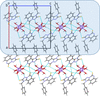
The crystal structure of the title compound shows a layered arrangement stacked along [100] where layers of 1∞[Na(H2O)1/1(H2O)4/2] chains are sandwiched by layers of molecular anions.
CCDC reference: 2110028