menu
menu


issue contents
August 2026 issue
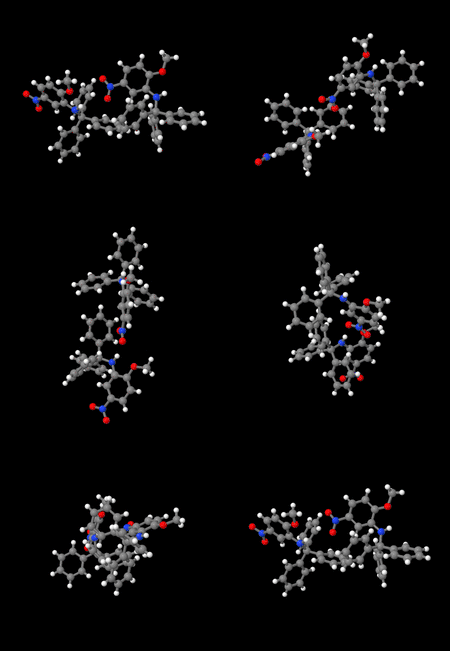
Cover illustration: Crystal structures tell us far more than the connectivity of the atoms. Filley & Crace [Acta Cryst. (2026). E82, 903–908] demonstrate that subtle differences in the packing in two N-alkyl derivatives of 2-methoxy-5-nitroaniline lead to a dramatic colour change in the crystals, which can be interpreted in terms of steric effects and different dipole stacking motifs.
early career research


Download citation


Download citation
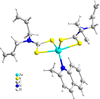
The crystal structure of the title compound, the heteroleptic complex [Zn(C7H10NS2)2(C10H9N)] reveals supramolecular dimers established by π–π interactions between adjacent quinaldine units with a centroid–centroid distance of 3.672 (2) Å. The compound crystallizes in the triclinic crystal system, space group P1, with the ZnII atom exhibiting a trigonal–bipyramidal geometry.
CCDC reference: 2556564
research communications
Download citation
Download citation
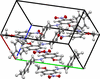
A striking color change from orange to yellow is observed in crystals of two N-alkyl derivatives of 2-methoxy-5-nitroaniline. The orange compound has a sterically unencumbered 4-methylbenzyl group and the yellow compound the more sterically demanding triphenylmethyl group. The crystal structures are used to rationalize a charge-transfer color center in the former compound, which is less favorable in the latter.
Download citation
Download citation
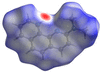
In the title salt, the cation is almost planar, implying significant conjugation of the lone pair of the secondary amino group N atom with the aromatic ring system. In the extended structure, N—H⋯O and C—H⋯O hydrogen bonds link the components into infinite chains of alternating cations and anions propagating along the b-axis direction.
CCDC reference: 2566614
Download citation
Download citation
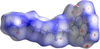
In the title compound, almost planar isatin and triazole rings are inclined by 78.47 (5)°. The molecules link into infinite chains along the b-axis direction through intermolecular bifurcated C—H⋯O hydrogen bonds. π–π and C—H⋯π(ring) interactions also help to consolidate the crystal packing.
CCDC reference: 2570724
Download citation
Download citation
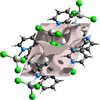
In the title salt, (C5H6N)[ZnCl3(C5H5N)], pyridine acts as a protonated counter-ion and a ligand in the complex anion.
CCDC reference: 2571358
Download citation
Download citation
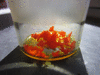
The crystal structure of the tetrakis(pentafluorophenoxy)bis(tetrahydrofuran)titanium(IV) complex is described, in which the titanium(IV) ion adopts a distorted octahedral coordination geometry. The coordinated tetrahydrofuran ligands adopt a cis configuration.
CCDC reference: 2570948
Download citation
Download citation
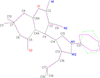
The two independent molecules of the title chromenecarbonitrile are related by approximate translation but differ in the orientation of the phenyl substituent. They are connected by classical N—H⋯Npyrazole hydrogen bonds to form a ribbon. The ribbons are joined by ‘weak' Cpyrazole—H⋯Nnitrile hydrogen bonds to form a layer structure.
CCDC reference: 2570429
Download citation
Download citation
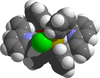
Single crystals of [Ph2Sn(OH)Cl·2Vipy]2 obtained as side product during the reaction of diphenyltin(IV) dichloride with 2-vinylpyridine, 2Vipy, have been structurally characterized by X-ray diffraction with respect to the influence of the adduct's non-centrosymmetry on bond lengths and angles.
CCDC reference: 2572540
Download citation
Download citation
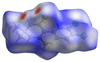
The title compound consists of dichlorophenyl and dihydropyrimidinethione rings, where the pyrimidine ring is in flattened-boat conformation. In the crystal, N—H⋯S hydrogen bonds link the molecules, enclosing R22(8) ring motifs, into centrosymmetric dimers.
CCDC reference: 1816810
Download citation
Download citation
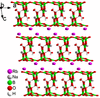
In the title compound, the pentaborate [B5O10(OH)]6− building units are interconnected to form a two-dimensional layered structure, adjacent single layers are further linked into double layers via O—H⋯O hydrogen bonds.
CCDC reference: 2543102
Download citation
Download citation
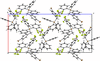
The crystal structures of three (4-bromobenzyl)triphenylphosphonium salts with perchlorate, tetrafluoroborate and triiodide anions are reported and compared using Hirshfeld surface analysis.
Download citation
Download citation
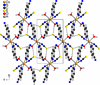
In the crystal structure of the title compound, the cobalt cations are octahedrally coordinated by two terminal N-bonding thiocyanate anions, two 4-cyanopyridine ligands and two water molecules into discrete complexes that are linked by intermolecular O—H⋯S hydrogen bonding into layers that condense into a three-dimensional hydrogen bonded network by weak intermolecular C—H⋯N interactions.
CCDC reference: 2574033
Download citation
Download citation
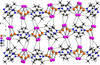
In the crystal structure of the title compound, two different CuI substructures are observed, which condense into layers by way of bridging 2,6-dimethylpyrazine ligands.
CCDC reference: 2574159
Download citation
Download citation
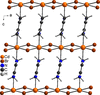
In the crystal structure of the title compound, the cadmium cations are linked by pairs of μ-1,1 bridging bromide anions into chains that are further connected into layers by the bridging 2,3-dimethylpyrazine coligands.
CCDC reference: 2574160
Download citation
Download citation
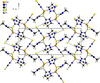
The title compound is a new isomer of Co(NCS)2(C3H6N2S)2. The cobalt cations are tetrahedrally coordinated by two N-bonding thiocyanate anions and two ethylenethiourea ligands into discrete complexes. Solvent-mediated conversion experiments prove that the new isomer is thermodynamically stable at room temperature, whereas the known triclinic isomer with an octahedral cobalt coordination and a chain structure is metastable.
CCDC reference: 2574161
Download citation
Download citation
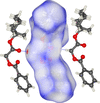
The packing in the crystal structure of the title compound is mainly consolidated by a weak C—H⋯O contact linking molecules into chains parallel to [100] and van der Waals interactions.
CCDC reference: 2535282
Download citation
Download citation
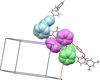
In the title compound, the dihedral angles between the central and peripheral aromatic rings are 83.47 (2) and 66.00 (2)° and the packing is consolidated by C—H⋯π interactions.
CCDC reference: 2574792
Download citation
Download citation
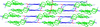
Three new molecular salts of norfloxacin with N-heterocyclic carboxylates exhibit distinct hydrogen-bonding patterns and π-stacking arrangements, giving rise to different supramolecular architectures.
Download citation
Download citation
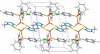
The title bimetallic complexes are isostructural and feature centrosymmetric rhombic Cu2S2 cores.
education and outreach

Introducing crystallography at the kindergarten level is discussed through a center-based activity framework and the development of a children's book for crystallography.