menu
menu


issue contents
October 2026 issue
Early view articles

early career research


Download citation


Download citation
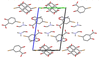
The asymmetric unit of the title compound comprises two molecules of 5-bromosalicylic acid and two molecules of N,N-dimethylformamide (DMF). The crystal structure is dominated by strong O—H⋯O hydrogen bonds between the carboxylic acid groups of the 5-bromosalicylic acid molecules and the carbonyl oxygen atoms of the DMF molecules, with the solvent acting as a hydrogen-bond acceptor. This interaction prevents the formation of the common carboxylic acid dimer observed in many benzoic acid derivatives.
CCDC reference: 2579645
research communications
Download citation
Download citation
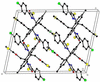
The asymmetric unit of the title molecule contains a planar oxadiazole, a thiophene and two phenyl rings. In the crystal, π–π stacking interactions and C—H⋯π(ring) interactions help to consolidate the packing.
CCDC reference: 2583252
Download citation
Download citation
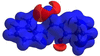
The asymmetric unit of the title compound comprises an ordered molecule, consisting of methylphenyl and pivaloyl moieties attached to the N atoms of the central thiourea entity.
CCDC reference: 1816816
Download citation
Download citation
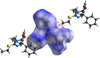
In the title molecule, the imidazolone ring is essentially planar and the inclinations of the planes of the two attached phenyl groups to its plane are distinctly different. There is a degree of π-delocalization in the ring about the tertiary nitrogen which involves its lone pair. Directed intermolecular interactions comprise C—H⋯O hydrogen bonds and two sets of C—H⋯π(ring) interactions. A Hirshfeld surface analysis was performed.
CCDC reference: 2583088
Download citation
Download citation
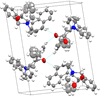
In the title compound, C24H24O2Si, the ethyl ester substituent shows two-site disorder and C—H⋯O contacts generate zigzag ribbons extending along [010].
CCDC reference: 2575735
Download citation
Download citation
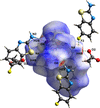
The title tetrahedral ZnII complex with 2-amino-6-fluoro-1,3-benzothiazole has been structurally characterized. The crystal packing is consolidated by N—H⋯O, bifurcated N—H⋯(O,F), C—H⋯π, O⋯π and offset π–π interactions.
CCDC reference: 2584886
Download citation
Download citation
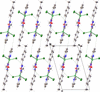
The ligand in the title complex was obtained by a condensation reaction between p-tolyl hydrazide and 2-acetylpyridine. The ligand molecule bonds to the metal ion in a tridentate manner via its imino nitrogen atom, its carbonyl oxygen atom, and the nitrogen atom of the pyridine ring. In the extended structure, pairwise N—H⋯Cl hydrogen bonds generate inversion dimers and very weak C—H⋯Cl interactions link the dimers into sheets.
CCDC reference: 2580323
Download citation
Download citation
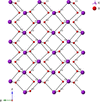
The crystal structure of the title salt is made up from a potassium cation and a disordered 2-ethoxy-2-oxoacetate anion. The packing interactions are through electrostatic interactions between the potassium ions and the oxygen atoms.
CCDC reference: 2584812
Download citation
Download citation
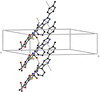
In the crystal, molecules are connected by intermolecular N—H⋯O interactions and π–π interactions [centroid–to-centroid distance = 3.8200 (12) Å], forming ribbons along the b-axis direction.
CCDC reference: 2584107
Download citation
Download citation
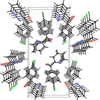
The title compound is a pharmaceutical impurity and possible intermediate in the synthesis of carbinoxamine. The aromatic rings of the molecule twist relative to one another resulting in an interplanar angle of 38.1 (1)°. In the extended structure, the molecules are packed into rippled sheets with offset face-to-face stacking of each aromatic ring with the equivalent ring in the neighboring molecule.
CCDC reference: 2584887
Download citation
Download citation
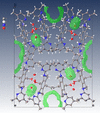
In the asymmetric unit, two molecules of the 1,3,5-substituted 2,4,6-trialkylbenzene and three water molecules are connected by hydrogen bonds, forming well-defined complexes that constitute the smallest supramolecular entities.
CCDC reference: 2583267
Download citation
Download citation
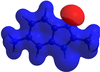
The molecule exhibits whole-molecule disorder in a 0.849 (4)/0.151 (4) ratio. The bicyclic portion is planar. In the crystal, a layer structure is generated by N—H⋯N hydrogen bonds and C—H⋯π(ring) interactions.
CCDC reference: 2584534
Download citation
Download citation
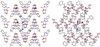
The crystal structure of the title compound demonstrates a tetracyclic organic compound with defined stereochemistry. In the solid state, the compound organizes in a racemic chiral fashion with alternating N-benzyl units.
CCDC reference: 2585299
Download citation
Download citation
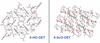
The solid-state structures of two synthetic psychoactive compounds that have recently appeared in products on the ‘magic mushroom' retail market are presented.
Download citation
Download citation
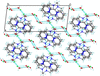
The title compound crystallizes as a two-component twin in space group P21/n with Z′ = 1, exhibiting hydrogen-bonding corrugated layers of chloride ions and water molecules that run approximately along the diagonal plane of the cell between columns of the stacked dications.
CCDC reference: 2585211
Download citation
Download citation
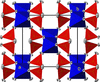
Zn(AsO3)2 is isotypic with the low-temperature modification of Zn(PO3)2 and consists of AsO4 tetrahedra condensed into polyarsenate chains with a periodicity of two tetrahedra.
CCDC reference: 2585628
Download citation
Download citation
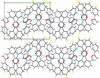
The title compound crystallizes in the monoclinic space group P21/c with one molecule in the asymmetric unit. The two chemically equivalent substituents adopt different orientations relative to the central benzene ring. In the crystal, inversion-related molecules form dimers through π–π stacking between oxazole rings and C—H⋯N hydrogen bonds. The dimers are further connected by C—H⋯N interactions into layers parallel to (100).
CCDC reference: 2586503
Download citation
Download citation
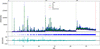
The crystal structure of metaraminol hydrogen tartrate has been solved and refined using synchrotron X-ray powder diffraction data and optimized using density functional theory techniques.
Download citation
Download citation
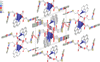
The crystal structure of a zinc(II) complex containing 3-(2-sulfanylidene-2,3-dihydro-1,3-benzoxazol-3-yl)propanoate and 1,10-phenanthroline ligands is described, together with its supramolecular features and Hirshfeld surface analysis.
CCDC reference: 2588848
Download citation
Download citation
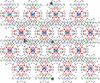
The title compounds were formed from the reaction of the metallo-ligand [FeII(L)]·(H2O) (H2L is 2-{[2-(2-hydroxy-3-methoxybenzylideneamino)phenylimino]methyl}-6-methoxyphenol, C22H20N2O4) with yttrium acetate and potassium nitrate.
education and outreach
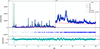
Although solving and refining a crystal structure using synchrotron powder diffraction data can be routine, many problems present features which make the process more difficult. These include difficulty in indexing, incorrect or approximate symmetry, and chemically-unreasonable models (poor conformations, incorrect compounds). Examples of each of these `interesting' features are provided, as well as the methods used for recognizing and overcoming them.