issue contents

Journal logoCRYSTALLOGRAPHIC
COMMUNICATIONS
ISSN: 2056-9890

October 2026 issue

Highlighted illustration

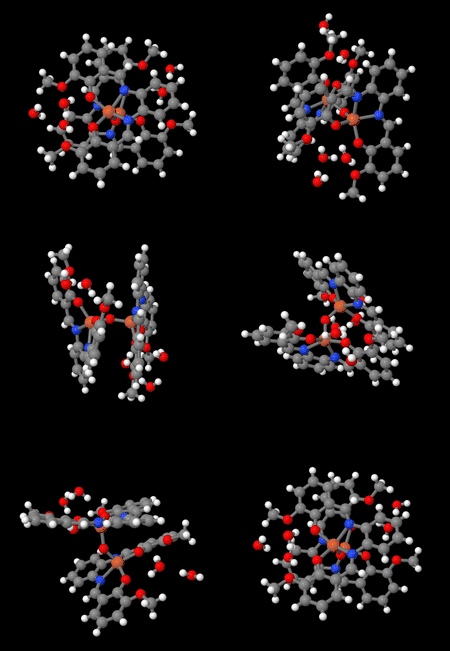
Cover illustration: Polynuclear transition-metal complexes are of interest in areas including molecular magnetism, catalysis and luminescence, while the incorporation of diamagnetic alkali-metal ions can provide insight into magnetostructural relationships. Using a compartmental Schiff-base ligand, this study reports two contrasting iron(III) assemblies: an oxido-bridged FeIII–FeIII bimetallic complex and an FeIII–K–FeIII trimetallic complex. Their structures illustrate how occupation of the ligand's outer oxygen-donor compartment by potassium changes the nuclearity and organization of the metal assembly, providing a structural basis for the further design of heterometallic d/s-block complexes. See: Thiam, Diouf, Orton, Ndoye, Gueye, Diouf, Thiam, Gaye & Coles [Acta Cryst. (2026). E82, 1195–1200].

early career research


link to html
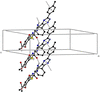
The asymmetric unit of the title compound comprises two mol­ecules of 5-bromo­salicylic acid and two mol­ecules of N,N-di­methyl­formamide (DMF). The crystal structure is dominated by strong O—H⋯O hydrogen bonds between the carb­oxy­lic acid groups of the 5-bromo­salicylic acid molecules and the carbonyl oxygen atoms of the DMF mol­ecules, with the solvent acting as a hydrogen-bond acceptor. This inter­action prevents the formation of the common carb­oxy­lic acid dimer observed in many benzoic acid derivatives.

research communications

link to html
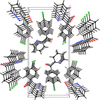
The asymmetric unit of the title mol­ecule contains a planar oxa­diazole, a thio­phene and two phenyl rings. In the crystal, π–π stacking inter­actions and C—H⋯π(ring) inter­actions help to consolidate the packing.

link to html
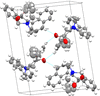
The asymmetric unit of the title compound comprises an ordered mol­ecule, consisting of methyl­phenyl and pivaloyl moieties attached to the N atoms of the central thio­urea entity.

link to html
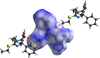
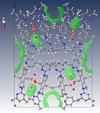
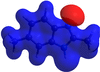
In the title mol­ecule, the imidazolone ring is essentially planar and the inclinations of the planes of the two attached phenyl groups to its plane are distinctly different. There is a degree of π-delocalization in the ring about the tertiary nitro­gen which involves its lone pair. Directed inter­molecular inter­actions comprise C—H⋯O hydrogen bonds and two sets of C—H⋯π(ring) inter­actions. A Hirshfeld surface analysis was performed.

link to html
In the title compound, C24H24O2Si, the ethyl ester substituent shows two-site disorder and C—H⋯O contacts generate zigzag ribbons extending along [010].

link to html
The title tetra­hedral ZnII complex with 2-amino-6-fluoro-1,3-benzo­thia­zole has been structurally characterized. The crystal packing is consolidated by N—H⋯O, bifurcated N—H⋯(O,F), C—H⋯π, O⋯π and offset π–π inter­actions.

link to html
The ligand in the title complex was obtained by a condensation reaction between p-tolyl hydrazide and 2-acetyl­pyridine. The ligand mol­ecule bonds to the metal ion in a tridentate manner via its imino nitro­gen atom, its carbonyl oxygen atom, and the nitro­gen atom of the pyridine ring. In the extended structure, pairwise N—H⋯Cl hydrogen bonds generate inversion dimers and very weak C—H⋯Cl inter­actions link the dimers into sheets.

link to html
The crystal structure of the title salt is made up from a potassium cation and a disordered 2-eth­oxy-2-oxo­acetate anion. The packing inter­actions are through electrostatic inter­actions between the potassium ions and the oxygen atoms.

link to html
In the crystal, mol­ecules are connected by inter­molecular N—H⋯O inter­actions and π–π inter­actions [centroid–to-centroid distance = 3.8200 (12) Å], forming ribbons along the b-axis direction.

link to html
The title compound is a pharmaceutical impurity and possible inter­mediate in the synthesis of carbinoxamine. The aromatic rings of the mol­ecule twist relative to one another resulting in an inter­planar angle of 38.1 (1)°. In the extended structure, the mol­ecules are packed into rippled sheets with offset face-to-face stacking of each aromatic ring with the equivalent ring in the neighboring mol­ecule.

link to html
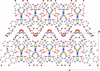
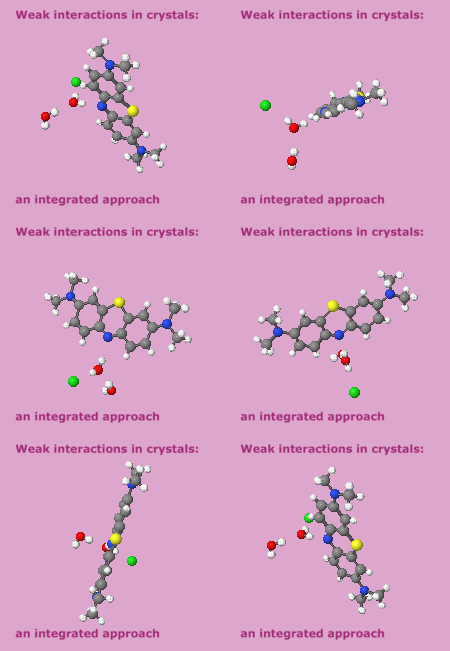
In the asymmetric unit, two mol­ecules of the 1,3,5-substituted 2,4,6-tri­alkyl­benzene and three water mol­ecules are connected by hydrogen bonds, forming well-defined complexes that constitute the smallest supra­molecular entities.

link to html
The mol­ecule exhibits whole-mol­ecule disorder in a 0.849 (4)/0.151 (4) ratio. The bicyclic portion is planar. In the crystal, a layer structure is generated by N—H⋯N hydrogen bonds and C—H⋯π(ring) inter­actions.

link to html
The crystal structure of the title compound demonstrates a tetra­cyclic organic compound with defined stereochemistry. In the solid state, the compound organizes in a racemic chiral fashion with alternating N-benzyl units.

link to html
The solid-state structures of two synthetic psychoactive compounds that have recently appeared in products on the ‘magic mushroom' retail market are presented.

link to html
The title compound crystallizes as a two-component twin in space group P21/n with Z′ = 1, exhibiting hydrogen-bonding corrugated layers of chloride ions and water mol­ecules that run approximately along the diagonal plane of the cell between columns of the stacked dications.

link to html
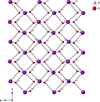
Zn(AsO3)2 is isotypic with the low-temperature modification of Zn(PO3)2 and consists of AsO4 tetra­hedra condensed into polyarsenate chains with a periodicity of two tetra­hedra.

link to html
The title compound crystallizes in the monoclinic space group P21/c with one mol­ecule in the asymmetric unit. The two chemically equivalent substituents adopt different orientations relative to the central benzene ring. In the crystal, inversion-related mol­ecules form dimers through π–π stacking between oxazole rings and C—H⋯N hydrogen bonds. The dimers are further connected by C—H⋯N inter­actions into layers parallel to (100).

link to html
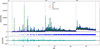
The crystal structure of metaraminol hydrogen tartrate has been solved and refined using synchrotron X-ray powder diffraction data and optimized using density functional theory techniques.

link to html
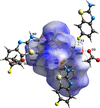
The crystal structure of a zinc(II) complex containing 3-(2-sulfanylidene-2,3-di­hydro-1,3-benzoxazol-3-yl)propano­ate and 1,10-phenanthroline ligands is described, together with its supra­molecular features and Hirshfeld surface analysis.

link to html
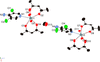
The title compounds were formed from the reaction of the metallo-ligand [FeII(L)]·(H2O) (H2L is 2-{[2-(2-hy­droxy-3-meth­oxy­benzyl­idene­amino)­phenyl­imino]­meth­yl}-6-meth­oxy­phenol, C22H20N2O4) with yttrium acetate and potassium nitrate.

link to html
In the title compound, the dihedral angle between the aromatic rings is 77.78 (8)°. In the crystal, the mol­ecules are linked into zigzag ribbons propagating along the [210] direction by pairwise O—H⋯O hydrogen bonds through their two carb­oxy­lic acid groups to generate centrosymmetric R22(8) dimers in each case. In addition, mol­ecules are connected via pairwise N—H⋯π inter­actions between the NH groups and the fluoro­benzene rings.

link to html
In the crystal structure of the title compound, the cobalt cations are octa­hedrally coordinated by two N- and two S-bonding thio­cyanate anions and two pyri­dine-4-car­bo­ni­trile ligands and are linked by pairs of μ-1,3-bridging anionic ligands into infinite linear chains. No directional inter­molecular inter­actions are observed between the chains.

link to html
The asymmetric unit of the title uranyl complex, [U(C5H7O2)2O2(C5H4Cl2N2)]·0.5CH3OH or [UO2(acac)2(4-amino-3,5-di­chloro­pyridine)]·0.5CH3OH, contains two crystallographically independent uran­yl(VI) complex mol­ecules and one methanol solvent mol­ecule. Each UVI atom adopts a UNO6 penta­gonal–bipyramidal coordination geometry, in which two uranyl O atoms occupy the axial positions, whereas four O atoms from two chelating bidentate acac ligands and one N atom from a 4-amino-3,5-di­chloro­pyridine ligand define the equatorial plane. In the crystal, the methanol solvent mol­ecule is linked to the amino group in the coordinated ligand by an inter­molecular N—H⋯O hydrogen bond, which is likely to contribute to the low-symmetry crystal arrangement.

link to html
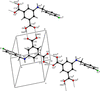
The asymmetric unit contains two mononuclear units of the complex, each consisting of one deprotonated ligand, one thio­cyanate anion (SCN−) coordinated through its nitro­gen atom, one free water mol­ecule, and one free 5-bromo­salicyl­aldehyde mol­ecule, forming a co-crystal. The copper atom is four-coordinate, adopting a slightly distorted square-planar geometry defined by the tridentate ligand and the nitro­gen atom of the thio­cyanate anion. The water mol­ecule plays a key role in linking the two complex units through O–H⋯O hydrogen bonds. In the crystal, C—H⋯O and C—H⋯Br hydrogen bonds allow the free 5-bromo­salicyl­aldehyde mol­ecule to form a bridge between two adjacent layers.

link to html
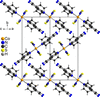
The synthesis and structure of a homoleptic silver(I) complex with four perfluoro­benzo­nitrile ligands bound in a distorted tetra­hedral arrangement combined with perfluoro­aluminate counter-ion are described.

link to html
A (meth­oxy­meth­yl)-substituted 1,2,4,5-tetra­zine was treated with BBr3 to obtain both the (hy­droxy­meth­yl)- and (bromo­meth­yl)-substituted 1,2,4,5-tetra­zines; all three compounds were characterized by single-crystal X-ray diffraction measurements, which revealed the formation of inter­molecular π–π stacks for all tetra­zines, as well as hydrogen-bonded dimers of the tetra­zine alcohol.

link to html
The title mol­ecule is present in its 3-imino-3H-isoindol-1-amine tautomeric form. In the crystal, inter­molecular N—H⋯N hydrogen bonds lead to the formation of infinite chains propagating parallel to [001].

link to html
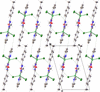
In the crystal structure of the title compound, the cadmium cations are linked by μ-1,1 bridging chloride anions into chains that are additionally connected by O—H⋯N hydrogen bonding via the water mol­ecules of crystallization into layers.

education and outreach

link to html
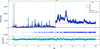
Although solving and refining a crystal structure using synchrotron powder diffraction data can be routine, many problems present features which make the process more difficult. These include difficulty in indexing, incorrect or approximate symmetry, and chemically-unreasonable models (poor conformations, incorrect compounds). Examples of each of these `inter­esting' features are provided, as well as the methods used for recognizing and overcoming them.