

 menu
menu


issue contents
November 2026 issue
Early view articles
early career research


Download citation


Download citation
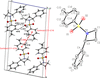
In the crystal structure of 2-phenyl-N-tosylazetidine, there are three close contacts stabilizing the supramolecular structure.
CCDC reference: 2593072
research communications
Download citation
Download citation
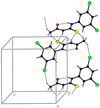
In the crystal, C—H⋯Cl and double-acceptor N—H⋯S and C—H⋯S hydrogen bonds link the molecules into infinite chains parallel to the the b axis.
CCDC reference: 1816809
Download citation
Download citation
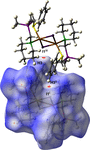
The dinuclear S,N-chelate title complexes feature a halide-bridged rhomboid-shaped Cu(μ2-X)Cu (X = I, Br) core with Cu⋯Cu contacts of 2.8249 (5) and 2.7631 (6) Å, respectively. The two isostructural complexes crystallize in the triclinic space group P1 with half molecule in the asymmetric unit.
Download citation
Download citation
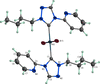
The synthesis and crystal structure of dibromidobis[1-butyl-4-(pyridin-2-yl)-1,2,4-triazol-5-ylidene]palladium(II) are presented
CCDC reference: 2590397
Download citation
Download citation
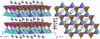
In the title compound, all the cations occupy tetrahedral sites, with the exception of rubidium, whose coordination number is twelve. The three types of tetrahedra are linked at their vertices to form double layers stacked along the c-axis direction. The planes occupied by the rubidium ions are sandwiched between these layers.
CCDC reference: 2576725
Download citation
Download citation
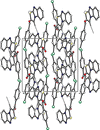
The title compound crystallizes in the monoclinic space group P21/c with two conformationally similar molecules (Z′ = 2) in the asymmetric unit. The fused thiazolo[3,2-a]benzimidazole framework is essentially planar, while the 4-chlorobenzoyl ring is inclined by ∼53° to the thiazole ring in both molecules. The crystal packing is consolidated by C—H⋯N hydrogen bonds, C—H⋯π contacts, and π–π stacking interactions, forming a three-dimensional supramolecular framework.
CCDC reference: 2591449
Download citation
Download citation
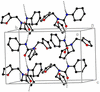
The asymmetric unit of the title compound contains two molecules, A and B, with one furan ring in each molecule showing ‘flip' rotational disorder. In the crystal, N—H⋯O hydrogen bonds link the molecules into separate infinite ⋯A⋯A⋯A⋯ and ⋯B⋯B⋯B⋯ chains propagating along the c-axis direction.
CCDC reference: 2591499
Download citation
Download citation
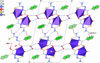
The title ZnII compound is a mono-periodic coordination polymer in which the doubly deprotonated phenylglyoxylic acid thiosemicarbazone ligand chelates one ZnII ion through O, N and S donors and bridges to the next through its second carboxylate O atom.
CCDC reference: 2591804
Download citation
Download citation
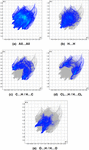
In the crystal of the title compound, molecules are linked by intermolecular C—H⋯O hydrogen bonds, forming a square-ring around a fourfold rotation axis parallel to the c-axis. In addition, C—H⋯π and π-π- interactions connect molecules, forming a three-dimensional network.
CCDC reference: 2591583
Download citation
Download citation
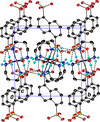
Two new layered structures of trans-diaquabis(propane-1,3-diamine)nickel(II) complexes with isomeric naphthalenedisulfonate counter-ions are presented.
Download citation
Download citation
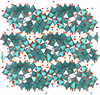
The single-crystal X-ray structure of (NH4)12[Mo36O112(OH)4(H2O)10]·26H2O reveals a new ammonium Mo36 isopolymolybdate polymorph containing a 12− charged cluster whose formulation is supported by Mo—OH—Mo bond-distance analysis.
CCDC reference: 2593690
Download citation
Download citation
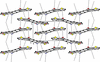
In the title crystal, molecular pairs are connected by C—H⋯N contacts, producing R22(16) motifs parallel to the (001) plane. Molecules are linked by C—O⋯π and π–π interactions, forming layers parallel to the (100) plane. These layers are connected by C—H⋯N interactions.
CCDC reference: 2594032