

 menu
menu


issue contents
October 2026 issue
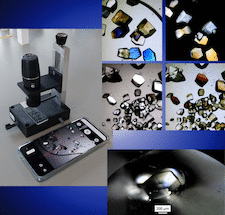
Cover illustration: Kennedy et al. [J. Appl. Cryst. (2026), 59, 1693–1706] describe a low-cost portable digital microscope device that can be used to monitor the growth of biological macromolecular crystals in crystallization plates. It is based on a commercially available digital microscope, and many of the parts can be 3D printed using the STL files included with the article. The device can be used with a cell phone or a personal computer for real-time imaging by professional and amateur scientists alike.
research papers



EQSANS-CLI is a command-line tool for small-angle neutron scattering data reduction. It exposes the full reduction pipeline through two input surfaces, an interactive terminal that accepts both slash commands and natural language, and a headless JSON mode designed for external AI agents, both built on a shared command-handler layer.

Open  access
access
We present an improved numerical angle-dependent absorption correction procedure for line-collimated small- and wide-angle X-ray scattering measurements in thin-walled quartz capillaries. The procedure accounts for the constrained illuminated volume, measured primary beam profiles and capillary-wall absorption, enabling physically consistent data reduction and reliable absolute scaling when conventional experimental scalar transmission corrections become unreliable.
Findings are presented on the impact of particle size and solidification history on defect formation in Al2024 alloy additive manufacturing powder. The results of this investigation suggest a trend of decreasing dislocation density in as-atomized samples as the particle size increases, with larger particles cooling more slowly.
We derive a generalized Parratt method applicable to anisotropic systems, which is devoid of the numerical instabilities arising in the method of characteristic matrices. We derive formulae for both reflectivity and transmissivity.
Open access
access
Modifications of the fundamental equation of X-ray stress analysis are proposed that allow correction of the hoop and longitudinal stresses obtained from sin2ψ measurements on samples featuring an inhomogeneous surface topography. The formalism is verified by angle- and energy-dispersive measurements performed on a ferritic steel sample with cylindrically shaped regions with different central angles.
Open access
access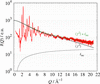
We performed grazing-incidence total X-ray scattering on an indium tin oxide thin film using a convergent incident beam. This approach enables the acquisition of total scattering profiles up to Q = 21 Å−1, demonstrating the feasibility of laboratory instruments for thin film pair distribution function analysis.
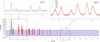
An analytical absorption correction for powder X-ray diffraction of flat plate samples in transmission geometry is presented. Independent determination of the optical thickness enables reliable refinement of atomic displacement parameters.
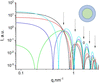
A general solution of the problem of observing isoscattering points in the form factors of quasi-spherical particles under contrast variation in a small-angle scattering experiment is presented. It uses the approach of basic functions extended to the practical area by considering experimental isopoints as caustic-type nodes.
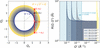
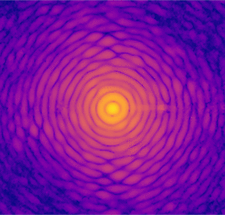
A practical and resolution-consistent data-reduction framework is established for ultra-small-angle neutron scattering, guiding users in correcting slit-geometry smearing and multiple scattering to obtain reliable intrinsic scattering profiles across combined ultra-small-angle and small-angle neutron scattering measurements.
Open access
access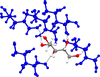
A new efficient embedding mechanism for molecule-in-a-crystal electron-density calculations during Hirshfeld atom refinement is made available in NoSpherA2 and benchmarked.
Open access
access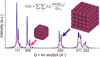
AES-Debye is an accurate, efficient and scalable engine for evaluating the Debye scattering equation that enables total scattering calculations for large atomistic models. Corrected pair-distance binning and numerically robust accumulation suppress discretization artifacts, while parallel CPU/GPU execution enables efficient computation of scattering intensities and pair distribution functions for structural analysis.

Download citation


Download citation
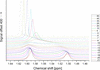
Variable-temperature NMR reveals a surprisingly high rotational barrier of ∼20 kcal mol−1 (∼83.7 kJ mol−1) for (1,4-diacetoxy-3-methylnaphth-2-yl)diphenylphosphine oxide, stabilizing distinct conformers. This fourfold increase over theoretical predictions highlights the critical role of solvent-induced stabilization in maintaining conformational integrity in sterically congested systems.
CCDC reference: 2503908
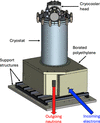
This article presents the design, installation and first experimental testing of a novel prototype target–moderator–reflector assembly for a compact accelerator-driven neutron source driven by a 35 MeV electron beam.
Open access
access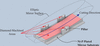
Multi-incident-angle neutron reflectometry is realized using elliptical metallic supermirrors for dual-beam focusing. This approach presents new opportunities for efficient interface analysis.
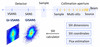
A grazing-incidence platform has been commissioned at the very small angle neutron scattering instrument of the China Spallation Neutron Source, with accessible length scales covering three orders of magnitude. The functions of this platform are validated by its ability to distinguish the in-plane assembly patterns of colloidal thin films fabricated by different coating techniques and composed of structures with sizes ranging from 100 nm to several micrometres.
NEUTRON | SYNCHROTRON
Open access
access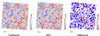
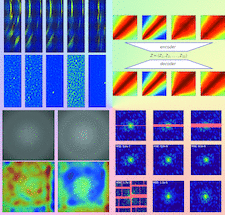
A self-supervised deep learning model, Noise2Void (N2V), denoises near-field high-energy diffraction microscopy diffraction images without requiring unobtainable clean data. These images allow for lower segmentation thresholds and detection of smaller and weaker diffraction peaks, which are often discarded or overlooked with conventional image processing methods. The result is a ∼9% increase in reconstruction confidence and a more accurate representation of fine microstructural features.
Open access
access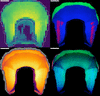
A highly efficient algorithm for raster scanning an area of non-rectangular shapes is presented. This method can significantly reduce the required scanning time for e.g. microbeam X-ray diffraction and X-ray fluorescence scanning microscopy.
Open access
access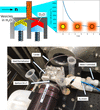
Time-resolved small-angle neutron scattering with rapid contrast variation enables direct non-invasive measurement of water permeation kinetics and membrane structure under iso-osmotic conditions for lipid membranes.
Download citation
Download citation
Open access
access
An open-source program for the calculation and visualization of polarization-derived properties of crystalline material is described, alongside the integration of a polarizing image sensor into a home-built high-throughput imaging setup.
Open access
access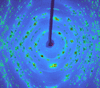
Using a newly developed 2D X-ray diffraction orientation simulation approach to isolate overlapping martensitic reflections, this study demonstrates that niobium controls continuous lattice symmetry evolution, whereas interstitial oxygen induces localized strain fields that nonlinearly govern the structural competition between α″-martensite and the athermal ω phase.
Open access
access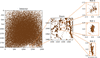
This work introduces a deterministic methodology for segmenting individual grain contributions from complex high-density Laue microdiffraction datasets by leveraging spatial correlations and clustering of peak appearance maps.
Open access
access
An experimental planning and data processing pipeline for spatially resolved neutron texture analysis has been implemented within the Mantid framework. The workflow processes time-of-flight neutron diffraction data to generate experimental pole figures, enabling non-destructive quantitative texture analysis of materials and components with complex texture distributions.
Download citation
Download citation
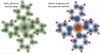
Experimental measurement of partial atomic charge using standard crystallographic data is accessible to a wide range of experimental practitioners of single-crystal X-ray diffraction without the need for high-angle data or specialized software.

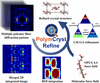
An automated workflow, PolymCrystRefine, has been developed for polymer crystal structure refinement from fiber diffraction data, combining joint force-field and intensity-gradient optimization, a region-of-interest-based data exploitation scheme, and a genetic algorithm guided by fiber-specific constraints.
Open access
access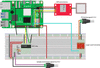
An inexpensive device based on a Raspberry Pi can give neutron scattering instruments the ability to carry out stroboscopic measurements in a relatively simple and flexible fashion. Stroboscopic measurements can be used to study fast kinetic processes in condensed matter systems.
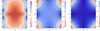
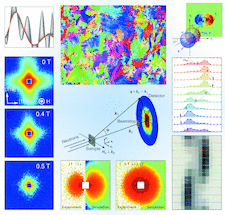
A micromagnetic framework of magnetic small-angle neutron scattering (SANS) is developed, which incorporates weak symmetric anisotropic exchange and predicts new angular harmonics in magnetic SANS cross sections of polycrystalline ferromagnets.
Open access
access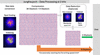
Jungfraujoch is a single-node FPGA–GPU server that enables 38 GB s−1 real-time crystallographic data acquisition using the PSI JUNGFRAU 9M detector at 2 kHz, with simultaneous on-the-fly processing, spot finding and indexing, and optional adaptive data reduction during continuous data streaming.
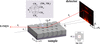
This work demonstrates that higher-order Bragg diffraction peaks in grazing-incidence small-angle X-ray scattering provide enhanced sensitivity to lateral structural parameters. Exploiting this information enables accurate three-dimensional reconstruction of hole patterns from limited-angle data, reducing acquisition time requirements for laboratory-scale X-ray metrology.
Download citation
Download citation
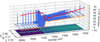
We describe a means to enable site-specific X-ray absorption spectra from Rietveld refinement of powder diffraction across an absorption edge using a variational approach to ensure Kramers–Kronig consistency.
teaching and education
Download citation
Download citation
Open access
access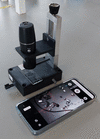
A low-cost, portable, medium-resolution polarizing digital light microscope device for monitoring crystal growth and for crystal harvesting is described. The device can be used with a cell phone or a personal computer for real-time imaging by professional and amateur scientists alike.
short communications
Open access
access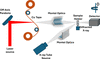
This communication highlights the feasibility of recording shot-noise-limited X-ray powder diffraction from organic crystals using a laser-driven X-ray source.
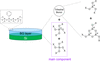
Sodium-free borosilicate glass thin films synthesized from diphenylborosiloxane exhibit enhanced hydrophobicity, offering a promising solution for durable surface modification of neutron experimental tools.
computer programs
Open access
access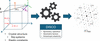
DISCO is a program capable of calculating the X-ray contrast factor for single- and polycrystalline materials in real time.
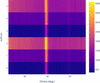
The Python residual stress (pyRS) software package has received substantial upgrades, including a backend reduction workflow and frontend graphical interface that enables the reduction and analysis of diffraction data for texture analysis, a new graphical interface for detector calibration, and a refined user interface allowing the exclusion of points from the residual stress analysis.
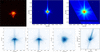
pyCXIM is a unified open-source software platform that integrates the complete Bragg coherent diffraction imaging workflow – from beamline alignment and real-time data assessment to GPU-accelerated phase retrieval and automated post-processing – within a single easy-to-install package, enhancing reproducibility and efficiency for synchrotron users.
Open access
access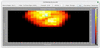
QuickProcess2 (QP2) unifies real-time image visualization, automated multi-pipeline data processing and experiment management into a single open-source platform for synchrotron macromolecular crystallography beamlines, enabling live quality assessment and concurrent data reduction for both standard rotation and serial crystallography experiments.
laboratory notes
Open access
access
We present a versatile state-of-the-art X-ray scattering laboratory within the ITACA.SB Research Infrastructure, enabling multi-scale structural characterization of complex biological specimens and advanced materials through integrated small- and wide-angle X-ray scattering (SAXS/WAXS) techniques. The platform supports simultaneous SAXS/WAXS acquisition, scanning microscopy, ultra-SAXS and size-exclusion chromatography SAXS measurements.
addenda and errata
Free
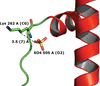
From August 2026, the online computing server Online_DPI [Kumar et al. (2015). J. Appl. Cryst. 48, 939–942] will be hosted by the International Union of Crystallography at https://dpi.iucr.org/.
Free
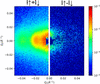
The name of one of the authors of the article by Grigoryeva et al. [J. Appl. Cryst. (2026), 59, 1129–1138] is corrected.