

 journal menu


issue contents
March 2026 issue
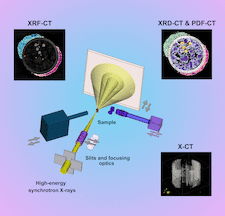
Cover illustration: High-energy multimodal X-ray computed tomography (CT) capabilities – including imaging (X-CT), fluorescence (XRF-CT), diffraction (XRD-CT), and scattering (PDF-CT) – enabled at the 28-ID-2 beamline of the National Synchrotron Light Source II (see Topsakal, O'Nolan, Drakopoulos, Bai, Dooryhee, Gill and Ghose, pages 531–542).
facility information


research papers


Open  access
access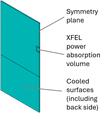
Thermal deformation in X-ray crystal optics in high-repetition-rate X-ray free-electron lasers can be effectively reduced by cryogenic cooling with liquid nitrogen, and possibly by second-order correction via focusing optics.
Open access
access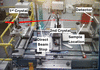
An application of bent Laue crystals as X-ray optics to increase beam intensity in bending-magnet beamlines at synchrotron facilities is presented.

Open access
access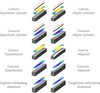
The closed-form expressions for elliptic cylinders, hyperbolic cylinders, ellipsoids, hyperboloids, and diaboloids used for X-ray mirror surface shapes are summarized. Additionally, a four-layer framework to fit the measured surface shape data in slope or height for convenient X-ray mirror surface characterization is proposed.
Open access
access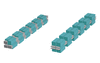
The degradation of circular polarization state in conventional APPLE-KNOT undulators has been noted. To overcome this limitation, we propose a novel APPLE-KNOT undulator design which utilizes the KNOT magnetic field as the dominant component.
Open access
access
X-ray waveguide optics enable spatial and coherence filtering of a nano-focused synchrotron beam and provide tailored illumination wavefronts for holographic imaging. Progress in fabrication, characterization and advanced waveguide interferometers can enhance holographic imaging.

Open access
access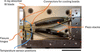
A fast thermally resilient X-ray shutter achieves 2 ms switching under heat loads above 20 W, enabling efficient photon use and minimizing radiation damage at fourth-generation synchrotron sources.
Open access
access
We describe a bending magnet endstation for X-ray fluorescence studies of metal distributions in millimetre-sized biological specimens. An existing setup using Kirkpatrick–Baez mirrors with 10.5 µm spatial resolution was supplemented with a second scanning setup with a capillary optic with 6.5 µm resolution.
Open access
access
A Jungfrau-1M integrating detector was characterized at Diamond Light Source and found to be effective for recording macromolecular crystallography diffraction patterns. Parameters for operation and data collection were explored and characterized. The Diamond facility will be upgraded and integrating detectors, such as Jungfrau, will be used more widely in the future.
Open access
access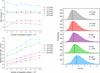
Advanced serial crystallography utilizing high-energy X-rays enhances diffraction efficiency, data quality and structural resolution under room-temperature conditions.
Open access
access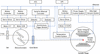
An Experimental Control System leveraging Bluesky and EPICS has been developed for the X-ray Magnetic Circular Dichroism endstation at Hefei Light Source-II. The design of a simulation debugging environment and the performance of three distinct scan modes have also been discussed.
Open access
access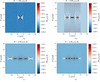
A theoretical framework for the propagation of partially coherent Gaussian radiation in a modified Mach–Zehnder interferometer designed for Fourier transform spectroscopy applications is presented.
Open access
access
Here, a compact two-electrode field-emission X-ray source employing a tungsten blade cathode was developed to deliver stable low-background output optimized for soft X-ray spectroscopy. The device's capability for high signal-to-noise element-specific analysis was demonstrated through successful TiO2 emission spectroscopy at the SXFEL facility, offering a practical laboratory-scale alternative to synchrotron sources.
Open access
access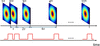
In this work, non-uniform interval-pulse X-ray photon correlation spectroscopy enabled the measurement of dynamics efficiently while reducing X-ray exposure by two orders of magnitude. This approach facilitates dense delay-time sampling and minimizes radiation damage, offering a powerful tool for studying sensitive systems.
Open access
access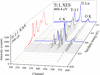
Fluorescence-line-selective soft X-ray spectroscopy using a superconducting tunnel junction (STJ) detector was applied to probe the electronic states of strontium titanate, demonstrating the capability of the STJ detector for high-energy-resolution soft X-ray absorption spectroscopy.
Open access
access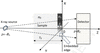
Geometrical magnification and X-ray energy are optimized with respect to spatial resolution, contrast, noise, radiation dose and other image quality characteristics. The optimization is performed using a simple theoretical model of a homogeneous edge feature embedded in a bulk uniform sample, and the resulting generic analytical expressions for image quality characteristics are evaluated for several sets of parameters relevant to synchrotron-based in-line X-ray imaging setups.
Open access
access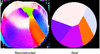
Linear dichroic X-ray tomography is a technique in which the linear dichroism of anisotropic materials is used to image crystal orientation in three dimensions. We show that the reconstruction of tomograms is subject to errors due to the change in polarization on propagation through the material and propose strategies for mitigating these effects.
Open access
access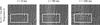
The first implementation of X-ray multi-projection imaging (XMPI) at the ForMAX beamline (MAX IV) enables the acquisition of multiple projections simultaneously without requiring sample rotation. This approach facilitates volumetric studies of fast dynamics at frame rates of 12.5 kHz with micrometre resolution, with the potential of even higher speeds, surpassing the limitations of state-of-the-art methods like time-resolved tomography.
Open access
access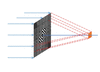
A defocused illumination method based on a beam-shaping condenser to suppress fringe artifacts arising from rectangular aperture diffraction and sub-grating interference is developed, providing an effective and practical approach for achieving wide-field and uniform illumination in X-ray microscopy.
Open access
access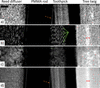
This study aims to guide users of dark-field imaging in selecting the most suitable technique for their imaging goals. To this end, we provide a summary table and highlight opportunities for future research into the sources of dark-field contrast across emerging methods.
Open access
access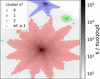
Bragg coherent diffraction imaging measurement sometimes requires manual and time-consuming cleaning of parasitic signals termed `aliens' from nearby particles that can affect the phase retrieval reconstruction. Here, we propose using a clustering technique to speed up this process while keeping the resolution of the reconstructed object high. A user-friendly Python Jupyter notebook program is available on Github.
Open access
access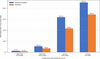
HiHolo, a high-performance CUDA-MPI software framework for X-ray holographic reconstruction, achieves performance improvement over existing solutions while introducing three enhanced iterative algorithms that effectively reduce artifacts and improve spatial resolution in propagation-based phase contrast imaging.
Open access
access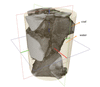
This work presents a neural-network framework that accelerates X-ray multi-contrast imaging—simultaneously delivering absorption, phase, and dark-field, while maintaining high spatial resolution, and outperforms correlation-based methods in speed, achieving a favorable balance between resolution and throughput. The method is agnostic to the modulation source (sandpaper, coded masks, gratings), enabling flexible deployment across setups and supporting real-time 2D/3D quantitative imaging for high-speed, in situ studies in materials science and biomedical applications.
Open access
access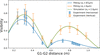
Coherence properties were evaluated and multi-contrast X-ray computed tomography was demonstrated using an X-ray Talbot interferometer on the NanoTerasu beamline BL09W. The results confirm the high spatial coherence and imaging performance of the source, paving the way for advanced X-ray phase imaging.
Open access
access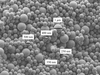
A multi-facility round-robin comparison of synchrotron- and laboratory-based nano-computed tomography using a standardized 3D phantom reveals superior resolution and acquisition speed at synchrotrons, while advanced laboratory systems achieve competitive image quality with extended scan times; phase contrast modalities further enhance structural visibility.
short communications
Open access
access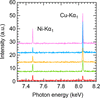
We successfully achieved simultaneous lasing of 7.48 keV Ni Kα1 and 8.05 keV Cu Kα1 emissions using an intense X-ray free-electron laser (XFEL) pulse. This achievement – the realization of simultaneous two-color X-ray lasing using a single-color XFEL pulse – is expected to advance the development of X-ray lasers and their applications.
Open access
access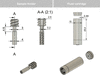
We present and demonstrate the use of a low-cost 3D printed flow cell for the study of liquid–solid systems using synchrotron computed microtomography. The designs are freely available with this publication.
beamlines
Open access
access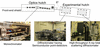
A high-throughput X-ray total scattering system was newly installed in BL04B2, achieving more than ten times faster acquisition times than those of the conventional setup.
Open access
access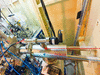
A wide-range beamline (130–10000 eV) combining both soft X-ray and hard X-ray photons has been constructed at SSRF for in situ X-ray photoemission spectroscopy investigations of the solid–gas interface, and for hard X-ray photoemission spectroscopy studies with layer-by-layer resolution.
Open access
access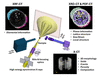
The development of multimodal X-ray computed tomography capabilities, including imaging, fluorescence, diffraction, and scattering, at the 28-ID-2 beamline of the National Synchrotron Light Source II is described.
Open access
access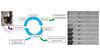
X-ray computed tomography scanning schemes and reconstruction capabilities at the BAMline (BESSY II)
An X-ray computed tomography scanning approach available at the BAMline effectively removes ring artifacts and enables real-time preview reconstruction through sequence-based step-scanning. Additionally, integrated X-ray spectral calculation software streamlines beamline adjustments for optimized imaging performance.
addenda and errata
Open access
access