

 journal menu


issue contents
May 2026 issue
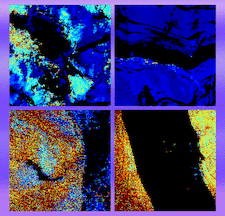
Cover illustration: Illustration of the effect of tissue preparation methods on the structure of bovine skeletal muscle sections (see Acharya, Baroni, Rodriguez-Fernandez, Carlsen and Liebi, pages 632–648). Spatial maps show variation in the I1,1/I1,0 equatorial intensity ratio of muscle obtained from scanning SAXS experiments in unprocessed tissue (top left), formalin-fixed tissue (top right), OCT-embedded tissue, deep-frozen at −80°C (bottom left), and snap-frozen tissue stored at −80°C (bottom right).
research papers


Open  access
access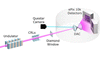
A setup for fielding high-pressure samples contained in diamond anvil cells (DACs) at the LCLS X-ray free electron laser is described and example powder X-ray diffraction data are presented. Future prospects for experimental capabilities in DACs enabled by the LCLS, such as short pulse laser interactions and multiple pulse modes, are discussed.
Open access
access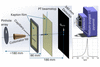
An X-ray scattering setup designed to capture small- and wide-angle X-ray scattering on a single, large area detector features a partially transmissive beamstop that facilitates non-invasive recording of X-ray beam position and intensity during acquisition of X-ray scattering images. The integrated transmitted intensity allows different datasets to be put on the same absolute scale and thereby achieve accurate differencing.
Open access
access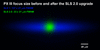
The X06DA-PXIII beamline at the Swiss Light Source, operating since 2008 and contributing to over 2650 crystal structures, has been fully rebuilt to harness the reduced emittance and improved performance of the SLS 2.0 storage ring. Its new optical design, featuring a toroidal mirror close to the source, horizontal 1:2 focusing, and a Kirkpatrick–Baez mirror system, enables efficient photon collection and tight beam focusing and thus improves overall efficiency.
Open access
access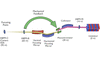
An electron-source feedback method has been demonstrated at the NSLS-II Hard X-ray Nanoprobe, using X-ray beam position data to drive electron beam corrections. The approach suppresses dominant vibration peaks and significantly improves X-ray beam stability and ptychographic image quality.
Open access
access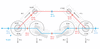
Time varying Bayesian optimization as a data driven approach for robust drift correction is outlined, and its application for a split and delay x-ray optical system is illustrated.
Open access
access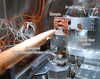
A total-reflection-based microscope compatible with X-rays and visible light for sample positioning without difficult calibration of the system is introduced.
Open access
access
A high-throughput field-programmable gate array (FPGA)-accelerated data-reduction and -analysis pipeline combined with high-performance computing enables the continuous handling of a 216 Gbps data stream from quasi-elastic gamma-ray scattering experiments at SPring-8.

Open access
access
This study introduces inclined scanning three-dimensional X-ray diffraction microscopy (i-S3DXRD) that enables three-dimensional orientation mapping of planar polycrystalline materials, revealing the thermal fatigue mechanism of Pb-free solder joints.
Open access
access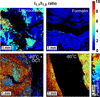
The effect of tissue-processing techniques, including fixation and embedding, on the structural information obtained from scanning small-angle X-ray scattering of muscle and connective tissue has been studied. This provides a framework for sSAXS users working with soft tissues to make an informed choice on the sample preservation method, tailored to their own requirements.
Open access
access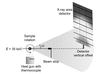
A newly measured reference dataset for the temperature differential scattering signal of water, acquired at the DanMAX beamline of the MAX IV synchrotron, is presented.
Open access
access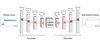
We introduce a high-performance Python-based XAS denoising package called XASDenoise, which implements our newly developed stationarity warping method and advanced denoising techniques based on Gaussian process regression and a convolutional autoencoder.
Open access
access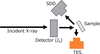
A transition-edge sensor (TES) enables simultaneous measurements of HERFD-XANES, RXES and RIXS with a high-energy resolution. This study employed a TES to investigate caesium compounds at the Cs LII-edge (5359 eV).
Open access
access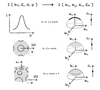
This work demonstrates that standard ARPES datasets often hinder correct comparison with band structure calculations due to intrinsic mixing of energy and momentum. It proposes an angle-based approach that preserves true k-space mapping, enabling more accurate and intuitive comparison with calculated electronic structures.
Open access
access
A scalable multi-tau two-time correlation framework enables efficient, time-resolved XPCS analysis of long duration high-frame-rate modern synchrotron data while preserving sensitivity to non-stationary dynamics.
Open access
access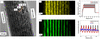
Resonant X-ray reflectivity was employed to probe the interfaces of low electron density contrast metallic multilayers.
Open access
access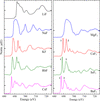
Experimental and computational F K-edge X-ray absorption spectra of a range of complex inorganic materials are presented and analysed, with discussion as to what information on F speciation and environment can be obtained from the spectra. Observations and recommendations are made that will assist future research in the collection and analysis of high-quality F K-edge spectra.
Open access
access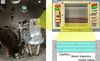
We present a standardized and highly automated pipeline for megahertz X-ray photon correlation spectroscopy (MHz-XPCS) on soft-matter samples at the MID instrument of the European XFEL. The workflow addresses AGIPD petabyte-scale data handling, detector-artifact correction, correlation analysis and FAIR data output, enabling routine MHz-XPCS with minimal user intervention.
Open access
access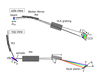
A resonant inelastic X-ray scattering microscopy system with a spatial resolution of 1.0 µm combined with ultrahigh energy resolution in the soft X-ray regime has been established.
Open access
access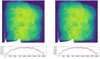
The development of a criterion for near-optimal selection of the Paganin-filter parameter based on noise power analysis measured via an image's noise power spectrum is described.
Open access
access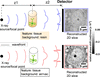
X-ray phase contrast tomography can efficiently image brain tissue at subcellular resolution. Critical point drying allows a gentle replacement of interstitial material by air, enhancing X-ray phase contrast of the ultrastructural features.
Open access
access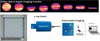
The ClearXCam is a diamond-based camera for synchrotron X-ray beams. This imaging detector has 2304 pixels for real-time X-ray beam monitoring with frame rates as fast as 100 Hz. The system provides quantitative beam diagnostics for synchrotron facilities, enabling rapid beam focusing and continuous monitoring of beam position and structure, and may facilitate beamline automation efforts.
Open access
access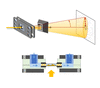
Fast-scanning small-angle X-ray scattering on biological cells in aqueous environments reveals intracellular anisotropy and orientation, and allows for systematic assessment of radiation damage caused by the measurements.
Open access
access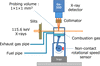
Compton-scattering imaging has been applied to a combustion engine under operation for the first time. With a time-resolved technique, a crank-angle dependency of Compton-scattered X-ray intensity is obtained at different positions in a combustion chamber.
Open access
access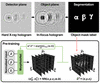
A physics-driven deep learning model enables single-shot retrieval of 3D phase and absorbance from shot-noise-limited hard X-ray holograms. Validated on both synthetic and experimental data, it provides robust reconstruction under weak illumination.
Open access
access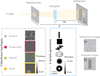
Single-mask phase contrast and dark-field imaging methods offer the great advantage of being simple to implement, translating most of the complexity to the numerical side. In this work, we study the impact of the modulation topology on the image quality retrieved both on numerical simulation and experiments.
Open access
access
Compact free-electron lasers are investigated as scalable, high-coherence light sources capable of enabling beyond-6G and quantum communication systems through ultrafast data rates, wide spectral tunability, and high signal-to-noise performance.
short communications
Open access
access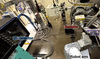
A compact six-axis robotic arm has been implemented at the BL02B1 beamline of SPring-8 as a high-precision goniometer for single-crystal diffraction. Its programmable control enables automated sample handling and centring, advancing autonomous high-throughput diffraction in preparation for SPring-8-II.
beamlines
Open access
access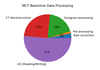
The Micro-Computed Tomography (MCT) beamline at the Australian Synchrotron has undergone significant advancements in data acquisition and processing infrastructure to support the growing diversity of user needs and experimental techniques. Recent developments in data acquisition and processing infrastructure at the beamline are presented.
Open access
access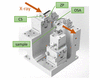
The newly commissioned hard X-ray ptychography endstation at the Taiwan Photon Source, TPS 25A2, is introduced, detailing the instrumental specifications and demonstrating a benchmark spatial resolution of 6.9 nm in 2D, showcased through the imaging of a standard test pattern, inorganic nanoparticles and a complex biological structure.
Open access
access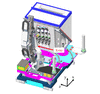
A high-efficiency 14-analyser X-ray emission spectrometer that offers novel capabilities has been developed for I20-Scanning at Diamond Light Source.
Open access
access
Characterization and testing of a new setup for absorption and scattering experiments with soft X-rays carrying an orbital angular momentum at the SEXTANTS beamline of Synchrotron SOLEIL are presented.
computer programs
Open access
access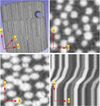
FibreSimulator is an open-source tool for generating realistic 3D phantoms of unidirectional fibre-reinforced polymers, enabling customizable fibre structures and simulating computed tomography scanning for algorithm development and validation.
Open access
access
A new open-source web-based graphical user interface, BioSAXS Customized Beamline Environment (BSxCuBE-Web), for the experimental control of bioSAXS experiments on beamline BM29 at the ESRF–EBS is presented.
letters to the editor
Open access
access
A standardized HDF5-based data format for azimuthally integrated scattering and diffraction data, developed within the NeXus framework, is presented. This format enables inter-operability across facilities and software, helps support FAIR principles, and simplifies data analysis workflows.
meeting reports
Open access
access
Report on the Temporally Coherent Synchrotron Light Sources workshop, held at DESY, Hamburg, Germany, 26–27 January 2026.
addenda and errata
Open access
access
Open access
access