


 menu
menu


issue contents
November 2026 issue
Early view articles
scientific comment


Open  access
access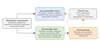
The AI Concierge: institutional design for recording, reconnection, and mutual growth at SPring-8-II
This Scientific Comment proposes the AI Concierge as an institutional design for recording and responsibly reusing tacit experimental judgments at synchrotron facilities. It specifies a minimum operational model that combines AI-assisted drafting with human confirmation, governance, provenance, and safeguards for knowledge reconnection.
research papers
Open access
access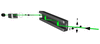
This work extends high-purity X-ray polarimetry into the 15–30 keV range, enabling polarization-filtered synchrotron Mössbauer spectroscopy of higher-energy nuclear resonances. A proof-of-principle experiment at 22.494 keV demonstrates a polarization purity of (1.2 ± 0.5) × 10−8, establishing the feasibility of the approach.
Open access
access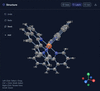
An interactive X-ray absorption spectroscopy (XAS) simulation/fitting platform for atomic 3D structure characterization integrates machine-learning-driven XAS simulation, 3D structure visualization and editing, and experimental XAS fitting into one unity for fast and user-friendly analysis.
Open access
access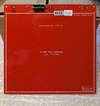
We present the results of testing 92 prototypes of a capacitor-based burn-through monitor at the LCLS XCS and XPP endstations. We quantify the beam energy density thresholds required to induce a detectable high-voltage electrical short prior to complete burn-through and demonstrate the reliability of this scalable, low-cost solution for machine and personnel protection at high-power light sources.
Open access
access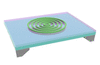
This study presents systematic measurements and rigorous coupled-wave analysis of relative and absolute diffraction efficiencies for sub-15 nm soft X-ray Fresnel zone plates. By decoupling intrinsic optical performance from practical beamline transmission losses, this work establishes a highly reliable metrology framework to support the development of next-generation high-resolution synchrotron optics.
Open access
access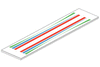
A shaped electrode design for lithium niobate adaptive X-ray mirrors connects actuator degrees of freedom to specific polynomial orders, enabling general shape control and the correction of defocus, coma and fourth-order aberrations with a limited number of inputs.
Open access
access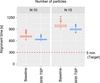
A particle swarm optimization-based automated two-mirror alignment method was developed to restore high-flux beams in approximately 5 min, and its 15 month deployment demonstrated its robustness and reliability.
Open access
access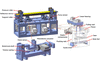
A small-radius-of-curvature bendable mirror system is developed for dynamic focusing in X-ray free-electron laser and synchrotron radiation beamlines, and a transfer-learning neural-network and differential-evolution framework is used for force-to-shape modeling and inverse optimization. The method achieves nanometre-level surface-profile prediction and sub-newton end-force recovery, providing an efficient route for rapid and repeatable tuning of active X-ray focusing mirrors.
Open access
access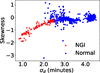
This paper presents a machine-learning-based approach for early fault detection in vacuum ion pumps at the European XFEL by analyzing pressure data to detect fault precursors. The developed method enables predictive maintenance, reducing unplanned downtime and improving operational reliability.
short communications

Open access
access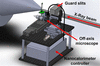
The custom in situ fast scanning chip calorimetry–small-angle X-ray scattering (SAXS) setup developed in this work enables synchronized calorimetric measurements and continuous SAXS acquisition with millisecond time resolution during ultrafast thermal protocols. By complementing the calorimetric signal with direct structural information, the method reveals cooling-rate-dependent non-integer-folded chain configurations and follows the evolution of lamellar thickness in the ultra-long monodisperse n-alkane n-C390H782 during heating at 1000 K s−1.
beamlines
Open access
access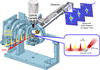
The XSS beamline at PAL-XFEL provides a femtosecond time-resolved Bragg coherent X-ray diffraction imaging setup, optimized for tracking transient lattice dynamics and nanoscale strain fields within single crystals during dynamic processes.
Open access
access
The DanMAX beamline at the MAX IV laboratory is designed for in situ and in operando studies using powder X-ray diffraction, total scattering, and full-field imaging in the 15–35 keV energy range.
computer programs
Open access
access
MIR2-Toolkit is an open-source Python program for analyzer-based multiple-image radiography analysis with integrated silicon-crystal diffraction modeling tools and a sample dataset for reproducible evaluation.

