


 journal menu


issue contents
January 2014 issue
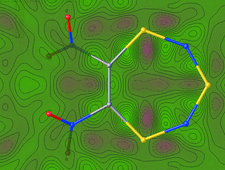
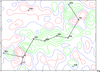
Cover illustration: Deformation density contours for 6,7-dinitro-1,3![[lambda]](/logos/entities/lambda_rmgif.gif) 4
4![[delta]](/logos/entities/delta_rmgif.gif) 2,5,2,4-trithiadiazepine, drawn in the mean plane of the ring at intervals of 0.05 e Å-3 (negative contours are shown as broken lines). Colour shading indicates whether the calculated difference electron density is positive (green) or negative (brown). See Jones [Acta Cryst. (2014), C70, 60-66].
2,5,2,4-trithiadiazepine, drawn in the mean plane of the ring at intervals of 0.05 e Å-3 (negative contours are shown as broken lines). Colour shading indicates whether the calculated difference electron density is positive (green) or negative (brown). See Jones [Acta Cryst. (2014), C70, 60-66].
editorial


Free 

inorganic compounds

Download citation


Download citation
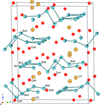
Polar intermetallic phases with complex structures are reported in the RE–Li–Sn system (RE = Ce, Pr, Nd, Sm). They crystallize in the chiral orthorhombic space group P212121 (No. 19), which is relatively uncommon among intermetallic phases.
Download citation
Download citation
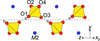
The four isotypic arsenate(V) and phosphate(V) dihydrates M2HXO4·2H2O (M = Rb, Cs; X = P, As) crystallize in the space group P21/c. A hypothetical proton-disordered C2/c structure is discussed.
metal-organic compounds
Download citation
Download citation
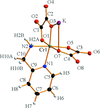
This study reports the structure of a new heteroleptic oxalate-based compound obtained with the 2-picolylamine ligand. It is built-up by bimetallic oxalate-bridged CrIII–K helical chains which are linked through centrosymmetric K2O2 units.
CCDC reference: 971307
Download citation
Download citation
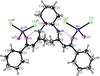
A one-dimensional chiral helical coordination polymer was synthesized from the rigid chiral bidentate Schiff base ligand 1,1-diphenyl-3,3′-[(1R,2R)-cyclohexane-1,2-diylbis(azanediyl)]dibut-2-en-1-one with MnII. The structure displays intramolecular ionic N+—H⋯O− hydrogen bonding and π–π interactions between pairs of phenyl rings which strengthen the chains.
CCDC reference: 974514
Download citation
Download citation
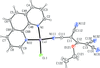
In the title complex, the (4 + 2) coordination polyhedron around the CuII centre includes N atoms from three different 1,1,3,3-tetracyano-2-ethoxypropenide ligands, so forming a two-dimensional coordination polymer.
CCDC reference: 975003
Download citation
Download citation
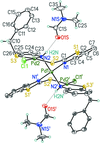
A linear trinuclear Pd3 complex containing N,S-coordinating 2-(benzylsulfanyl)anilinide and 1,3-benzothiazole-2-thiolate ligands has  symmetry and a Pd⋯Pd separation of 3.2012 (4) Å. All three PdII atoms have a square-planar geometry, while the central PdII core shows an all N-coordination. 1,3-Benzothiazole-2-thiolate was formed in situ from 2-(benzylsulfanyl)aniline.
symmetry and a Pd⋯Pd separation of 3.2012 (4) Å. All three PdII atoms have a square-planar geometry, while the central PdII core shows an all N-coordination. 1,3-Benzothiazole-2-thiolate was formed in situ from 2-(benzylsulfanyl)aniline.CCDC reference: 975011
Download citation
Download citation
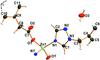
The title compound has a fivefold interpenetrating diamondoid three-dimensional metal–organic framework, with each ZnII centre surrounded by two O-donor atoms from monodentate carboxylate groups belonging to two different benzene-1,4-diacetate ligands and by two triazole N-donor atoms from two different 1,4-bis[(1H-1,2,4-triazol-1-yl)methyl]benzene ligands.
CCDC reference: 975731
Download citation
Download citation
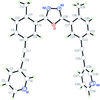
The new nano-sized rigid double-armed oxadiazole-bridged ligand 2,5-bis{2-methyl-5-[2-(pyridin-3-yl)ethenyl]phenyl}-1,3,4-oxadiazole has been used to create two novel metallocyclic complexes with one adopting a 20-membered `0'-shaped metallocyclic structure and the second adopting a discrete `8'-shaped metallocyclic structure.
Download citation
Download citation
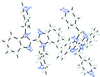
The new ligand 1,1′-bis(pyridin-4-ylmethyl)-2,2′-bi-1H-benzimidazole has been combined with HgX2 (X = Cl, Br and I) to create three one-dimensional coordination polymers. The three complexes have one-dimensional zigzag chains and the HgII centres are in a distorted tetrahedral [HgX2N2] geometry in each case.
organic compounds
Download citation
Download citation
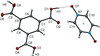
Cocrystallized trimesic acid (TMA) and pyrazine N,N′-dioxide (PNO) molecules form strong O—H⋯O hydrogen bonds, but also important weak C—H⋯O and dipole–dipole intermolecular interactions, to generate a densely packed three-dimensional network.
CCDC reference: 942551
Download citation
Download citation
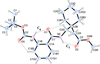
A hybrid βγ dipeptide, Boc-Ant-Gpn-OMe, adopts a folded conformation stabilized by intramolecular six- (C6) and seven-membered (C7) hydrogen bonds, together with weak C—H⋯O and C—H⋯π interactions, resulting in a ribbon-like structure.
CCDC reference: 895752
Download citation
Download citation
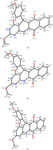
Five types of hydrogen bond link three independent molecules into a three-dimensional framework structure.
CCDC reference: 975294
Download citation
Download citation
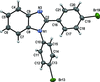
Molecules of two substituted 1H-benzimidazoles are arranged in dimeric units through C—H⋯N and parallel-displaced π-stacking interactions. The molecular packing of the dimers arises by the concurrence of a diverse set of weak intermolecular C—X⋯D (X = H, NO2; D = O, π) interactions.
Download citation
Download citation
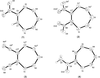
The most precise determinations to date for the 1,3,5,2,4-trithiadiazepine and 1,3,5,2,4,6-trithiatriazepine ring systems are presented, including deformation density maps consistent with the expected bonding electron density.
Download citation
Download citation
In two hydrated structures of bis(adeninium) zoledronate, the zoledronate anion displays its usual zwitterionic character, with a protonated imidazole ring; however, the ionization state of the phosphonate groups of the anions are different.
addenda and errata
Free