


 journal menu


issue contents
October 2016 issue
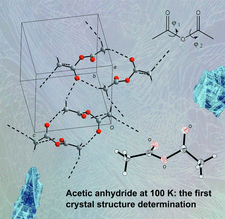
Cover illustration: Acetic anhydride is a widely used acetylation reagent in organic synthesis. The crystal and molecular structure, as determined by single-crystal X-ray analysis at 100 K, is reported for the first time. The molecule adopts an exact C2-symmetric conformation about a crystallographic twofold axis. See Seidel, Goddard, Nöthling & Lehmann [Acta Cryst. (2016), C72, 753-757].
research papers


Download citation


Download citation
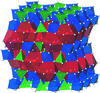
A new strontium germanate, SrGe2O5, was crystallized at 6 GPa and 1223 K. The effect of cation size on the crystal structure is discussed in terms of bonding nature.
CCDC reference: 1500633
Download citation
Download citation
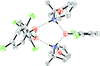
In the solvated salt derived from 2,4-dichlorophenol, tert-butylamine, 2,6-dichlorophenol and tetrahydrofuran, five components, namely two tert-butylammonium cations, one 2,4-dichlorophenol molecule, one 2,4-dichlorophenolate anion and one 2,6-dichlorophenolate anion, are bound by N—H⋯O and O—H⋯O hydrogen bonds to form a hydrogen-bonded ring with the graph-set motif  (10), which is further associated with two pendant tetrahydrofuran solvent molecules by N—H⋯O hydrogen bonds. The hydrogen-bonded ring has internal symmetry, with a twofold axis running through the centre of the 2,6-dichlorophenolate anion, and is isostructural with a previous structure.
(10), which is further associated with two pendant tetrahydrofuran solvent molecules by N—H⋯O hydrogen bonds. The hydrogen-bonded ring has internal symmetry, with a twofold axis running through the centre of the 2,6-dichlorophenolate anion, and is isostructural with a previous structure.CCDC reference: 1501723
Download citation
Download citation
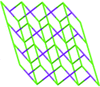
Two new transition metal complexes, namely [Co(L)0.5(IPA)(H2O)]n and [Cd(L)0.5(IPA)(H2O)]n (L is 1,4-bis{[1-(pyridin-3-ylmethyl)-1H-benz[d]imidazol-2-yl]methoxy}benzene and IPA is isophthalate), have been constructed by a symmetric N-donor ligand and a carboxylate ligand under hydrothermal conditions. An X-ray crystallographic study reveals that the complexes are isostructural, with both exhibiting a three-dimensional supramolecular architecture built by hydrogen bonds.
Download citation
Download citation
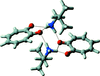
The organic salt formed by transfer of a proton between tropolone and isobutylamine has been studied by crystallographic, computational, and statistical methods, revealing an extensive hydrogen-bonding network but a surprising absence of the π-mediated interactions that characterize many other troponoid-based crystals.
CCDC reference: 1494859
Download citation
Download citation
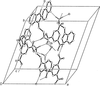
The crystal structure of the bis(quinoline) adduct dihydrate of tris(tryptaminium 3,5-dinitrobenzoate) shows an extensively hydrogen-bonded and π–π-bonded one-dimensional columnar extension.
CCDC reference: 1504923
Download citation
Download citation
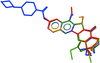
The crystal structure of 7-ethyl-10-hydroxycamptothecin monohydrate suggests that the hydrogen-bond network around the water molecule and the lactone ring promotes the hydrolysis reaction in the crystal.
CCDC reference: 1504071
Download citation
Download citation
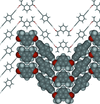
The 1:1 cocrystal of 1,4-diethynylbenzene with 1,3-diacetylbenzene and the 1:1 cocrystal of 1,4-diethynylbenzene with benzene-1,4-dicarbaldehyde feature a strong nonconventional ethynyl–carbonyl sp-C—H⋯O hydrogen bond between the components.
Download citation
Download citation
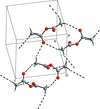
Acetic anhydride is a widely used acetylation reagent in organic synthesis. The crystal and molecular structure, as determined by single-crystal X-ray analysis at 100 K, is reported for the first time. The molecule adopts an exact C2-symmetric conformation about a crystallographic twofold axis.
CCDC reference: 1505908
Download citation
Download citation
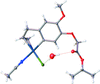
Crystallization experiments with the dinuclear chelate ring complex di-μ-chlorido-bis[(η2-2-allyl-4-methoxy-5-{[(propan-2-yloxy)carbonyl]methoxy}phenyl-κC1)platinum(II)] using five different conditions has resulted in four different complexes.
book reviews
Free