


 journal menu


issue contents
July 2018 issue
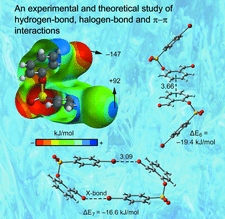
Cover illustration: A series of solid-state structures of 2- and 4-formylphenyl 4-substituted benzenesulfonates were investigated. Remarkably, halogen-bonding interactions are found to be important to rationalize their solid-state crystal structures. See Andleeb, Khan, Bauzá, Tahir, Simpson, Hameed & Frontera [Acta Cryst. (2018), C74, 816-829].
research papers


Download citation


Download citation
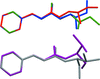
In order to study the correlations between anticonvulsant activity and molecular structure, the crystal structures of three new cinnamamide derivatives with proven anticonvulsant activity were determined by X-ray diffraction. The molecular structures and intermolecular interactions were analyzed in order to propose a pharmacophore model for cinnamamide derivatives.
Download citation
Download citation
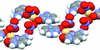
The coordination modes, hydrogen-bond patterns, supramolecular architectures and π–π stacking interactions of three new Cd and Zn complexes of cytosine and 5-fluorocytosine, namely bis(cytosine)diiodidocadmium(II), bis(cytosine)dinitratocadmium(II) and (6-amino-5-fluorocytosine)aquadibromidozinc(II)–4-amino-5-fluorocytosine (1/1), are described and analyzed.
Download citation
Download citation
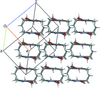
Three new pharmaceutical salts of the antioxidant drug emoxypine (EMX) with pharmaceutically acceptable maleic (Mlt), malonic (Mln) and adipic (Adp) acids ([EMX+Mlt], [EMX+Mln] and [EMX+Adp], respectively) were synthesized and their crystal structures characterized using single-crystal X-ray diffraction, solid-state DFT and QTAIMC analysis. The thermochemical and solubility properties of the three EMX salts were studied, with the maximum solubility increase (38 times) being observed for [EMX+Mln].
Download citation
Download citation
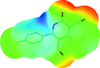
A novel multifunctionalized 2-pyridone derivative was synthesized and its crystal structure was analyzed. A detailed optical analysis was performed and time-dependent density functional theory enables a mechanistic view of luminescence.
CCDC reference: 1843857
Download citation
Download citation
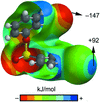
A series of solid-state structures of 2- and 4-formylphenyl 4-substituted benzenesulfonates were investigated. Remarkably, halogen-bonding interactions are found to be important to rationalize their solid-state crystal structures.
Download citation
Download citation
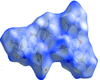
To examine the role of different functional groups involved in the intermolecular interactions and conformational geometries adopted in xanthenediones, a series of three substituted xanthenedione derivatives have been crystallized and analysed for their intermolecular interactions via Hirshfeld analysis.
Download citation
Download citation
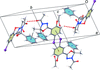
Nine new 2-(4-acetyl-5-aryl-5-methyl-4,5-dihydro-1,3,4-oxadiazol-2-yl)-4-iodophenyl acetate compounds were synthesized, of which four show promising in vitro cytotoxicity on two human cancer cell lines.
Download citation
Download citation
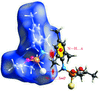
N—H⋯A (A = S and π) hydrogen bonds were studied in a new amidothiophosphoester structure. The driving force for the N—H⋯π interaction is the presence of the electron-rich (2,4,6-CH3)3C6H2 segment.
CCDC reference: 1435273
Download citation
Download citation
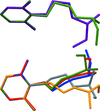
Two new succinates of 1-hydroxypropan-2-aminium derivatives have been prepared and characterized by single-crystal X-ray diffraction. The N atoms are protonated by proton transfer from succinic acid. The salts display similar supramolecular architectures, i.e. two-dimensional networks.
Download citation
Download citation
Open  access
access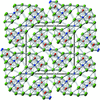
A study of the ternary Rh–Mn–Bi phase diagram revealed the existence of two new ternary bismuthides, viz. hexarhodium pentamanganese octadecabismuthide (Rh6Mn5Bi18) and rhodium manganese tribismuthide (RhMnBi3). Their crystal structures represent new structure types.