


 journal menu


issue contents
August 2018 issue
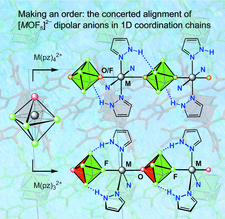
Cover illustration: Two new CuII complexes based on 3,4,5-trimethyl-1H-pyrazole ligands and [MOF5]2- (M = Nb and Ta) inorganic bridges feature one-dimensional chains, which exhibit strict orientational order of the polar anions and deliver a protocol for the rational construction of polar infinite structures. See Sharko, Erhart, Krautscheid & Domasevitch [Acta Cryst. (2018), C74, 929-935].
research papers


Download citation


Download citation
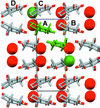
Semisynthesis, rearrangment, absolute configuration and changes in the ring puckers of a novel 19,20-δ-lactone (9βH)-pimarane started from the natural product annonalide, which has also been redetermined here.
Download citation
Download citation
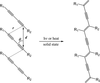
Two polymorphic structures of the diacetylene 6-[(phenylcarbamoyl)oxy]hexa-2,4-diyn-1-yl isonicotinate are reported. One polymorph was inert to polymerization, but the other showed polymerization reactivity by thermal annealing or photoirradiation.
Download citation
Download citation
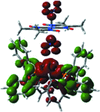
An unusual heterobimetallic bis(triphenylphosphane)(NO2)AgI–CoIII(dimethylglyoximate)(NO2) coordination compound with both bridging and terminal –NO2 (nitro) coordination modes has been isolated from the reaction of [CoCl(DMGH)2(PPh3)] (DMGH is dimethylglyoximate) with excess AgNO2 and was characterized by X-ray crystallography, different spectroscopic techniques and electrospray ionization mass spectrometery (ESI–MS).
CCDC reference: 1851946
Download citation
Download citation
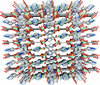
The hydrothermal reaction between Cd(NO3)2·4H2O, benzene-1,2,4,5-tetracarboxylic acid and 1,4-bis(pyridin-4-yl)buta-1,3-diene produced a three-dimensional anionic coordination network with tubular channels. The cavities of the anionic network are occupied by protonated pyridinium cations. Interestingly, the organic cations connect the anionic coordination network through hydrogen bonds to form a complicated supramolecular framework with photoluminescence properties.
CCDC reference: 1845552
Download citation
Download citation
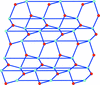
Two coordination polymers with different structures have been prepared under hydrothermal conditions, based on mixtures of Cd(NO3)2·4H2O and trans-1-(2-aminopyridin-3-yl)-2-(pyridin-4-yl)ethene with two similar dicarboxylic acids (5-methylisophthalic acid or 5-hydroxyisophthalic acid). Both of these compounds exhibit good thermal stability and photoluminescence properties.
Download citation
Download citation
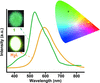
A new luminescent NiII complex has been synthesized and characterized by elemental analysis, UV–Vis, FT–IR, 1H NMR, 13C NMR and photoluminescence spectroscopies, LC–MS/MS and single-crystal X-ray diffraction.
CCDC reference: 1589491
Download citation
Download citation
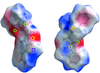
The supramolecular architectures of the crystal structures of two phosphorylated azaheterocycles were characterized using X-ray diffraction analysis. One of them is dominated by two infinite chains composed of unique symmetry-independent molecules linked by distinctively different synthons, while the second structure adopts a ladder packing topology.
Download citation
Download citation
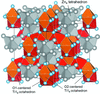
The crystal structures of filled Ti2Ni-type Ti3Zn3O1.03 and Ti3Zn3O1.27 were analysed by X-ray diffraction for single crystals prepared using a Bi flux. A new interstitial O-atom site and split sites of the Ti and Zn atoms were found for Ti3Zn3O1.27.
Download citation
Download citation
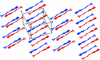
Pure γ polymorphs of 3-chloro- and 3-bromo-trans-cinnamic acids are isostructural and undergo irreversible thermal transformation to different β polymorphs at similar temperatures. A transformation also occurs for the γ form of their solid solution, with a molar ratio close to 1:1, producing a form similar to pure β-3-chloro-trans-cinnamic acid.
Download citation
Download citation
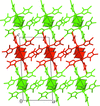
Two new CuII complexes based on 3,4,5-trimethyl-1H-pyrazole ligands and [MOF5]2− (M = Nb and Ta) inorganic bridges feature one-dimensional chains, which exhibit strict orientational order of the polar anions and deliver a protocol for the rational construction of polar infinite structures.
Download citation
Download citation
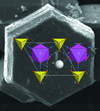
The first Mn member of the struvite morphotropic series, CsMn(H2O)6(PO4), has been synthesized hydrothermally and its hexagonal crystal structure was determined. It is shown that the size of the A+ ionic radius within the morphotropic series AM(H2O)6(XO4) affects the type of crystal structure and the values of the unit-cell parameters. Structural relationships with Na(H2O)Mg(H2O)6(PO4) and the mineral hazenite, KNa(H2O)2Mg2(H2O)12(PO4)2, are discussed.
CCDC reference: 1854647
Download citation
Download citation
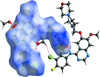
Gefitinib (or Iressa) exists in two polymorphic forms, a stable form I and a metastable form II. A methanol solvated form was synthesized and was investigated theoretically and experimentally.
CCDC reference: 1517944
Download citation
Download citation
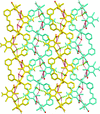
Two one-dimensional CdII coordination polymers with 5-amino-2,4,6-tribromoisophthalic acid (H2ATBIP) and flexible N-donor bipyridyl ligands have been synthesized and characterized.
Download citation
Download citation
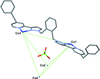
A new Co4L6 tetrahedral cage constructed from a substituted pyrazolyl–pyridine ligand has been synthesized and structurally characterized. The [Co4L6 ClO4]7+ cage exhibits outward-facing pockets at each corner of the tetrahedron.
ClO4]7+ cage exhibits outward-facing pockets at each corner of the tetrahedron.CCDC reference: 1483894
Download citation
Download citation
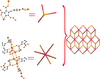
A two-dimensional CdII coordination polymer was assembled from 1-(4-carboxylbenzyl)-2-propyl-1H-imidazole-4,5-dicarboxylic acid and 1-(4-carboxybenzyl)-2-propyl-1H-imidazole-4-carboxylic acid ligands and is described as a 3,6-coordinated complex with a (43)2(46.66.83) topology network. The solid-state photoluminescence properties of the new complex were investigated.
CCDC reference: 1856015
Download citation
Download citation
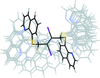
The reaction of 1,4-bis(quinolin-2-ylsulfanyl)but-2-yne with iodine leads to two different single crystals, namely the dimonoiodide hemihydrate and the monoiodide triiodide of the 1,2-dihydro-1,1′-bi[thiazolo[3,2-a]quinoline]-10a,10a′-diium dication. Interaction of the iodide anions with the dication takes place through chalcogen bonds.
Download citation
Download citation
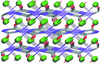
A three-dimensional zinc(II) coordination polymer was synthesized using 5-sulfobenzene-1,3-dicarboxylate (5-sulfoisophthalate) monosodium salt, KOH and Zn2+. The topological analyses revealed that K—O interactions form a two-dimensional network and the coordination of the Zn2+ ions gives rise to a three-dimensional network.
CCDC reference: 1526885
Download citation
Download citation
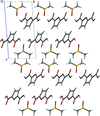
The crystal structures of furan-2,5-dicarboxylic acid (FDCA) dimethylformamide disolvate and dimethyl sulfoxide monosolvate were determined using single-crystal X-ray diffraction and exhibit hydrogen bonds between the FDCA and solvent molecules. A two-dimensional network is formed in the DMSO solvate.