


 journal menu


issue contents
February 2022 issue
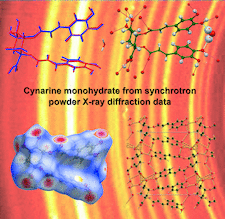
Cover illustration: The crystal structure of cynarine monohydrate has been solved and refined using synchrotron powder X-ray diffraction data and optimized using density functional techniques. See Kaduk, Boaz, Markun, Gindhart & Blanton [Acta Cryst. (2022), C78, 101–106].
scientific commentaries


Open  access
access
In a detailed powder diffraction study of the structural forms of psilocybin, Sherwood et al. [Acta Cryst. C78, 36–55] cast doubt that any other anhydrous polymorphs could exist.
research papers

Download citation


Download citation
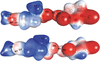
Melting of glutamic acid results in pyroglutamic acid monohydrate which has self-cocrystallized with the unreacted reactant. The crystal structure of the resulting cocrystal has been evaluated via topological analysis based on a multipolar atom model which reveals the presence of very strong hydrogen bonding.
Download citation
Download citation
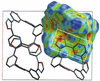
The macrocycle trioxazolo[23]metacyclophane was synthesized in three steps by the multicomponent van Leusen reaction and consists of meta-linked phenylenes connected through positions 4 and 5 of an oxazole heterocyclic ring. The macrocycle possesses a twisted saddle-like shape and interacts with nearby molecules by various π–π interactions.
CCDC reference: 2133260
Download citation
Download citation

The X-ray crystal structure of bis(2,6-diisopropylphenyl) tellurone, the first well-defined monomeric diorganotellurone without cocrystallized solvents and without stabilizing intramolecular contacts, is reported.
CCDC reference: 2141192
Download citation
Download citation
Open access
access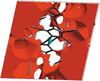
The crystal structure determination of the enigmatic `decacyanoferrocene' identifies this compound as cis-[{C5(CN)5}2(MeCN)4Fe].
CCDC reference: 2141277
Download citation
Download citation
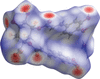
The crystal structure of cynarine monohydrate has been solved and refined using synchrotron powder X-ray diffraction data and optimized using density functional techniques.
Download citation
Download citation
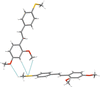
Weak intermolecular interactions in a series of biologically active 4′-methylthio-trans-stilbenes
The crystal structures of nine methoxy-substituted 4′-methylthiostilbenes, which are potential inhibitors of human recombinant cytochrome P450 enzymes, were determined. The geometries were compared with those found during docking studies at the active site of the receptor and some relevant differences were identified.
Download citation
Download citation
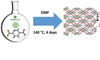
A new gadolinium(III)–pyridine-2,5-dicarboxylic acid three-dimensional coordination polymer has been synthesized via a typical solvothermal method. The three-dimensional anionic framework has channels along the c axis which are filled by dimethylazanium cations. Interestingly, the framework shows a helical-type assembly running down the a axis.
CCDC reference: 1990670
Download citation
Download citation
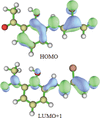
A novel zero-dimensional dinuclear zinc complex of (Z)-3-[(3-acetyl-2-hydroxyphenyl)amino]-2-bromoprop-2-enal (H2L) was synthesized. Theoretical calculations of the bond orders and excited state of H2L confirmed that there is extensive electron delocalization. The main frame of the complex remains stable to about 190 °C and the complex possesses high purity and acid and alkali resistance.
Download citation
Download citation
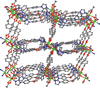
A cadmium(II) compound, prepared by reaction of Cd(NO3)2·6H2O with benzene-1,4-diacetic acid and bis[4-(2-methylimidazol-1-yl)phenyl]methanone in a mixture of H2O and dimethylformamide, possesses a new three-dimensional pillar–layer framework based on CdII–PBEA layers and MIPMO pillars, which can be simplified into a pcu topological network. The title compound displays a highly selective and sensitive sensing for Fe3+ ions in aqueous solution. In addition, it displays a high photocatalytic activity for the degradation of methylene blue (MB) in water under UV light irradiation.
CCDC reference: 2143254