

 journal menu


issue contents
April 2022 issue
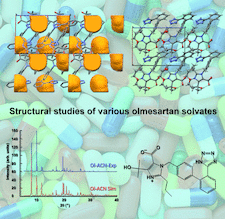
Cover illustration: The preparation and structural investigation of seven solvates of the antihypertensive drug olmesartan are described. All the structures were found to be isostructural and the supramolecular arrangements are held in a similar way by strong N—H⋯O hydrogen bonds. See Grosu, Martin, Turza, Miclaus, Kacso & Borodi [Acta Cryst. (2022), C78, 240–249].
research papers


Download citation


Download citation
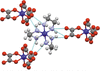
[Co(en)3][Co(ox)3]·5H2O shows stereoselective hydrogen-bonding interactions depending on the axis of interaction of [Co(en)3]3+. This has implications for chiral discriminations in solution.
CCDC reference: 2076925
Download citation
Download citation
Open  access
access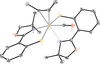
Two isomers of the molybdenum(II) complex Mo(CO)(C2Me2)(S-Phoz)2 [S-Phoz is 2-(4,4-dimethyloxazolin-2-yl)thiophenolate] have been synthesized and characterized by X-ray diffraction at 100 K and by spectroscopy (NMR and IR). They show quite different Mo—N and Mo—S distances.
Download citation
Download citation
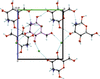
The X-ray crystal structure of D-mannosamine hydrochloride (2-amino-2-deoxy-D-mannose hydrochloride) was determined and compared to those of structurally-related α-D-glucosamine hydrochloride and β-D-galactosamine hydrochloride, with a focus on ionic hydrogen bonding in these crystals.
CCDC reference: 2154074
Download citation
Download citation
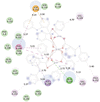
A trinuclear zinc complex with six N-phenylanthranilic acid ligands is structurally characterized and docking with SARS-CoV-2 is reported.
CCDC reference: 2155769
Download citation
Download citation
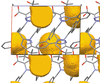
The preparation and structural investigation of seven solvates of the antihypertensive drug olmesartan are described. All the structures were found to be isostructural and the supramolecular arrangements are held in a similar way by strong N—H⋯O hydrogen bonds.
Download citation
Download citation
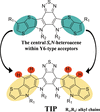
A novel π-extended decacyclic S,N-heteroacene with a conjugated backbone has been attained by the Cadogan reaction. The single-crystal structure is reported, as well as the optical and electrochemical properties.
CCDC reference: 2130077
Download citation
Download citation
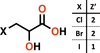
The crystal structures of three β-halolactic acids have been determined: β-chlorolactic acid (I) (Z′ = 2), β-bromolactic acid (II) (Z′ = 2), and β-iodolactic acid (III) (Z′ = 1). The difference between the molecules in the asymmetric units of I and II is due to the direction of the hydrogen bond of the alcohol group to a neighboring molecule, which results in changes in the hydrogen-bond network.