


 journal menu


issue contents
April 2026 issue
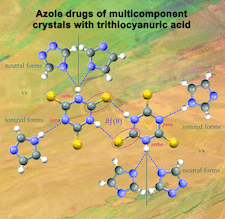
Cover illustration: The supramolecular architectures of five azole active pharmaceutical ingredients (econazole, luliconazole, isavuconazole, voriconazole and posaconazole) with trithiocyanuric acid have been characterized, with particular emphasis on their hydrogen-bonding functionalities. Four-molecule assemblies formed via N—H⋯N/S hydrogen bonds are analyzed using QTAIM and pairwise interaction energy calculations to elucidate their stability and energetics. See Ben, Domagała & Chęcińska [Acta Cryst. (2026), C82, 176–188].
early career research


Download citation


Download citation
Open  access
access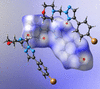
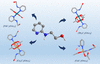
X-ray crystallography revealed that the reaction of 2-{[4-(4-bromophenyl)-1H-1,2,3-triazol-1-yl]methyl}phthalimide with morpholine led to substitution of the phthalimide group, including migration of the substituent from N1 to N2 on the 1,2,3-triazole ring.
research papers
Download citation
Download citation
Methods for the reproducible preparation of three hydrated solid forms of the antiviral compound tecovirimat (forms I, III and V) are presented and their phase purity was verified by powder X-ray diffraction using Rietveld refinement. Two previously unknown crystal structures (forms I and V) were determined. A comparative analysis was made of the hydrogen-bonding motifs and packing architectures.
Download citation
Download citation
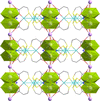
A new nickel coordination polymer electrode material for hybrid supercapacitors, Ni–mba–K(Na) (where H2mba is 2-mercaptobenzoic acid), has been prepared successfully. As a hybrid capacitor electrode material, Ni–mba–K(Na) exhibits the characteristics of battery-type electrode materials but demonstrates a capacitor-level power density and cycling stability. This structure and performance have rarely been investigated.
CCDC reference: 2533014
Download citation
Download citation
Single-crystal X-ray diffraction studies of Cu, Pd and Rh complexes with 2-(pyridin-2-ylamino)ethanol (L1) revealed how ligand flexibility governs coordination geometry, supramolecular organization and crystallization behaviour. These results provide valuable structural insights for the rational design of thermolabile ionic traps incorporating thermosensitive moieties.
Download citation
Download citation
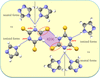
The supramolecular architectures of five azole active pharmaceutical ingredients (econazole, luliconazole, isavuconazole, voriconazole and posaconazole) with trithiocyanuric acid have been characterized, with particular emphasis on their hydrogen-bonding functionalities. Four-molecule assemblies formed via N—H⋯N/S hydrogen bonds are analyzed using QTAIM and pairwise interaction energy calculations to elucidate their stability and energetics.
Download citation
Download citation
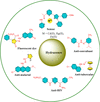
The crystal structure of a fluorenone-based bis-hydrazone consists of two fluorene subunits connected by a conjugated =N—N=C—C=N—N= chain. Although the molecule contains bulky fluorenyl moieties on the termini of the conjugated chain, no polymorphs or solvated phases were obtained. Two methyl groups were found to be located in trans positions with respect to one another, thereby providing extra stability to the rigid bis-hydrazone.
CCDC reference: 2502370