

 menu
menu


issue contents
July 2026 issue
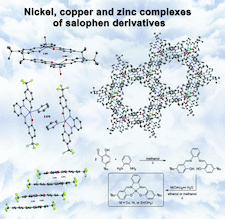
Cover illustration: The structures of late first-row transition-metal (Ni, Cu, and Zn) complexes of salophen derivatives are reported. This family of compounds showcases the ease with which peripheral modifications can be made to salophen systems, including the installation of basic sites in the metal secondary coordination sphere. See Seymour Jr, Amsbaugh, Colcord, Fejes, Gebhardt, Yap & Deegan [Acta Cryst. (2026), C82, 336–350].
scientific commentaries


Free 
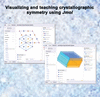
Jmol Space Group Symmetry Visualizer [Johnston & Hanson (2026). Acta Cryst. C82, 258–266] represents a valuable contribution to crystallographic education and practice. Its significance lies in making symmetry visible, manipulable and shareable in a browser-based environment.
feature articles

Open access
access
Over 2000 previously unpublished crystal structures have been deposited in the Cambridge Structural Database as CSD Communications in a project to make the results of public funding available to the scientific community.
early career research

Download citation


Download citation
Open access
access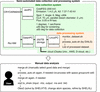
A semi-automated MicroED data collection and processing system was established and shown to be suitable for the structural investigation of submicrometer-scale biogenic crystals.
Download citation
Download citation
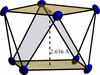
A homopolyatomic bismuth cluster compound, Bi8[AlBr4]2 was successfully synthesized through a one-pot reaction in a Lewis acidic ionic liquid (LAIL) reaction media, and its crystal structure was characterized via single-crystal X-ray diffraction. The electronic structure investigation reveals that the compound exhibits semiconducting behavior with a direct band gap of 1.51 eV.
CCDC reference: 2563714
research papers
Download citation
Download citation
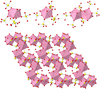
Three rare-earth selenates of ytterbium and thulium were synthesized by hydrothermal methods. Single-crystal X-ray diffraction analysis shows that all three compounds form three-dimensional framework structures constructed from interconnected LnOx polyhedra (Ln = Yb, Tm; x = 7–8) and selenate (SeO42−) and/or selenite (SeO32−) groups.
Download citation
Download citation
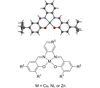
The structures of late first-row transition-metal (Ni, Cu, and Zn) complexes of salophen derivatives are reported. This family of compounds showcases the ease with which peripheral modifications can be made to salophen systems, including the installation of basic sites in the metal secondary coordination sphere.
Download citation
Download citation
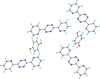
Seven new crystal structures of 3,6-bis(pyridin-2-yl)- and 3,6-bis(pyridin-4-yl)-1,2,4,5-tetrazine with halogen- and hydrogen-bond donors reveal how pyridyl orientation and donor type govern supramolecular assembly, producing hydrogen-bonded triads and chains. Variations in pyridine-to-tetrazine dihedral angles, stacking, and donor interactions highlight the tunability of these tetrazines for directing crystal packing and noncovalent interactions in designed materials.
Download citation
Download citation
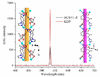
Two chiral coordination polymers based on a new lactic acid derivative ligand show efficient transfer from central chirality to helical chirality and exhibit notable SHG responses.
Download citation
Download citation
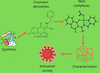
The characterization and description of the crystal structures of new halogenated coumarin derivatives and their nickel(II) complexes are reported alongside their anticancer activity.