

 menu
menu


issue contents
August 2026 issue
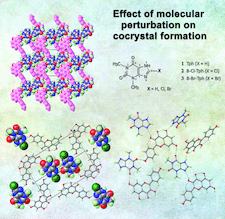
Cover illustration: The tendency for alkaloid–flavonoid cocrystal formation is found to be markedly different for theophylline (Tph) compared to its 8-halo analogues. Through screening with 13 common flavonoids, Tph is found to form cocrystals with six flavonoids, whereas 8-Cl-Tph and 8-Br-Tph each form cocrystals with just two, myricetin and kaempferol. The weakening of the alkaloid N9 atom as a hydrogen-bond acceptor towards the hydrogen-bond-donor-rich flavonoids may play a role in this differing tendency. See Ye, Sung & Williams [Acta Cryst. (2026), C82, 414–426].
best practice series


Open  access
access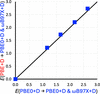
This article describes best practices for `zero Kelvin' energy calculations on molecular crystals and is targeted for non-experts who would like to perform their own calculations or assess the accuracy and validity of such calculations reported in the scientific literature.
early career research

Download citation


Download citation
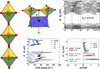
A new heteroanionic rare-earth chlorosilicate, Pr3Cl5[SiO4], was synthesized by a self-flux-assisted high-temperature reaction. Single-crystal X-ray diffraction shows that it crystallizes in the orthorhombic space group Pnma and contains orientationally disordered discrete [SiO4]4− tetrahedra within a three-dimensional Pr–Cl/O framework. Electronic structure calculations indicate a wide indirect band gap of ∼4.53 eV, with bonding dominated by strong Si—O interactions.
CCDC reference: 2565032
Download citation
Download citation
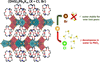
The structure of a disordered porous metal halide semiconductor, namely, (DHS)2Pb5Cl14 (DHS is double-protonated [2.2.2]cryptand), is reported, along with the evaluation of its water stability and its correlation with the composition of the inorganic part.
CCDC reference: 2558390
research papers
Download citation
Download citation
Open access
access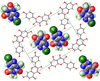
The tendency for alkaloid–flavonoid cocrystal formation is found to be markedly different for theophylline (Tph) compared to its 8-halo analogues. Through screening with 13 common flavonoids, Tph is found to form cocrystals with six flavonoids, whereas 8-Cl-Tph and 8-Br-Tph each form cocrystals with just two, myricetin and kaempferol. The weakening of the alkaloid N9 atom as a hydrogen-bond acceptor towards the hydrogen-bond-donor-rich flavonoids may play a role in this differing tendency.
Download citation
Download citation
Open access
access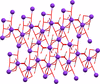
The crystal structures of eight salt forms of the carboxylate-functionalized monoazo dye Mordant Orange 1 are presented and discussed, primarily in terms of their coordination behaviour.
Download citation
Download citation
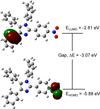
Crystals from a tetrasubstituted 1H-imidazole were obtained and theoretical calculations were carried out to determine electronic and structural properties. Weak interactions define the crystal packing in this sterically demanding compound. The nitro groups play a key role by their influence on the polarization of the molecule.
CCDC reference: 2444299
Download citation
Download citation
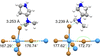
A novel Dion–Jacobson hybrid perovskite, (R)-3-(dimethylamino)pyrrolidinium tetrabromidoplumbate(III), with a single chiral organic cation, was successfully synthesized and undergoes a reversible first-order isomorphic structural phase transition at 448 K, accompanied by obvious thermal hysteresis.
Download citation
Download citation
Open access
access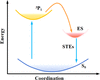
The hybrid halide [H2bpa][SbCl5] [H2bpa is 4,4′-(ethane-1,2-diyl)dipyridin-1-ium] exhibits efficient orange emission centred at 600 nm with a photoluminescence quantum yield of 65.57%.
CCDC reference: 2543274
Download citation
Download citation
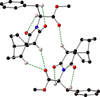
The crystal structures of five imides are reported and contain intermolecular C—H⋯O and C—H⋯F hydrogen bonds along with intermolecular C—H⋯π and π–π interactions. The synthetic conditions employed in this chemistry, along with NMR and LR-MS characterization data, are also included.
Download citation
Download citation
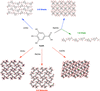
The rich coordination chemistry of gallic acid has been explored by treatment of the acid with alkali metal acetate salts. The crystal structures of six new alkali metal-based coordination polymers of gallic acid have been obtained using single-crystal X-ray diffraction techniques.