


 menu
menu


issue contents
September 2026 issue
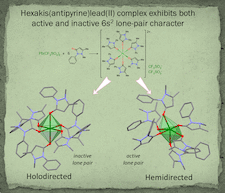
Cover illustration: Single-crystal X-ray diffraction studies on [Pb(anti)6]X2 (anti = antipyrine; X = OTf− and ClO4−) compounds revealed for the triflate salt, the formation of two polymorphs with both holodirected regular octahedral geometry (eccentricity value ɛ = 0) and hemidirected symmetry of a ψ-pentagonal bipyramid (ɛ = 0.14). This work demonstrates, for the first time, that one lead(II) ion can exhibit both active or inactive 6s2 lone-pair character in a complex. See Krzysztof Łyczko & Monika Łyczko [Acta Cryst. (2026), C82, 524–533].
scientific commentaries


Free 
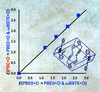
The tutorial on best practices in `0 K' DFT energy calculations on molecular crystal structures by van de Streek & Johnson [Acta Cryst. (2026), C82, 383–400] provides a highly accessible and practical guide for performing reliable periodic density functional theory calculations in organic crystals.
early career research

Download citation


Download citation
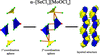
Moisture-sensitive trichloridoselenium tetrachloridooxidomolybdate, α-[SeCl3][MoOCl4], was synthesized from MoOCl4 and Se2Cl2, and structurally characterized by single-crystal X-ray diffraction, revealing a layered ionic solid comprising [SeCl3]+ cations and dimeric [Mo2O2Cl8]2− anions linked through secondary Se⋯Cl interactions, with electronic structure analysis indicating semiconducting behavior.
CCDC reference: 2577134
Download citation
Download citation
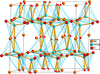
Alumina crucibles act as unintended aluminium sources in Pb-flux syntheses, yielding two heavily disordered metal oxides, with Pb3GeAl10O20- and BaZnGeO4-related structures.
Download citation
Download citation
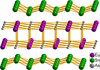
EuSnAs was discovered as the first arsenide adopting the tetragonal NbCrN structure type and its layered structure features corrugated Sn sheets separated by [EuAs] slabs.
CCDC reference: 2579686
research papers
Download citation
Download citation
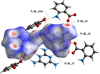
Three hydrous triaminopyrimidine (TAP) salts were synthesized and structurally characterized. All three exhibit protonation at the N1 position and form R22(8) TAP–carboxylate heterosynthons. Structural diversity arises from anion topology and hydration, yielding tetramers, chains and 3D frameworks. Hirshfeld analysis highlights dominant H⋯H contacts, with O⋯H and N⋯H interactions directing supramolecular assembly and dimensionality.
Download citation
Download citation
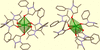
Single-crystal X-ray diffraction studies on [Pb(anti)6]X2 (anti = antipyrine; X = OTf− and ClO4−) compounds revealed for the triflate salt, the formation of two polymorphs with both holodirected regular octahedral geometry (eccentricity value ɛ = 0) and hemidirected symmetry of a ψ-pentagonal bipyramid (ɛ = 0.14). This work demonstrates, for the first time, that one lead(II) ion can exhibit both active or inactive 6s2 lone-pair character in a complex.
Download citation
Download citation
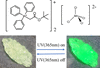
A novel phosphonium-based manganese(II) hybrid crystal, (TBTP)2[MnCl4] [TBTP is (tert-butoxycarbonyl)methyltriphenylphosphonium], displays green luminescence with a millisecond-scale lifetime (515 nm, 2.83 ms), attributed to the Mn2+ 4T1→6A1 transition. Electronic structure analysis reveals a spatial separation of frontier orbitals, a structural feature that may aid in achieving the long-lived emission.
CCDC reference: 2573766
Download citation
Download citation
Open access
access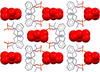
The structures of the hydrous and first anhydrous phases of crystalline psilocybin have been determined using single-crystal X-ray diffraction.
Download citation
Download citation
Open access
access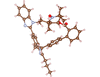
The first crystal structure of the telmisartan–tempol conjugate YK-4-250 is reported, revealing the intramolecular C–H⋯π interactions that stabilize the nitroxide radical while preserving the angiotensin AT1 receptor antagonist pharmacophore.
CCDC reference: 2522559
Download citation
Download citation
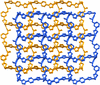
By altering the metal centre and auxiliary ligand, two chiral lactate-based coordination polymers exhibit distinct helical chirality expressions and properties.
Download citation
Download citation
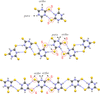
Trithiocyanuric acid forms either R22(8) dimers or linear chain motifs in nitroimidazole cocrystals, giving rise to two competing drug–coformer supramolecular binding schemes.
Download citation
Download citation
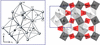
Garnets where the mean-square displacements of the tetrahedral cations are largest in the direction of adjacent dodecahedral cations were discovered through structure refinements of the Na-bearing vanadate garnet series. This peculiar atomic displacement behaviour occurs when the dodecahedral sites are occupied by different cation species with different valences and largely different sizes.
Download citation
Download citation
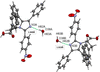
A new imidazole derivative of phenylalanine was synthesized, the crystals displaying dimeric and/or tetrameric structures with unusual water double bridges.
CCDC reference: 2575435