


 menu
menu


issue contents
October 2026 issue
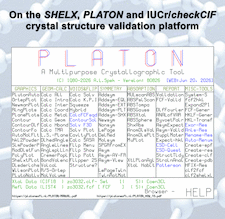
Cover illustration: With checkCIF the IUCr has created a unique platform for the validation and archiving of the result of a small-molecule crystal structure study. See Spek [Acta Cryst. (2026), C82, 595–602].
A Tribute to George Sheldrick


Open  access
access
With checkCIF the IUCr has created a unique platform for the validation and archiving of the result of a small-molecule crystal structure study.
early career research

Open access
access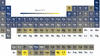
A statistical evaluation of the entries in the Cambridge Structural Database reveals trends in structural quality as described by the accessible quality indicators in the CSD with respect to the structures' publication year and the elements contained.

Download citation


Download citation
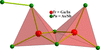
The first As-containing representatives of the Sr5Al2Sb6 structure type are reported. The anionic substructures in Eu5Ga2As6 and Ba5In2As6–xSbx [x = 0.49 (2) and 2.92 (2)] comprise 1D chains of corner- and edge-sharing [TrPn4] tetrahedra with pendant [Pn2] dumbbells (Tr = Ga, In; Pn = As, Sb). The mixed-pnictogen phases reveal site-selective As/Sb substitution as a potential route for tuning the bonding and physical properties of this family.
Download citation
Download citation
Open access
access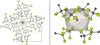
The solvent-free structure of the thallium(I) salt of the weakly coordinating anion tetrakis[3,5-bis(trifluoromethyl)phenyl]borate, Tl[BC32H12F24], exhibits short Tl⋯F contacts and a supramolecular architecture governed by C—H⋯F hydrogen bonds and weak F⋯F and C—F⋯π interactions. Disorder and tilting of the arene rings generate different close-contact motifs, giving rise to hinge-like intermolecular interactions and pronounced anisotropic thermal expansion along the crystallographic a and b axes.
CCDC reference: 2581457
Download citation
Download citation
Open access
access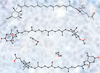
The first small-molecule single-crystal X-ray structure of fucoxanthin is reported, resolving a long-standing crystallographic problem in carotenoid structural chemistry.
CCDC reference: 2584036
Download citation
Download citation
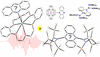
The crystallographic bond metrics of a 1:1 cocrystal containing a potassium–phenazine adduct and a phenazine-bridged homobimetallic zinc(II) complex indicate that the bimetallic zinc component is singly reduced. However, the solution-state electron paramagnetic resonance of this system indicates two distinct phenazine radical environments.
CCDC reference: 2559830
Download citation
Download citation
Open access
access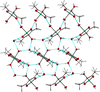
Two cocrystals of trans-NiII(hfac)2(H2O)2 containing cocrystallized water or 1,2-dimethoxybenzene were characterized by single-crystal X-ray diffraction. The hydrogen-bonding networks in each cocrystal were compared to previously reported structures, revealing that NiII(hfac)2(H2O)2 is capable of forming a variety of hydrogen-bond network motifs depending on the nature of the coformers in the crystal structure. Cocrystallization of 1,2-dimethoxybenzene was found to inhibit the formation of extended hydrogen-bond networks.
research papers
Download citation
Download citation
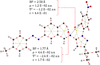
An azo–azomethine–pyrazole donor–π–acceptor hybrid crystallizes with two independent molecules (Z′ = 2) linked through a co-operative network of O—H⋯N, C—H⋯O and C—H⋯N interactions. Hirshfeld surface and QTAIM analyses reveal the hierarchical contribution of strong and weak noncovalent interactions to the conformational stabilization and supramolecular assembly of the crystal structure.
CCDC reference: 2579603
Download citation
Download citation
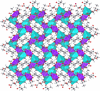
A brief overview of the existing data on related UO22+-containing crystal structures uncovered some peculiarities about three new derivatives. The first crystal structure with simultaneously present H3O+ and Be2+ cations was solved. The rigidity of topology to the change of the nature of the fragments and ways to control the atom environment via the ratio of the reagents are discussed.
Download citation
Download citation
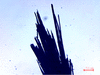
The title compound is a hydrated sodium salt of a nitrosyl iron–sulfur cluster. While retaining the typical [Fe4S3(NO)7]− core framework, a unique one-dimensional hydrogen-bonded supramolecular network is formed induced by Na+. The refinement process properly handled the 60° rotational disorder phenomenon of the anion in this structure.
CCDC reference: 2582104
Download citation
Download citation
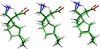
The crystal structures of mirogabalin and mirogabalin besylate have been solved and refined using synchrotron powder X-ray diffraction data, and optimized using density functional theory techniques.
Download citation
Download citation
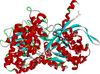
The title Schiff base compound was synthesized by the reaction of 4-(benzyloxy)-2-hydroxybenzaldehyde and 2,4-dimethoxyaniline in a 1:1 ratio. In the crystal, there are two independent molecules in the asymmetric unit and both molecules were refined as having a mixture of the imino–phenol and iminio–phenolate tautomeric forms. The compound exhibits significant inhibition properties.
CCDC reference: 2336543
Download citation
Download citation
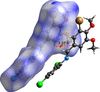
Halogen substitution within a Schiff base induces a twisted molecular conformation with an E configuration around the C=N bond, which strongly influences the supramolecular assembly. The results provide insight into how molecular design can control both the conformation and packing of halogen-substituted Schiff bases, offering avenues for the development of functional materials.
CCDC reference: 2505928
Download citation
Download citation
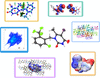
The crystal structure of a key intermediate for Elagolix synthesis was determined and systematically investigated. Structural analysis indicates that the molecule adopts a noticeably twisted `V'-shaped conformation. Weak interaction analyses and 3D energy frameworks demonstrate that the supramolecular network is co-operatively maintained by classical N—H⋯O hydrogen bonds and predominant intermolecular dispersion forces.
CCDC reference: 2574018