


 menu


issue contents
November 2026 issue
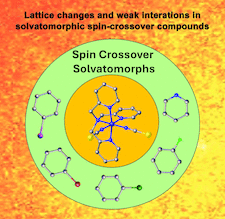
Cover illustration: Five new solvatomorphic spin-crossover compounds were crystallized and structurally characterized. Variable-temperature X-ray diffraction, Hirshfeld surface analysis and NCI plots shed light on the role of weak interactions. See Brüx, Bartusel & Kleemiss [Acta Cryst. (2026), C82, 723–733].
early career research


Download citation


Download citation
Four ionic-liquid-derived hybrid chloride salts containing 1-butyl-3-methylimidazolium, [BMIm]+, cations and isolated [CdCl4]2−, [SeCl6]2−, [SnCl6]2−, and [BiCl6]3− anions were structurally characterized, and electronic structure calculations yield calculated band gaps ranging from 2.91 to 4.44 eV.
Download citation
Download citation
Open  access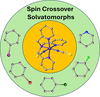
Five new solvatomorphic spin-crossover compounds were crystallized and structurally characterized. Variable-temperature X-ray diffraction, Hirshfeld surface analysis and NCI plots shed light on the role of weak interactions.
CCDC references: 2565651; 2565652; 2565653; 2565654; 2565655; 2565656; 2565657; 2565658; 2565659; 2565660; 2565661; 2565637; 2565638; 2565639; 2565640; 2565641; 2565642; 2565643; 2565644; 2565645; 2565646; 2565647; 2565648; 2565649; 2565626; 2565627; 2565628; 2565629; 2565630; 2565631; 2565632; 2565633; 2565634; 2570240; 2570241; 2570242; 2570243; 2570244; 2570245; 2570246; 2570247; 2570248; 2565664; 2565665; 2565666; 2565667; 2565668; 2565669; 2565670; 2565671; 2565672; 2565673; 2565674
research papers
Download citation
Download citation
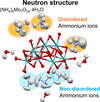
The crystal structure of ammonium molybdate tetrahydrate was investigated using time-of-flight neutron diffraction. Three of the six ammonium ions exhibited hydrogen-site disorder in the asymmetric unit, which was correlated with the surrounding hydrogen-bonding network.
Download citation
Download citation
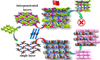
Comparative single-crystal structural analysis of two isoreticular MOFs uncovers a counterintuitive relationship in interpenetration hierarchy. In the Cd-based framework, twofold interpenetrated 2D layers are densely packed, which blocks 3D catenation, whereas loosely packed Co-based layers permit extensive 3D interpenetration. The study establishes that metal–node geometry governs the packing density of 2D layers, which in turn determines the ultimate 3D topology and solvent-accessible void volume.
CCDC reference: 950271
Download citation
Download citation
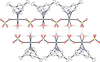
The crystal structures of six transition-metal compounds of the form [M(SO4)(C6H7N)2(H2O)2]n are presented, where M = Mn, Co, Ni, Cu, Zn, and Cd. The isostructural compounds form infinite chains of octahedral metal centres bridged by sulfate anions. Two chains are joined together through hydrogen bonds to form infinite double chains in each structure.
Download citation
Download citation
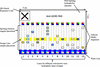
The structures of a famotidine–copper(II) chloride complex and a famotidine propionic acid–cobalt(II) tetrachloride are reported. These compounds have implications in the colorimetric measurements on Paper-Based Analytical Devices (PADs).