

 menu
menu


issue contents
August 2026 issue
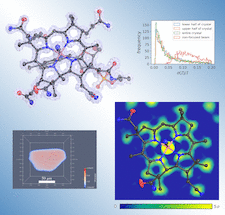
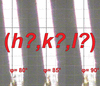
Cover illustration: Li et al. [J. Appl. Cryst. (2026), 59, 1200–1218] introduce the use of X-ray convergent-beam diffraction to obtain spatially resolved structural information from crystals by projection topographic imaging. The cover image illustrates application of the approach to a vitamin B12 crystal.
research papers


Open  access
access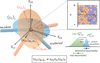
This work demonstrates that diffraction-based residual strain calculations and uncertainty estimates depend on how grain populations are sub-sampled, with important implications for interpreting residual stresses in heterogeneous materials with fine-scale microstructure and strain gradients.
Open access
access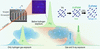
Powder diffraction is used to reveal X-ray-induced hydride formation in palladium nanowires in a gaseous hydrogen environment.
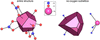
This work provides a unified crystallographic description of a series of rare-earth nitrate hydrates, [RE(NO3)3(H2O)n]·xH2O (RE = La–Lu, Y), and their aqueous solutions. The findings integrate X-ray diffraction, EXAFS, topological descriptors and computational modelling to offer transferable methodologies for interpreting structural anomalies in coordination compounds and precursors for functional materials.
Open access
access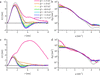
Pair distance distribution functions of interacting ellipsoidal particles can be hard to interpret. This difficulty can be circumvented partially by the generalized indirect Fourier transformation.
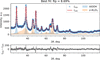
A full-profile quantitative X-ray phase analysis method is developed for mixtures of low-temperature aluminium oxides and pseudoboehmite, combining experimental and calculated (via the Debye scattering equation) reference profiles. The approach provides high accuracy for model γ-Al2O3/χ-Al2O3 and γ-Al2O3/AlOOH mixtures and is applicable to complex nanocrystalline oxide and catalyst systems with poorly described diffraction patterns.
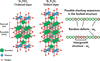
This study investigates the impact of correlated Ruddlesden–Popper faults on the diffraction patterns of tetragonal A2BO4-type structures, using Sr2TiO4 as a representative example. Simulations demonstrate that these correlations give rise to distinctive diffraction features – including intensity redistribution, anisotropic peak broadening and diffuse scattering – that distinguish coherent intergrowths of Sr2TiO4 and Sr3Ti2O7 from conventional two-phase systems.

The purpose of this study was to develop a novel machine learning integrated framework for predicting the crystallization kinetics of amorphous drugs doped with low-concentration polymer. Several critical features influencing crystallization of amorphous solid dispersions were identified, encompassing active pharmaceutical ingredient related molecular descriptors and polymer-specific properties.

Download citation


Download citation
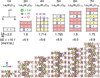
The structure and composition of metastable (N×H)-polytypes, N ∈ {3, 4, 5, 6, 7}, belonging to the family of La2WO6-related tungstates, are revealed by means of a La–O–W ternary convex hull construction based on density functional theory.
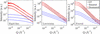
A non-iterative analytical framework based on truncated Abel inversion is developed for desmearing slit-geometry ultra-small-angle neutron scattering data. The method directly relates measured and intrinsic intensities without iterative or empirical corrections, and achieves accurate and stable recovery of scattering profiles. Application to polymer-blend data demonstrates smooth continuity with small-angle neutron scattering measurements, enabling rigorous and model-independent data integration.

A systematic study of bent Si(111) analyser crystals evaluates the effects of growth method, surface treatment and thickness on neutron reflection performance. The results identify optimal crystal characteristics for future high-resolution neutron backscattering spectrometers, including MIRACLES at the European Spallation Source.
Open access
access
NeuDiff Agent accelerates the TOPAZ single-crystal neutron diffraction workflow at the Spallation Neutron Source from measured data to a structure suitable for publication through governed tool execution, auditable provenance and checkCIF assessment.
Open access
access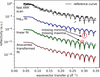
X-ray reflectometry is accelerated to 213 µs net exposure time using galvanometer scanning, which enables unprecedented temporal resolution for studying dynamic thin-film processes.
Open access
access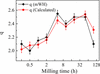
This study emphasizes the physical interpretation of Stephens' phenomenological parameters with respect to the nature of dislocations in cubic symmetry, validated through illustrative examples based on modified Williamson–Hall plot analysis.
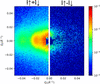
Structural and magnetic ordering in a ferrofluid consisting of hard magnetic SrFe12O19 nanoplatelets is studied by polarized small-angle neutron scattering in magnetic fields up to 1000 Oe. The results reveal consecutive and reversible transitions of the isotropically disordered phase existing at H < 20 Oe into a 1D-nematic columnar structure at 20 < H < 250 Oe, followed by rearrangement to smectic-like lateral ordering with collinear magnetization in neighboring columns above H = 250 Oe.
Open access
access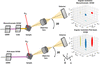
A quantitative comparison between pink-beam and monochromatic dark-field X-ray microscopy (DFXM) shows that pink-beam DFXM offers up to two orders of magnitude higher flux and improved signal-to-noise ratio for time-resolved imaging, at the expense of an approximately tenfold loss in angular resolution. The results establish performance criteria and experimental strategies for optimizing pink-beam DFXM in studies of microstructure and strain evolution in crystalline materials.
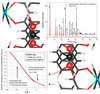
In situ small-angle X-ray scattering (SAXS) and powder X-ray diffraction (XRD) studies, combined with density functional theory (DFT), are used to gain new insights into the variable structure and ordering of a 1-D coordination polymer under different gas pressure conditions. It is demonstrated how DFT calculations can elucidate SAXS and XRD studies of variable or uncertain structures when unambiguous single-crystal XRD determinations cannot be fully realized.
Open access
access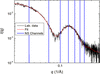
We present a model-independent approach based on the Shannon sampling theorem to retrieve key structural parameters of proteins and core–shell micelles directly from small-angle X-ray scattering (SAXS) profiles. By bypassing the pair distribution function, the method overcomes q-truncation artifacts and provides reliable mass, size and aggregation number estimates even from noisy laboratory data. This formalism enables fast, robust and high-throughput analysis for both in situ and operando experiments.
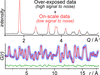
We report a data-healing strategy that restores saturated intensities and expands the usable dynamic range of total scattering measurements.
Open access
access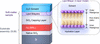
We demonstrate a Fisher-information-based strategy for optimizing the solid substrate structure in polarized neutron reflectometry experiments on soft-matter samples. The approach identifies magnetic reference layer designs that improve experimentally accessible information and provides a general framework for more efficient reflectometry experiment planning.
Download citation
Download citation
Open access
access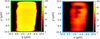
Molecular crystal diffraction with a highly focused X-ray beam decouples crystal morphology and molecular structure by measuring magnified topographs from every reflection.
CCDC reference: 2554990
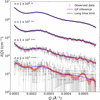
Bonse–Hart ultra-small-angle neutron scattering measurements are often limited by counting statistics. By taking advantage of the smooth variation of I(Q) with Q, we show that Gaussian-process-based inference can recover the main structural features of the scattering profile from lower-count data and can identify when further counting no longer improves precision because instrument discretization becomes limiting.
Download citation
Download citation
Open access
access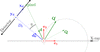
A measurement protocol and data reduction workflow are presented for obtaining single-crystal X-ray total-scattering datasets on an absolute scale, capturing both Bragg and diffuse intensities from the same dataset. The study demonstrates consistency between scale factors derived from Bragg refinements and from spherical integration of the total-scattering signal against a theoretical baseline, paving the way for structural refinements that simultaneously fit both contributions.
CCDC reference: 2562362
Open access
access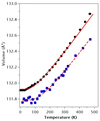
Temperature-dependent single-crystal X-ray, powder X-ray and neutron diffraction measurements reveal the thermal expansion behavior of FeWO4 from 2 to 1123 K. Significant differences between natural ferberite and a FeWO4:Fe2WO6 composite highlight the influence of multiphase and microstructural effects on derived thermoelastic parameters.
Open access
access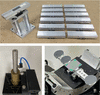
With the recent gain in popularity of grazing-incidence instruments, harmonization is needed to establish intercomparability. This review of existing instruments and methods highlights the diversity of approaches in the community and is a first step towards reference methods.
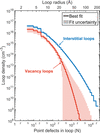
A rigorous integral X-ray diffuse scattering (XRDS) method is presented for experimentally determining separate size distributions for interstitial- and vacancy-type dislocation loops in irradiated single-crystalline materials. This new capability is facilitated by a numerical formulation for directly evaluating the integral XRDS intensities associated with individual defect clusters, and the technique is demonstrated by analyzing measurements of ion-irradiated tungsten that show distinct size distributions for the two loop types.
Open access
access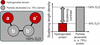
Segmental deuteration, combined with inverse contrast-matching small-angle neutron scattering (iCM-SANS) and small-angle X-ray scattering (SAXS), provides structural constraints that improve discrimination of conformation ensembles of multi-domain proteins derived from molecular dynamics (MD) simulations.
Open access
access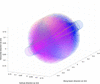
A neutron microscope is presented comprising a Wolter-I nested mirror optic as condenser and a 2D array of neutron achromats as objective.

This work introduces an integrated protocol that combines computational modeling, microscopy and directed single-crystal X-ray diffraction to unambiguously identify the bending geometry in flexible organic crystals, overcoming the limitations of conventional methods. Applied to three model compounds, the protocol definitively resolved their active slip systems, providing a robust and generalizable framework essential for establishing reliable structure–property relationships in this field.
Open access
access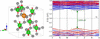
First-principles calculations suggest the tetragonal space group P43212 for the multiferroic compound α-LiFe5O8, with a direct band gap smaller than that in its widely known cubic space group P4332. The tetragonal lattice distortion a > c is explained by relatively strong antiferromagnetic exchange interactions parallel to the c axis and by Fe–O–Fe magnetic superexchange interactions, consistent with Fe 3d–O 2p hybridization.
Open access
access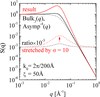
For porous and/or bicontinous structures with rather broad correlation peaks and small diffuse scattering, a heuristic theory makes the connection to conditions of material production.
short communications
Open access
access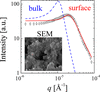
A new example for coherent multiple scattering is presented that confirms the Teubner–Strey model with its surface scattering for porous materials.
Open access
access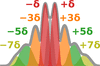
The temperature evolution of the high-harmonic incommensurate magnetic ordering of Dy3+ in DyFeO3 orthoferrite is compared with the literature results on the soliton lattice of TbFeO3 observed in an external magnetic field.
CIF applications
Open access
access
The mmCIF Validator provides real-time automated validation of mmCIFs against a valid PDBx/mmCIF dictionary. The validator is available as both a Visual Studio Code extension and a standalone Python script for integration into automated workflows.
computer programs
Open access
access
XRD-Rust is a Rust-accelerated reimplementation of the computational core of the pymatgen powder X-ray diffraction calculator that preserves full Python workflow compatibility while significantly improving performance for large-scale simulations. Benchmarks on large crystallographic databases show average speedups of 4–6× and peak gains of up to 719×, enabling efficient high-throughput dataset generation and faster interactive diffraction analysis.
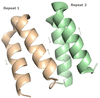
The Rep3D algorithm has been developed to enable rapid and accurate identification of repeats in the three-dimensional structure of proteins, significantly improving our understanding of protein functions and interactions.
laboratory notes
Open access
access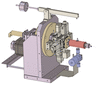
Gas-controlled capillary spinner for time-resolved powder X-ray diffraction under dynamic conditions
The newly developed gas-controlled capillary spinner enables continuous high-speed sample rotation during in situ powder X-ray diffraction under dynamic gas conditions. By improving the uniformity of the diffraction intensity, this system enables reliable millisecond time-resolved structural analysis for operando studies.