


 journal menu


issue contents
 access
July 2025 issue
scientific commentaries


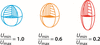
Combining improved diffraction methods, modeling approaches and advanced computations allows for a detailed understanding of atomic thermal motions in crystals. Thus, the Topical Review by Hoser & Madsen [(2025). IUCrJ 12, 421–434] covers the Debye–Waller factor, the importance of anisotropic displacement parameters, and the interplay of experiment and theory to accurately capture collective atomic vibrations in molecular crystals.
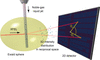
Crystallization is a fundamental non-equilibrium process in materials science, yet its early transient states remain difficult to probe experimentally. Möller et al. [(2025). IUCrJ 12, 462–471] use femtosecond X-ray scattering and X-ray cross-correlation analysis to reveal the structural evolution of defect-containing crystals forming in a supercooled noble-gas liquid.
topical reviews
MATERIALS | COMPUTATION

This review commemorates the centenary of the Debye–Waller factor, highlighting its significance in quantifying the impact of thermal vibrations on scattering intensities as well as on crystal properties in small-molecule crystallography. It provides an introduction to thermal motion and displacement parameters, offering insights for chemists and crystallographers.
research papers
MATERIALS | COMPUTATION
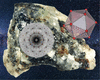
A single grain of the icosahedral AlCuFe quasicrystal extracted from the Khatyrka meteorite has been studied by means of high-resolution synchrotron X-ray diffraction at the ESRF. We found that the mineral is a phason-wave modulated icosahedral quasicrystal, a feature already observed for synthetic quasicrystals. This result might be used as a tracer to shed light on the thermal history of the meteorite.
MATERIALS | COMPUTATION


The refinement flexibility of the Hansen–Coppens multipole model is tested on DFT calculated structure factors for the tetrakis(μ-acetato)diaquadicopper model system. The Cu scattering factor performs the best of all the options tried for most of the monitored parameters despite the Cu2+ nature of the complex studied. The Hansen–Coppens model performs similarly well when comparing deviations among computational chemistry methods.
PHYSICS | FELS

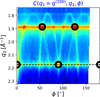
We demonstrate an advanced scattering method for accessing the 3D reciprocal space of crystalline structures forming in a rapidly supercooled noble-gas liquid using a combination of femtosecond X-ray diffraction and X-ray cross-correlation analysis.
MATERIALS | COMPUTATION
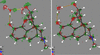
Single-crystal X-ray structures measured at around 20 K to high resolution were refined with structure-specific restraints from quantum chemical molecule-in-cluster and full-periodic computations, which permits benchmarking levels of theory of varying sophistication. Restraints can then `augment' low-quality crystal structures, with other possible applications.
BIOLOGY | MEDICINE

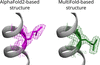
A set of crystallographic structures has been obtained for the small antiviral protein LCB2 using molecular replacement models from six different structure-prediction programs. This set of structures can be interpreted as a multiconformer ensemble, improving quality metrics and offering an interesting insight into side-chain dynamics.
CRYO | EM
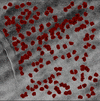
Vitreous sectioning (CEMOVIS) is an alternative to FIB milling for generating thin samples suitable for cryo-EM imaging. We show that CEMOVIS samples preserve the high-resolution structural details of macromolecular complexes such as the 60S ribosome, despite the visible macroscopic damage visible in the samples.