journal menu


issue contents
 | STRUCTURAL BIOLOGY |
ISSN: 2059-7983
CCP-EM Spring Symposium 2019
Edited by Tom Burnley, John Briggs, Rebecca Thompson and Paula da Fonseca
This virtual issue collects together articles from the 2019 CCP-EM Spring Symposium.



Open  access
access
Amyloid structure determination in RELION is increasingly popular, but may suffer from refinements becoming stuck in local minima. This paper describes a new method for initial model generation that may alleviate this problem.
Open access
access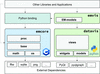
This article presents an overview of the development of two basic software libraries for image manipulation and data visualization in cryo-EM: emcore and emvis.

Open access
access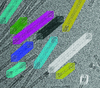
Two approaches for the selection of filaments from cryo-EM micrographs are described.
Open access
access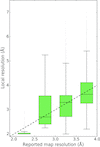
A new module of the ARP/wARP suite for automated model building into cryo-EM maps is presented.
Open access
access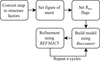
The model-building software Buccaneer has been repurposed based on existing methods for building models into cryo-EM maps. These approaches are implemented in the latest CCP-EM model-building pipeline (version 1.4.0).

Open access
access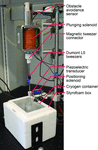
A method is presented for high-speed low-volume cryo-EM specimen preparation with a device constructed from readily available components.
EMDB reference: apoferritin, EMD-20837
Open access
access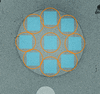
Methods for obtaining the maximum out of a cryo-EM data-collection session are described.
Open access
access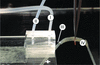
Sample preparation within single-particle cryo-electron microscopy can still be a significant bottleneck, with issues in reproducibility, ice quality and sample loss. New approaches have recently been reported that use spraying or pin printing instead of the traditional blotting approach. Here, experience in the use of different nozzle designs and spraying regimes is reported together with their influence on the resulting spray and grid quality.
EMDB reference: apoferritin, EMD-10533
Open access
access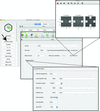
The concept of statistical signal detection by controlling the false-discovery rate (FDR) to aid the atomic model interpretation of cryo-EM density maps is reviewed. The recommended usage of the FDR software tool is presented together with its successful integration into the CCP-EM suite.