

 journal menu


issue contents
January 2023 issue
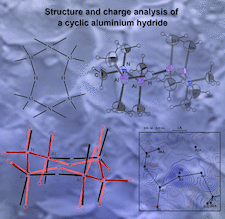
Cover illustration: The title compound crystallizes as eight-membered rings with –(CH3)2Al–(CH3)2N–(CH3)2Al– moieties connected by single hydride bridges. The molecular structures and partial atomic charges determined both by X-ray methods and by DFT calculations are compared. See Corfield & Schrier [Acta Cryst. (2023), C79, 12–17].
scientific commentaries


Open  access
access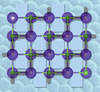
The article of Yamashita et al. [Acta Cryst. (2022), C78, 749–754] on water intercalation into the B1 structure of KCl under high pressure illustrates the ability of in situ crystal growth to by-pass kinetic barriers between phases, demonstrating the importance of this approach in phase discovery.
research papers

Download citation


Download citation
Open access
access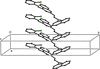
Three new styrylquinoline–chalcone hybrids are been syntheized using a three-step reaction sequence. In two of them, a combination of hydrogen bonds and π–π stacking interactions generates three-dimensional assemblies, but in the third, only a single weak π–π stacking interaction is present, linking the molecules into chains.
Download citation
Download citation
Open access
access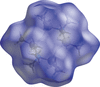
The title compound crystallizes as eight-membered rings with –(CH3)2Al–(CH3)2N–(CH3)2Al– moieties connected by single hydride bridges. The molecular structures and partial atomic charges determined both by X-ray methods and by DFT calculations are compared.
CCDC reference: 2222230
Download citation
Download citation
Open access
access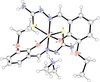
The FeIIIS2N2O2 chromophore contains two O,N,S-donating dianionic ligands in perpendicular planes, with the O and S atoms in cis and the N atoms in trans positions. The FeIII ion is in the high-spin state at 100 K. The variable-temperature magnetic susceptibility measurements (5–320 K) are consistent with the presence of a high-spin S = 5/2 FeIII ion.
CCDC reference: 2223775