


 journal menu


issue contents
November 2025 issue
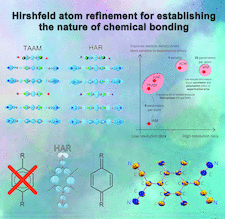
Cover illustration: The performance of the Hirshfeld atom refinement (HAR) and transferable aspherical atom model (TAAM) approaches in crystal structure refinement and the determination of the nature of chemical bonds is compared for a series of quinone-like compounds, known for single-double bond alternation. The HAR approach is shown to adequately reproduce the bond alternation in the electron-density distribution, while the TAAM approach does not perform as well in such specific cases. See Cieszyński, Krzeszczakowska & Makal [Acta Cryst. (2025), C81, 648–657].
scientific commentaries


Free 

Powder diffraction is a widespread technique found in academic, forensic, industrial research and quality-control laboratories the world over. The recent article by Kabova et al. [(2025), Acta Cryst. C81, 559–569] provides step-by-step guidance on how to proceed and the software the authors use, from sample preparation and the powder diffraction measurement itself, to the verification of the final structure.
research papers

Download citation


Download citation
Open access
access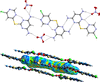
A dissymmetric pyrimidine thioether N,N′-bidentate ligand was synthesized along with its hydrated form, nitrate salt and a cobalt(II) complex. All four structures were characterized by single-crystal X-ray diffraction and Hirshfeld surface analysis to evaluate their potential for ion sensing via hydrogen-bonding interactions.
Download citation
Download citation
Open access
access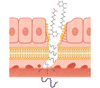
This study presents the first comprehensive crystallographic characterization of salcaprozoic acid (HNAC), the free acid form of salcaprozate sodium (SNAC), using single-crystal X-ray diffraction. A well-organized hydrogen-bonding framework underpins the robust crystal packing and thermal stability of the compound. Complementary IR spectroscopy highlighted the impact of hydrogen bonding on vibrational modes.
CCDC reference: 2451829
Download citation
Download citation
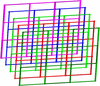
In the presence of 4-[4-(1H-imidazol-1-yl)phenyl]pyridine (ipp), containing imidazole and pyridine groups, the carboxylic acid ligand 2-methoxyterephthalic acid (H2mta) undergoes a self-assembly reaction with CoII ions, forming a three-dimensional coordination polymer, {[Co(mta)(ipp)]·H2O}n, with four distinct helical chains and a fivefold interpenetration feature.
CCDC reference: 2482773
Download citation
Download citation
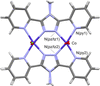
A new CoII dimer with bridging bis(pyridyl)pyrazolate ligands has been structurally characterized and its high-spin nature has been verified by DFT calculations. This work provides an important insight into the correlation between the structural features and the electronic properties of related CoII dimers with an implication of their relevance to reactivity in various types of catalysis.
CCDC reference: 2492073
Download citation
Download citation
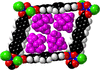
The investigation focuses on a terphenyl compound functionalized with a carboxylate and a hydroxyl group, located at opposite ends of the molecule. The structures of the neutral acid, along with various anionic forms of the molecule, including Zn coordination polymers, are described.
Download citation
Download citation
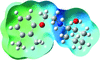
Four new crystal structures of salts of N-[(2,3-dimethylphenoxy)alkyl]aminoalkanol derivatives with anticonvulsant activity are reported. The crystal packing of all the salts is dominated by charge-assisted hydrogen bonding between the protonated N atom and the carboxylate group of the corresponding acid. The conformations of the cations are very similar to those obtained using theoretical calculations, with lowest energy for both the gas and the liquid phases.
Download citation
Download citation
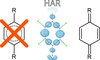
The performance of the Hirshfeld atom refinement (HAR) and transferable aspherical atom model (TAAM) approaches in crystal structure refinement and the determination of the nature of chemical bonds is compared for a series of quinone-like compounds, known for single–double bond alternation. The HAR approach is shown to adequately reproduce the bond alternation in the electron-density distribution, while the TAAM approach does not perform as well in such specific cases.
Download citation
Download citation
Open access
access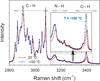
The crystal structure of the metastable form of S-ibuprofen–nicotinamide cocrystals was solved from powder X-ray diffraction data and explains the main mechanisms responsible for the relative stability of the two forms of the cocrystals. This also made it possible to explain the transition mechanism between the two forms with temperature.
CCDC reference: 2495679
Download citation
Download citation
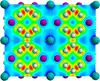
MgNi2B6 crystallizes as a new representative of the CeCr2B6 structure type. The coordination polyhedra around the Mg atoms are based on centred hexagonal prisms. The environment of the Ni atom is a 10-vertex polyhedron. The B atoms form an eight-membered channel along b, which is filled with Mg and Ni atoms. Electronic structure calculations show a strong B–B interaction.
CCDC reference: 2495417
Download citation
Download citation
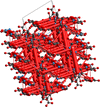
The role of intermolecular interactions in the 1:1 gallic acid–N-methylurea cocrystal was characterized using Hirshfeld surface analysis and energy-framework approaches. Special attention was paid to the system of O—H⋯O and N—H⋯O hydrogen bonds that links the components into dimeric complexes. The possibility of proton transfer within this supramolecular heterosynthon was examined using quantum-chemical calculations.
CCDC reference: 890612