menu
menu


issue contents
September 2026 issue
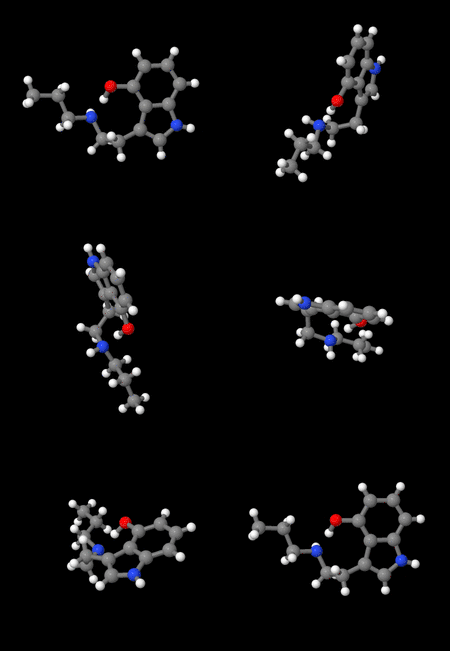
Cover illustration: It is known that an increase in the steric bulk of the methyl group of norpsilocin (4-hydroxy-N-methyltryptamine or 4-OH-NMT) influences the psychoactive effects in animal models. The synthesis and crystal structure of two such derivatives, N-ethyl-4-hydroxytryptamine (4-OH-NET) and 4-hydroxy-N-propyltryptamine (4-OH-NPT), are described. See: Naeem, Chadeayne, Golen & Manke [Acta Cryst. (2026). E82, 1082–1086].
A Tribute to George Sheldrick


Download citation


Download citation
Two crystallographically independent molecules are present in the asymmetric unit of the title compound. C—H⋯O, N—H⋯O, C—H⋯π and π–π contacts connect molecules in the crystal.
CCDC reference: 1540677
early career research
Download citation
Download citation
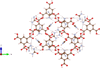
The redetermined structure of 3:1 urea/trimesic acid, 3CO(NH2)2·C6H3(CO2H)3, has monoclinic (P21/c) symmetry. The compound has a hydrogen-bonding network structure of high interest for crystal engineering.
CCDC reference: 2561710
Download citation
Download citation
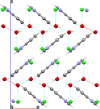
The title benzimidazolium chloride hydrate crystallizes in the orthorhombic space group Pnma. It was isolated as an unexpected product from a reaction mixture containing NbCl5 and o-phenylenediamine.
CCDC reference: 2562397
Download citation
Download citation
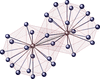
The previously unreported intermetallic compound BaCu5 crystallizes in the rare SrZn5 structure type, completing a missing composition in the alkaline-earth copper family.
CCDC reference: 2579957
research communications
Download citation
Download citation

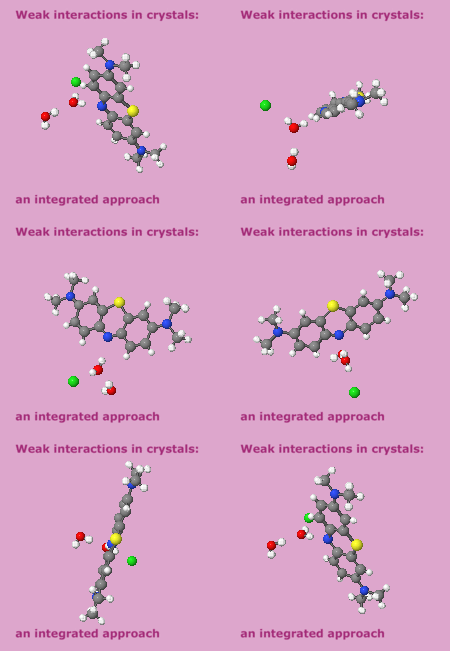
In the crystal, intermolecular N—H⋯O, O—H⋯Cl, O—H⋯O and C—H⋯O hydrogen bonds connect molecules to form a three-dimensional network. The molecules are further connected by C—H⋯π interactions and face-to-face π–π interactions into layers parallel to the (001) plane.
CCDC reference: 2577688
Download citation
Download citation
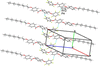
Synthesis and structure of 4-[(2,3,4,5,6-pentafluorophenoxy)carbonyl]phenyl 4-(decyloxy)benzoate
In the title compound, the dihedral angles between the central aromatic ring and its peripheral rings are are 76.57 (2) and 69.71 (3)° and the C10 alkyl chain adopts an extended conformation.
CCDC reference: 2576874
Download citation
Download citation
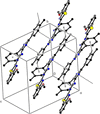
In the crystal, the molecules are linked by intermolecular C—H⋯O and C—H⋯N hydrogen bonds, forming sheets parallel to the (010) plane. Furthermore, molecules are connected by C—H⋯π and π–π [centroid-to-centroid distance = 3.7380 (12) Å] interactions, forming ribbons along the a-axis direction.
CCDC reference: 2389378
Download citation
Download citation
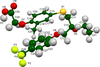
The crystal structure of seladelpar has been solved and refined using synchrotron X-ray powder diffraction data, and optimized using density functional theory techniques.
Download citation
Download citation

A hydrated salt of 3-methylpyridine and 5-nitroisophthalic acid has been synthesized using the reflux method. The crystal structure is consolidated by a network of significant intermolecular interactions, including O—H⋯O, N—H⋯O, and C—H⋯O hydrogen bonds, along with additional π–π interactions, which collectively contribute to the robustness of the solid-state architecture.
CCDC reference: 2579208
Download citation
Download citation
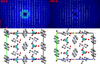
The crystal structure of tetraethylammonium molybdate dihydrate reveals two-dimensional layers of tetrahedral molybdate molecules bridged by water molecules, with each Mo-oxo serving as a hydrogen bond acceptor.
Download citation
Download citation
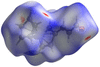
The title compound is a second orthorhombic polymorph of Fe(C5H5)(C8H7O) and crystallizes in the same space group as the first polymorph.
CCDC reference: 2579562
Download citation
Download citation
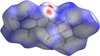
In the crystal, enantiomeric molecules are linked by C—H⋯O hydrogen bonds, forming layers parallel to the (101) plane. In addition, C—H⋯π interactions and Br⋯π contacts create layers parallel to the (101) plane.
CCDC reference: 2579217
Download citation
Download citation
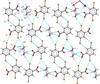
The crystal structure of piperazine-1,4-diium bis(2,5-dibromobenzoate) is reported, with detailed analysis of its intra- and intermolecular hydrogen-bonding interactions, supramolecular architecture, and Hirshfeld surface analysis.
CCDC reference: 2578701
Download citation
Download citation
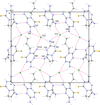
In the title compound, the cations are hydrogen bonded in pairs, which are bridged by the chloride anions through N—H⋯Cl hydrogen bonding.
CCDC reference: 2570884
Download citation
Download citation
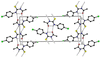
The title compound consists of a chlorophenyl ring and acetyl moiety bridged over a thiourea functional group. In the crystal, N—H⋯S and N—H⋯O hydrogen bonds link the molecules into infinite chains along the a-axis direction. Neither π–π nor C—H⋯π(ring) interactions are observed.
CCDC reference: 1816806
Download citation
Download citation
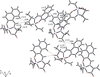
The reaction of the Schiff base ligand N-[(2-hydroxynaphthalen-1-yl)methylidene]alanine, H2L, with dichlorodiorganosilicon compounds, Cl2SiR2, yields pentacoordinated silicon complexes LSiR2.
Download citation
Download citation
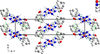
In the title molecule, the benzyltriazole moiety and the phenyl portion of the 3-(2-oxo-2-phenylethyl) group are disordered over two sites. In the crystal, layers of molecules parallel to the ab plane are generated by C—H⋯O and C—H⋯N hydrogen bonds, enclosing R22(10) and R22(16) ring motifs, and C—H⋯π(ring) interactions.
CCDC reference: 2581766
Download citation
Download citation
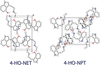
The solid state structures of two synthetic N-monoalkytryptamine analogs of the ‘magic' mushroom natural product norpsilocin are presented.
Download citation
Download citation
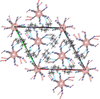
Bis(tetraethylammonium) dodecacyanododecaborate(2−) crystallizes in the trigonal space group P3. The B12(CN)122– subunit has nearly icosahedral symmetry and interacts with the Et4N+ cation in the structure by multiple weak Csp3–H⋯N hydrogen bonds between CN groups on the anion and methyl or methylene H atoms on the cation.
CCDC reference: 2051082
Download citation
Download citation
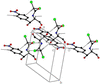
The racemic title compound crystallizes in space group P1 compared to C2221 for the chiral natural form.
CCDC reference: 2582935
Download citation
Download citation
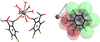
A lanthanum-based complex with chemical formula [La(tbpa)(Htbpa)(H2O)7] where H2tbpa is 3,4,5,6-tetrabromophthalic acid has been prepared and structurally described.
CCDC reference: 2430860
Download citation
Download citation
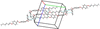
In the title compound, the aromatic ring of the 4-hexyloxybenzoyl moiety and the central benzoate ring are twisted relative to one another, subtending a dihedral angle of 39.7 (2)°. The hexyloxy chain adopts an extended, approximately all-anti conformation and two short intramolecular C—H⋯O contacts are observed. In the extended structure, C—H⋯π interactions help to consolidate the packing.
CCDC reference: 2582616