

 journal menu


issue contents
December 2025 issue
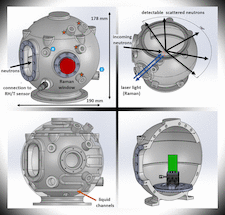
Cover illustration: Kreuzer et al. [J. Appl. Cryst. (2025), 58, 2026–2036] present a sample environment for simultaneous quasi-elastic neutron scattering and Raman spectroscopy experiments, enabling measurements on e.g. polymer films under controlled and variable relative humidity and temperature.
research papers


Open  access
access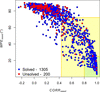
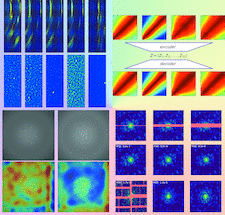
This paper highlights the significant contribution made by artificial intelligence to the phasing process, with a focus on its application to small structures ranging in volume from 1000 to 3500 Å3.
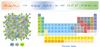
TransMagNet is a branch network model that predicts crystal systems and space groups directly from chemical compositions with high accuracy, providing a novel approach for materials design and discovery without relying on structural data.
Open access
access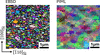
Our work presents a physics-informed machine learning approach that advances materials characterization by overcoming the fundamental resolution limits of synchrotron X-ray Laue microdiffraction. By integrating deep learning with physical constraints, we demonstrate that nanoscale grain mapping can be achieved even when using micrometre-sized X-ray probes.
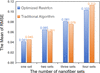
This study introduces Restrfcn, a transformer-based deep learning framework to accurately extract 3D nanofiber orientation parameters from complex wide-angle X-ray diffraction patterns, even with variable fiber sets. By optimizing the model via statistical hypothesis testing, the approach enables real-time analysis for high-throughput synchrotron experiments, advancing nanofiber composite characterization.
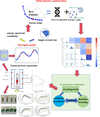
A Gaussian process regression neural network model has been developed to accelerate the geometric optimization of the crystal growth parameters of CdZnTe (CZT) grown by the travelling heater method (THM). An actual THM growth experiment using the optimized growth parameters demonstrates that the machine learning method is effective in guiding the THM growth of CZT crystals for photon-counting detector applications.

Download citation


Download citation
Open access
access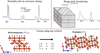
After 55 years, the average crystal structure of dypingite is finally revealed. Our research shows that ambient humidity controls long-range disorder within this mineral and unlocks its potential as a tunable, non-toxic material for developing next-generation functional materials.
Open access
access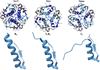
This study explores the impact of controlled relative humidity variations on the stability and structural response of crystalline insulin complexes, combining in situ X-ray powder diffraction (XRPD) with single-crystal X-ray diffraction. The results reveal significant alterations in unit-cell parameters and differing stability among insulin complexes with m-cresol and m-nitrophenol, highlighting in situ XRPD as a powerful tool for assessing the influence of environmental factors on the stability of pharmaceutical proteins.
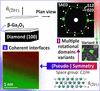
Epitaxial β-Ga2O3 films on (001) diamond exhibit strong texture with multiple rotational domains, driven by pseudo-symmetry and lattice mismatch factors. Coherent and incoherent domain boundaries influence the film's microstructure, impacting its thermal and electrical transport behavior for power electronics applications.
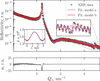
The transition from the kinematical to the dynamical regime of X-ray diffraction in smectic liquid crystal multilayers is investigated. To this end, synchrotron X-ray reflectivity data obtained from a real liquid crystal were analysed. A quantitative criterion for this transition is derived.
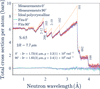
We carried out complementary time-of-flight neutron powder diffraction and transmission measurements to characterize four beryllium samples and assess extinction effects. The measured transmission data could be explained with a lattice-plane-dependent extinction model, while the diffraction measurements rule out texture as the cause of the discrepancies between the calculated and observed cross sections. Our results demonstrate that neutron transmission measurements are particularly sensitive to extinction effects.
Open access
access
In this combined computational and experimental study, we demonstrate that, despite its widespread use, a methanol–ethanol ratio of 4:1 is not optimal for use as a pressure-transmitting medium. Consistent with previous reports, we confirm that ethanol primarily serves to delay crystallization. However, our results also demonstrate that different components and ratios can offer modestly higher hydrostatic limits.
Open access
access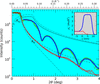
X-ray reflectivity data collection using a nanobeam and model fitting of small micrometre-sized areas on a substrate are presented.

Open access
access
A fully automated, real-time structure solution pipeline, Instamatic-solve, has been developed by linking XDS and SHELXT to the continuous-rotation electron diffraction method within Instamatic. Instamatic-solve automatically handles data processing and structure solution right after data collection, providing real-time assessments of data quality and structural information for efficient analysis.
Open access
access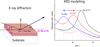
This study investigates the structural evolution of co-sputtered Cu-based thin films with varying concentrations of Nb and Pd, using X-ray diffraction, scanning electron microscopy and energy-dispersive X-ray spectroscopy. A random intercalation model is proposed to explain the observed structural trends and is applicable to other co-deposited thin-film systems.
Open access
access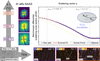
A novel small-angle X-ray scattering modelling approach is introduced for the analysis of precipitation behaviour in metallic systems exhibiting scattering signals with streaks originating from the embedding matrix. This approach enables in situ tracking of the microstructural evolution, such as the volume fraction and size of second phases, during continuous heating, and it is showcased for a near-α Ti alloy.
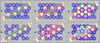
The three-dimensional structure of a natural bidisperse opal has been reconstructed using one (single) transmission electron microscopy image. The structure was confirmed by numerical modelling of the image and turned out to be of MgZn2 type.
Open access
access
We present a sample environment for simultaneous quasi-elastic neutron scattering and Raman spectroscopy experiments demonstrated on soft-matter films under variable and controlled relative humidity and temperature.
Open access
access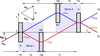
A split-crystal neutron interferometer allows longer arm separation and length. However, since the visibility of the interference is sensitive to seismic and acoustic noise, it is crucial to design and operate the interferometer acknowledging this problem. To aid in this process, we present a mathematical model that quantifies how time-dependent accelerations affect the phase and visibility of the interference fringes.
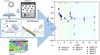
This study shows that surface mechanical attrition treatment (SMAT) induces beneficial compressive residual stresses and subgrain refinement in atomic diffusion additive manufacturing (ADAM)-produced 17–4 PH stainless steel. Accurate residual stress evaluation critically depends on the appropriate selection of grain-interaction models, without which the performance predictions for additively manufactured components under high loading conditions may be compromised.
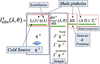
We describe the construction and performance of the small-angle scattering instrument ib-SAS at the compact accelerator-based neutron source RANS, RIKEN, Japan.
Open access
access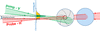
We experimentally demonstrate that the scattering-induced decrease in light intensity experienced by a crystal embedded in a high-viscosity jet is very limited in materials such as lipidic cubic phase or hydroxyethyl cellulose, and therefore cannot justify the use of pump energies exceeding the linear excitation regime under realistic experimental conditions.
Open access
access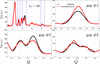
A reconstruction procedure for patterns with incomplete information is reported. It is based on a modified Papoulis–Gerchberg algorithm. The modifications were introduced to guide the reconstruction procedure. The reconstruction algorithm could prove useful in specific experimental geometry setups.
Open access
access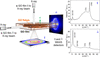
We present a methodology based on wide-angle X-ray scattering for the quantitative assessment of interflake ordering in graphene oxide films, providing a structural parameter to characterize anisotropy in disordered 2D materials.
Open access
access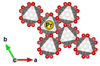
A full symmetry-mode decomposition analysis of PrNiO3 across its temperature-induced structural phase transitions allows identification of oxygen stretching and Jahn–Teller-like modes as the primary drivers of charge disproportionation at ∼130 K, concomitant with the metal–insulator transition. These distortions persist and evolve through the high-temperature orthorhombic to rhombohedral transition.
Download citation
Download citation
Open access
access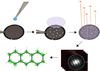
This article reports sub-Å structure determination of vacuum-sensitive organic samples in the solid state at room temperature by serial electron diffraction using formvar encapsulation for sample preservation.
Open access
access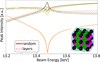
Anomalous diffraction analysis of hybrid perovskite thin films enables quantification of components in mixed compositions, as well as prospective investigation of superlattice ordering and spatial component distribution.
Open access
access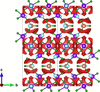
A simple modification to the bond valence site energy method is proposed to account for the asymmetrical coordination around post-transition metal cations in fluoride conductors due to the presence of electron lone pairs. A total of 136 structures from the Inorganic Crystal Structure Database are screened and several potential new conductors are suggested.
computer programs
Open access
access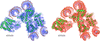
Crystallographic and cryo-electron microscopy maps with variable resolution can be calculated as a sum of analytic shell-function approximations to atomic images. To implement this procedure, a stand-alone Python script, ModQMap, has been developed.
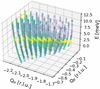
TasVisAn and InsPy are two Python packages for data reduction, visualization and analysis, instrument resolution calculation, and resolution convolution fitting for both traditional single-detector and modern multi-analyser triple-axis spectrometers.
addenda and errata
Open access
access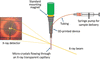
Information concerning sample preparation in the article by Ghosh et al. [J. Appl. Cryst. (2023), 56, 449–460] is clarified.
crystallographers
Free