

 journal menu


issue contents
July 2025 issue
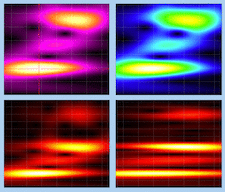
Cover illustration: A wavelet transform map of an EXAFS spectrum obtained with the software Fastosh is shown in the top-left picture (see Landrot and Fonda, pages 1085–1094). An interactive tool featured in Fastosh enables to choose in the map a specific pixel whose location is indicated by a red cross and then display its corresponding wavelet spectrum in k space (not shown here). The same data are also shown in the top-right, bottom-left and bottom-right pictures but with different colors, R range and R/k space resolutions, respectively.
facility information



research papers


Open  access
access
An injector testbed for continuous-wave free-electron lasers based on a direct current gun and an interchangeable very high frequency gun is under construction. Its physical design and performance have been studied carefully.


Open access
access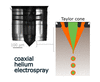
This study presents the Coaxial Helium Electrospray (CHeES) technique, employing a 3D-printed microfluidic coaxial nozzle to broaden the single particle imaging sample range at XFELs, enhancing sample conductivity support and reducing background noise.
Open access
access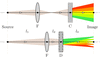
Theoretical background, optical design, experimental test results, and numerical simulations of the high-luminosity meV-resolution single-shot hard X-ray spectrograph for spectral diagnostics of cavity-based X-ray free-electron lasers are presented.
Open access
access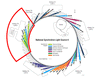
We describe the structural biology resources available at the National Synchrotron Light Source II at Brookhaven National Laboratory and ponder the future for automated experiments, micro-focusing crystallography and structure prediction to inform structural biology studies.
Open access
access
This study optimizes a Diamond Light Source photon absorber using additive manufactured (AM; 3D printing) conformal cooling channels in copper, achieving a maximum temperature drop of 11%, pressure drop reduction of 82% and examination of the AM print quality and its compliance with synchrotron and particle accelerator hardware applications using custom benchmark artefacts. These improvements can reduce thermal fatigue failure, component size, vibrations and energy consumption of absorbers, boosting overall facility efficiency, reliability and beam stability.
Open access
access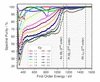
A new set of tools to allow more accurate modelling of plane grating monochromators in SHADOW3 are presented.
Open access
access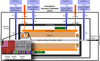
The performance and experience with one of the first commercially constructed conduction cooled superconducting undulators (SCU16) for the BioSAXS beamline at the Australian Synchrotron are described.
Open access
access
The resilience of recently upgraded double-crystal monochromators under increasing power load at Diamond Light Source is discussed. Experimental evidence and modelling are described.
Open access
access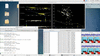
A versatile Mamba-based software framework for automated attitude tuning of beamlines is reported, which is expected to be able to cover most attitude-tuning needs (beam focusing, sample alignment etc.) in a simple and maintainable way. As well as a few real-world examples at the High Energy Photon Source and Beijing Synchrotron Radiation Facility, both in China, also presented is a virtual-beamline mechanism based on easily customisable simulated detectors and motors.
Open access
access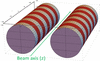
We propose a vertically polarized superconducting multipole wiggler (V-SC-MPW) designed to reduce emittance growth. This paper presents a low-field, short-period design utilizing Nb3Sn coils, demonstrating its feasibility for vertically polarized hard X-ray generation in modern low-emittance rings with minimal impact on beam quality.
Open access
access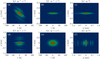
This work develops a 6D phase space tracing module in the FURION software. The 6D phase space tracing provides a solution for the rapid simulation of ultrashort pulse propagation in X-ray beamlines, especially in dispersive beamline systems.
Open access
access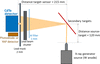
This paper presents the evaluation results of the response of a pixelated photon-counting detector, equipped with ohmic-type cadmium telluride sensors, under high-energy X-ray irradiations.
Open access
access
We present an easily assembled, low-cost beam-tilting extension for synchrotron-based ultra-small-angle X-ray scattering (USAXS) / small-angle X-ray scattering (SAXS) beamlines enabling grazing-incidence (GIUSAXS) and transmitted (GTUSAXS) experiments on liquid surfaces with negligible loss of X-ray flux. The setup is implemented at the sample stage with ∼0.5 m of additional space and provides incidence angles up to ∼0.6°, corresponding to approximately twice the critical angle of typical reflector materials.
Open access
access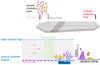
By coupling asymmetrical-flow field-flow fractionation to small-angle X-ray scattering (AF4–SAXS), we enable precise, size-resolved analysis of polydisperse samples. Our automated AF4–SAXS system at the EMBL P12 beamline streamlines workflows, making advanced characterization accessible to both novice and experienced users, with principles adaptable to other facilities.
Open access
access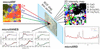
A synchrotron-based multi-modal approach shows the presence of a new vanadium-containing compound in basic-oxygen-furnace slags.
Open access
access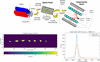
A robust integration is introduced of the extended-range high energy resolution fluorescence detection technique, multiple-crystal spectrometers and binary data splicing techniques for the further refinement of spectra in X-ray emission spectroscopy, revealing deeper insights into material properties and atomic transitions.
Open access
access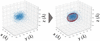
Improved accuracy of the octahedral local rotation in SrTiO3 has been achieved by simultaneous two-metal-edge EXAFS refinement.
Open access
access
The MUSTACHE setup, described in this work, provides a state-of-the-art approach for investigating phenomena induced by high-energy X-rays, specifically targeting deep-core ionization, Auger cascades, and molecular photofragmentation triggered by these processes. Optimized for the tender and hard X-ray range, this high-resolution electron–multi-ion coincidence setup enables efficient detection of high-kinetic-energy electrons and their correlated ions with high momentum resolution.
beamlines
Open access
access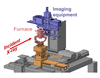
This study introduces an advanced in situ visualization system using synchrotron white X-rays, enabling real-time imaging with micrometre resolution to investigate the solidification behaviors of metallic materials. These findings advance the understanding of microstructural evolution during melting and solidification, contributing to the development of materials with optimized properties.
Open access
access
The superconducting wiggler beamline IMAGE at the KIT Light Source, dedicated to full-field hard X-ray imaging applications in materials and life sciences, with a focus on high-throughput computed tomography, laminography experiments and systematic in situ and operando studies, is described.
Open access
access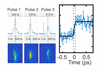
A novel timing tool suited for FemtoMAX is described. This will allow sub-100 fs time-resolved measurements at FemtoMAX.
Open access
access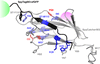
A description of the beamlines within the structural biology ALS-ENABLE P30 resource at the Advanced Light Source synchrotron at Lawrence Berkeley National Laboratory is given, highlighted through the biophysical characterization of the SpyCatcher–SpyTag protein system.
Open access
access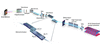
A dispersive X-ray absorption spectroscopy instrument has been developed and implemented at the Advanced Photon Source's Advanced Spectroscopy Beamline. The instrument uses a convexly bent Bragg-crystal analyzer to disperse a polychromatic X-ray beam and independent Kirkpatrick–Baez mirrors for focusing, thereby providing a simple and flexible method for acquisition of X-ray absorption spectra, with the absorption at each energy measured simultaneously in a single shot.
computer programs
Open access
access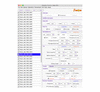
The main functionalities of Fastosh, especially those that are unique to the program, are presented. This notably includes various tools based on chemometry (e.g. MCR-ALS) and some functions to interprete the Fourier or wavelet transform using a quick-EXAFS modelling approach.
Open access
access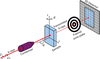
MARTApp is an open-source software for magnetic vector reconstruction of the data acquired from magnetic transmission X-ray microscopy. It automates the tasks of image normalization, alignment, computation of magnetic signal and the reconstruction of quasi-2D and -3D systems. Following the developed procedure, the magnetization of a simulated 3D magnetic texture has been recovered.
addenda and errata
Open access
access