

 journal menu


issue contents
January 2026 issue
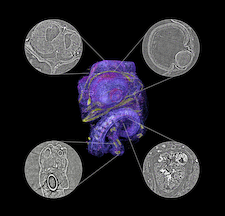
Cover illustration: Virtual histology and 3D anatomy of a Brazilian skink embryo (Brasiliscincus agilis) (see Colaço et al., pages 170–180). By retaining embryos within the female's body through their development, this species offers rare insights, making it a powerful model for research in vertebrate anatomy, organogenesis and the evolution of development (EvoDevo).
facility information



overview


Open  access
access
We provide a historical introduction and our thoughts on the current trends including some based on papers in this special issue of Journal of Synchrotron Radiation celebrating the 50th Anniversary of the Stanford SSRL synchrotron radiation and protein crystallography initiative led by Keith Hodgson.
perspectives
Open access
access
It has been 50 years since the publication in PNAS of our first results on the utilization and demonstrated benefits of synchrotron radiation for macromolecular crystallography. In this brief article, I offer some personal observations and comments about that early research at Stanford and the Stanford Synchrotron Radiation Project (SSRP, later renamed SSRL), how it evolved, and consider key factors in how and why synchrotron radiation ultimately catalyzed a new and transformational paradigm for study of the structure of biomolecules.
research papers

Open access
access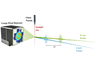
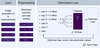
Analysis strategies for time-resolved X-ray solution scattering at high repetition rate XFEL sources
An analysis of experimental artifacts in time-resolved X-ray solution scattering data acquired at high repetition rate XFEL sources, specifically at the FXE instrument at the European XFEL, is presented.
Open access
access
Methods using spontaneous radiation to monitor and optimize the Aramis hard X-ray beamline are presented, together with the eight-year evolution of these improvements and the resulting record performance.
Open access
access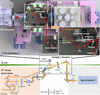
The development of a timing diagnostic tool at the CSI endstation of the Shanghai Soft X-ray Free Electron Laser Facility achieves precise temporal characterization for advanced pump–probe experiments. The tool's unique design enables X-ray pulse monitoring without sample-stage rotation with both spectral-encoding and spatial-coupling methods, offering a reliable solution for X-ray pump–probe experiments at the CSI endstation.
Open access
access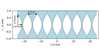
This work investigates the temporal effects of refractive X-ray lenses on ultra-short pulses from X-ray free-electron lasers. Using both a full Fresnel theory model and a simplified ray-tracing approach, the paper analyzes the pulse elongation and spatio-temporal distortions introduced by these focusing optics.
Open access
access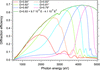
Monochromators based on multilayer gratings can provide a very high throughput on an extended energy range (1 to 5 keV) in the tender X-ray domain. A multilayer mirror must be associated with the grating to achieve a fixed exit direction. We show how important an accurate modeling of the reflectivity of these two elements is to achieve both an optimal design and an optimal tuning.
Open access
access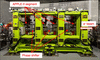
A four-segmented APPLE-II undulator was constructed, and its operation has started at NanoTerasu BL13U. The performance of arbitrary polarization control using phase shifters is demonstrated.
Open access
access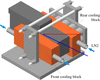
A liquid-nitrogen-cooled silicon channel-cut monochromator was developed and tested under synchrotron radiation with incident powers up to 417 W. The minimal deformation and the maintained high stability indicate its suitability as a first optical element for fourth-generation synchrotron sources, such as SPring-8-II.
Open access
access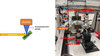
We present Gaia, a cryogenically cooled monolithic array of 96 high-purity germanium pixel detectors integrated with a custom low-noise application-specific integrated circuit and a field-programmable gate array-based data acquisition system. The system achieves an average energy resolution of 711 eV at 122 keV and 253 eV at 5.89 keV, and serves as the foundation for a forthcoming 384-pixel detector.
Open access
access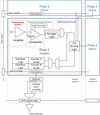
Here, we present SELUN, a novel X-ray photon counting hybrid pixel detector developed at DECTRIS Ltd for coherent diffraction imaging techniques at synchrotron facilities.
Open access
access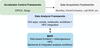
MAPI is a modular web-based framework designed to unite legacy analysis code with heterogeneous backends (edge, on-premises, high-performance computing, cloud), dramatically accelerating data analysis workflows and offering a scalable flexible blueprint for modernizing synchrotron data analysis.
Open access
access
A high-temperature furnace for multimodal synchrotron-based X-ray microscopy and diffraction imaging
Here, a novel high-temperature contactless furnace, compatible with a range of X-ray diffraction and imaging techniques, is introduced. This study outlines its design, characterizes its thermal performance, and demonstrates strain relaxation and grain growth within an iron grain upon in situ annealing, utilizing dark-field X-ray microscopy at the ESRF-ID03 beamline.
Open access
access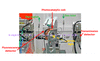
This article reports a versatile operando X-ray absorption spectroscopy (XAS) cell and set-up for the photocatalytic reduction of CO2 in the gas phase, which is validated individually for both photocatalysis and XAS measurements. A detailed operando experiment reveals the link between Mo species evolution and deactivation of the photocatalyst.
Open access
access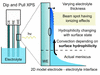
This work provides guidelines on how to meaningfully perform a dip-and-pull X-ray photoelectron spectroscopy (XPS) experiment applied to electrochemistry and electrocatalysis to obtain information on both the electrode properties and the electrode/electrolyte interface. The aim is to facilitate access to the dip-and-pull XPS method to newcomers from the field of electrochemistry.
Open access
access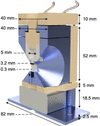
A reactor is described, whose modular design enables in situ X-ray scattering and spectroscopy, infrared spectroscopy, gas and liquid injection under autoclave-like conditions and magnetic stirring for solvothermal synthesis up to 200°C and 8 bar.
Open access
access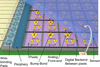
A new event-driven, energy-resolving ASIC intended for full-field X-ray fluorescence imaging is presented. Its frameless mode of operation was validated on a synchrotron beamline using a bump-bonded, 2D segmented silicon sensor, demonstrating per-pixel energy measurements with event-driven readout. Using on-chip spectral acquisition together with autonomous system control, this prototype establishes key building blocks for future real-time elemental mapping in biological, environmental and materials research.
Open access
access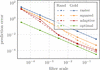
We present a reinforcement learning based approach to X-ray imaging which allows for up to an order of magnitude lower exposure time to reach the same image quality as with a standard raster scan. This is achieved by splitting the imaging task into several steps and letting initial measurements inform the exposure distribution at later stages of the sequence.
Open access
access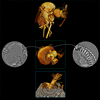
From whole specimens to histological level reconstructions, images derived from 3D synchrotron-based microtomography (SR-microCT) have emerged as a tool that is revolutionizing a wide range of biological research. This paper presents the first commissioning results from experiments to image the anatomy of small animals and specimens from zooarchaeology and palaeontology carried out on MOGNO, the nano- and microtomography beamline at Sirius/LNLS, Brazil.

Open access
access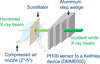
A high-speed X-ray microscope design optimized for white beam synchrotron radiation enables real-time in situ imaging of crack dynamics during electron beam powder bed fusion (PBF-EB) of high-Z materials. With high temporal resolution and 10 µm spatial resolution, the system reveals previously unobservable crack evolution behavior in Ni-based superalloys, potentially advancing understanding of additive manufacturing processes.
short communications
Open access
access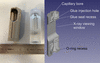
A description of stereolithography printing a disposable, high-reliability alternative to commercially available stopped-flow capillary and cuvette holders is given. The new design offers all the advantages of rapid prototyping for enhanced design flexibility.
beamlines
Open access
access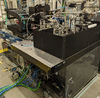
An introduction is provided to the extended (atmospheric pressure) capabilities of the Single-Particle, Clusters and Biomolecules and Serial Femtosecond Crystallography (SPB/SFX) scientific instrument at the European X-ray Free-Electron Laser facility.
Open access
access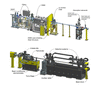
The Spanish synchrotron ALBA has recently inaugurated BL31-FaXToR, a beamline for hard X-ray micro-tomography. The design, performance and scientific program of the beamline are described.
Open access
access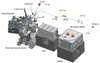
A valence-band resonant inelastic X-ray scattering instrument, operating in the tender X-ray range, uses an incoming beam with a linear energy dispersion to reach the intrinsic resolution of the Rowland spectrometer. Such a scheme is insensitive to the incident bandwidth and therefore preserves count-rates despite the higher resolution.
Open access
access
Comprehensive upgrades to optics, detectors and the endstation at the CXS beamline have transformed its coherent diffraction imaging performance, enabling routine Bragg coherent diffraction imaging and microbeam diffraction, and adding the capability for transmission geometry nano-imaging via ptychography.
computer programs
Open access
access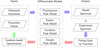
MapsTorch is a new open-source package that enables automatic differentiation for X-ray fluorescence (XRF). The robust performance of MapsTorch makes it possible to automate steps that are usually manual in XRF analysis, including initial spectrum fitting and elemental intensity refinement, and therefore can support automated, high-throughput workflows for synchrotron facilities.
Open access
access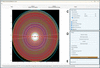
MuscleX-Diffraction Imaging (MuscleX-DI) is an integrated, open-source software suite for data reduction and visualization of scanning X-ray diffraction (XRD) experiments. It is developed in Python and runs on Linux, Microsoft Windows or macOS. MuscleX-DI offers an end-to-end software analysis pipeline that ingests diffraction patterns and raster scan parameters to generate 2D visualizations of various calculated measurements from raw XRD patterns. Modules can be run via a graphical user interface or in a `headless mode' from the command line. We provide an overview of the general structure of the MuscleX-DI software package.
addenda and errata
Open access
access