


 journal menu


issue contents
September 2025 issue
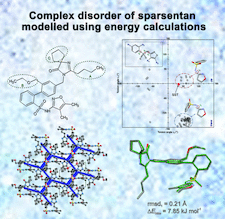
Cover illustration: A molecule of non-immunosuppressive agent sparsentan displaying a complex disorder of multiple sections was modelled and interpreted with the assistance of energy calculations. See Gelbrich, Saršüns & Braun [Acta Cryst. (2025), C81, 530–538].
research papers


Download citation


Download citation
Open  access
access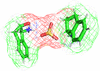
The cleavage of the HIV-1 protease inhibitor indinavir sulfate via a one-pot synthesis reflux method with 1-propanol successfully yielded the salt bis(2-hydroxy-2,3-dihydro-1H-inden-1-aminium) sulfate. The reported analysis provides comprehensive insights into the chemical transformations, thermal stability and molecular interactions of the salt, contributing to its characterization and potential pharmaceutical applications.
CCDC reference: 2324379
Open access
access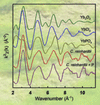
Ce, Gd and Yb can accumulate as lanthanide phosphate structures in the alga Chlamydomonas reinhardtii supplemented with phosphate and may be a means of selective recovery of rare earths from solution. EXAFS structural analysis of some Ce, Gd and Yb compounds are presented.
Download citation
Download citation
Open access
access
Greater solubility facilitated the isolation of the ortho-isomer from a CO2 elimination reaction that primarily produces the para-isomer [Pt{(p-BrC6F4)N(CH2)2NEt2}Cl(py)]. X-ray crystallography identified the syn and anti rotamers of [Pt{(o-BrC6F4)N(CH2)2NEt2}Cl(py)] in a 1:1 ratio in the solid state.
Download citation
Download citation
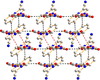
Two cocrystals of imidazo[1,2-a]pyridine-3-carbonitrile (IPC) with 4-nitrobenzoic acid (4-NBA) and 4-nitrophenol (4-NP) have been synthesized and characterized by X-ray diffraction and Hirshfeld surface analysis, and their noncovalent interactions have been investigated.
Download citation
Download citation
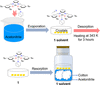
Stimuli-responsive crystalline materials have demonstrated significant potential for developing multifunctional systems. Achieving precise structural modulation in non-porous crystalline phases remains a critical challenge. We report a solvatomorphic crystalline system which exhibits a reversible single-crystal-to-single-crystal transformation during acetonitrile adsorption/desorption, establishing a strategy for modulating optoelectronic properties in non-porous crystalline materials through solvent-mediated structural reorganization.
Download citation
Download citation
Open access
access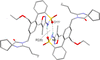
A molecule of sparsentan displaying a complex disorder of multiple sections was modelled and interpreted with the assistance of energy calculations.
CCDC reference: 2480328
Download citation
Download citation
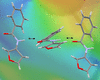
The crystal structures of two closely related N-arylbenzamides were determined experimentally using single-crystal X-ray diffraction. Predictions of the geometries of the gas-phase isolated conformers corresponding to molecules in the crystals were performed with DFT calculations. Molecular interaction energies and Hirshfeld surfaces were used to examine differences in the energetics of nearest-neighbor interactions in the two crystalline environments in an attempt to explain any conformational changes that may occur upon crystallization of the isolated conformers.
Download citation
Download citation
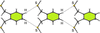
The crystal structures of eight compounds whose common features are an aromatic ring (naphthalene or benzene) and the presence of two hydroxymethyl groups or two sulfanylmethyl groups were examined. Different positions of the functional groups relative to each other are of fundamental importance in the way the molecules of these compounds are packed in the unit cells and have an impact on the interactions of the molecules of the compounds with each other.