

 journal menu


issue contents
August 2025 issue
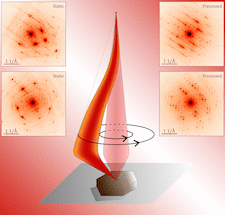
Cover illustration: Plana-Ruiz et al. [J. Appl. Cryst. (2025), 58, 1249–1260] investigate the use of electron beam precession in a (scanning) transmission electron microscope for serial crystallography experiments, showing its potential for better crystal structure determination and refinement in the context of 3D electron diffraction.
feature articles


Open  access
access
We share personal experience in the fields of materials science and high-pressure research, discussing which parameters are important to control and document in order to make deposited powder diffraction data reusable, reproducible and replicable.
research papers

Open access
access
The X-ray restrained wavefunction (XRW) approach could be a useful tool to propose new exchange–correlation (xc) functionals for density functional theory. Here, orbital-averaged XRW perturbation potentials of atoms (neon, argon and krypton) and simple molecules (dilithium and urea) are extracted and visualized for the first time, and their possible use in the development of new xc functionals is discussed.
Open access
access
We report a comparison of modulation of intensity with zero effort (MIEZE), a neutron spin–echo technique, and neutron time-of-flight spectroscopy, a conventional neutron scattering method. The basis of this comparison is provided by measurements performed on pure water under the same measurement conditions.
A statistical model for complex oxide superlattices is introduced. The model can be applied in kinematical calculations of X-ray diffraction intensities for epitaxially grown samples.
Open access
access
The mechanical behavior of piezoelectric ZnO nanowires was studied, demonstrating a fracture strength of up to 3 GPa, significantly higher than that of bulk ZnO. This enhanced strength increases energy-harvesting potential and reveals unexpected plasticity with dislocation storage in the basal plane.
Open access
access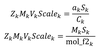
Two recently reported quantitative phase analysis (QPA) methods—the direct derivation method (DDM) and the unit-cell scattering power method—have been further developed into the Ck-corrected DDM and the molecular scattering power method, respectively. These methods are compatible with the conventional Rietveld QPA routine, as demonstrated through quantification of disordered clay mineral phases using the TOPAS software.
Open access
access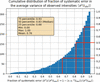
The weighted agreement factor in small-molecule crystallography is, for half of a sample (N = 314) of published data sets, so large that it cannot be explained by errors like unrecognized disorder or twinning. Instead, the standard uncertainties are most likely flawed in these cases.

Download citation


Download citation
Open access
access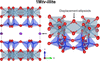
Combined synchrotron X-ray diffraction and pair distribution function analyses have been used to determine, for the first time, the anisotropic atomic displacement parameters of illite, offering new insights into its atomic dynamics.
CCDC reference: 2449650
Open access
access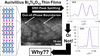
An analytical model is presented that successfully describes how out-of-phase boundaries in epitaxial thin films of layered materials affect X-ray diffraction (XRD) peak profiles. It is applied to describe the experimental XRD profiles of two types of Aurivillius oxide thin films: SrBi2(Ta,Nb)O9 and Bi4Ti3O12.
Open access
access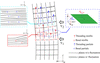
Using a machine learning method, this study enhances crystal structure analysis for a cross-sectional hydride vapor-phase epitaxy GaN wafer, revealing hidden features and aiding structural investigations, and outperforming the conventional method.
Open access
access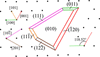
Epi-growth of the {010} form of polar brushite (CaHPO4·2H2O) on the {010} form of non-polar gypsum (CaSO4·2H2O) is described.
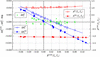
Optical rotation parameters of potassium titanyl arsenate non-enantiomorphous biaxial crystals along the birefringence direction were investigated using an improved dual-wavelength polarimetric method.
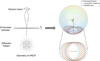
We present a MATLAB-based framework implementing golden-ratio shift orientation sampling for continuous precession rotation electron diffraction tomography, achieving convergence within 512 Bloch wave calculations per frame, which is a tenfold reduction compared with conventional protocols. We also describe numerical tests for dynamical intensities calculated using the Bloch wave method for different three-dimensional electron diffraction methods.
Open access
access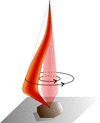
The use of electron beam precession in a (scanning) transmission electron microscope for serial crystallography experiments is thoroughly investigated, showing its potential for better crystal structure determination and refinement in the context of 3D electron diffraction.
Open access
access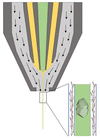
Superstable micrometre compound jets have been produced for serial femtosecond X-ray crystallography.
Open access
access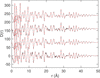
Hermite functions are used to represent pair distribution functions from total scattering data in order to allow the effects of resolution to be taken into account.
Open access
access
This work introduces an algorithm to extract quantitative orientation and phase information of thin films using grazing-incidence X-ray diffraction. The approach is demonstrated using experimental data from three distinct systems, showcasing its broad applicability.
Open access
access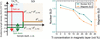
This study introduces a quantitative framework for evaluating magnetic reference layers (MRLs) in polarized neutron reflectometry and demonstrates that CoTi alloys outperform conventional Fe- and Ni-based MRLs. The tunability of CoTi's nuclear and magnetic scattering length densities enables superior sensitivity, making it a highly effective choice for enhancing contrast and resolving phase ambiguity in soft-matter and thin-film research.
Open access
access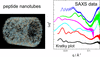
Peptide nanotubes have diverse structures, which can be elucidated by small-angle scattering. Here, we discuss in detail appropriate models for form- and structure-factor effects exemplified by analysis of data for several classes of peptide nanotubes.
Open access
access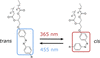
Time-resolved small-angle X-ray scattering is applied to investigate the kinetics of reversible light-induced switching of mesophase transitions from a lamellar to a cubic Pn3m phase in mixed phospholipid and azobenzene amphiphile lyotropic liquid crystals.
Open access
access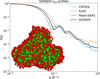
We present a new analysis approach for calculating the solution X-ray scattering of high-resolution models of biomacromolecules. We introduce novel grid-based methods for evaluating both the hydration shell and excluded volume scattering contributions. The methods are implemented in the new open-source software AUSAXS.
Open access
access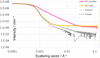
We present the first combined analysis of X-ray dark-field signals and small-angle X-ray scattering curves from several samples representing different sources of scattering.
Open access
access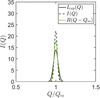
A strategy based on the central moment expansion approach is proposed for addressing the resolution discrepancy inherent in cross-sectional measurements obtained via small-angle scattering experiments.
Open access
access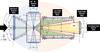
Various neutron detection approaches for industrial use at the time-of-flight small-angle neutron scattering instrument iMATERIA (J-PARC) are described here.
Open access
access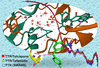
The structures and stabilities of transthyretin tetramers and their complexes with tolcapone or tafamidis bound at the T4-site, in aqueous solutions without and with 8 M urea, are revealed using SEC-SWAXS and NMR.
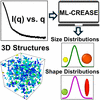
In this work we use the machine learning based CREASE method to identify the distributions in sizes (diameter, aspect ratio) and shapes (spheres to ellipsoids) of nanoparticles from their small-angle X-ray scattering data.
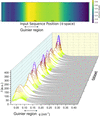
This work proposes a deep neural network solution to address the inefficiency challenge of the correlation function analysis method in the interpretation of small-angle X-ray scattering data for phase-separated structures of polymers.
Open access
access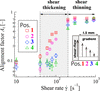
A new 1–2 plane shear cell has been developed to observe structural changes and concentration fluctuations under flow fields depending on the velocity gradient, which cannot be measured by the Rheo-SANS small-angle neutron scattering technique.
Open access
access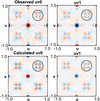
High-energy X-ray scattering in an ultra-small-angle grazing-incidence geometry is employed for local structure analysis of epitaxially grown single-crystalline thin films with atomic scale resolution. This novel approach allows for non-invasive, non-destructive and quantitative 3D analysis of local order in thin films, providing a valuable complement to traditional solid-state characterization techniques.
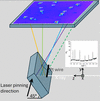
A combined modified Warren–Averbach and modified Williamson–Hall analysis of diffraction peaks obtained by energy scanning of Laue microdiffraction patterns is introduced. For the first time the method allows estimation of the adequacy of the chosen dislocation model. It was applied to characterize the dislocation structure at the micrometre scale in a laser-peened Ni polycrystal.
Open access
access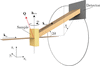
We derive a closed analytical expression that allows determination of the strain and lattice rotation from the deviation of experimental observables (e.g. goniometer angles) from their nominal position for an unstrained lattice. We also propose an experimental geometry wherein such measurements can be carried out while keeping the illuminated sample volume constant, facilitating registration of data.
teaching and education
Open access
access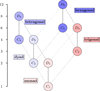
The Hasse diagram of the 3D point-group classes is built with six motifs that have a well defined parity that determines their structure. Of the seven crystal systems, three are built with odd motifs, three are built with even motifs and the last one, the monoclinics, is `ambidextrous' as they are built with both.
short communications
Open access
access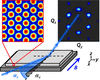
A perspective is given on the opportunities provided by near-surface small-angle neutron scattering for the characterization of nanoscale magnetic phenomena near surfaces and their extension into nano-confined volumes in the thin-film limit.
Open access
access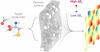
This work presents a high-throughput method for predicting molecular adsorption sites on ionic surfaces using pairwise Coulomb and Lennard–Jones potentials. Requiring only a CIF as input, the approach enables rapid identification of stable adsorption structures, offering an efficient pathway for studying complex surface–adsorbate interactions.
CIF applications
Open access
access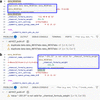
The design and features of the CIF extension for Visual Studio Code are presented.
computer programs
Open access
access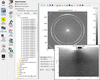
Pydidas is a new Python package for processing X-ray diffraction data, offering a user-friendly interface and versatile processing options. It includes a graphical user interface for the entire data processing pipeline and is intended to be easily accessible for non-experts.
Open access
access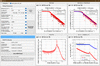
The program PRINSAS 2.0 is designed to fit the polydisperse spherical pore model to small-angle scattering (SAS) data of porous materials. It improves accessibility for users without extensive SAS analysis or programming experience, while being optimized for porous systems commonly found in geological samples. The fitting algorithm is validated on experimental and synthetic data sets to ensure broad applicability, and is benchmarked against other tools in the field for acquiring size distribution.
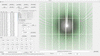
Laueprocess, a program for processing Laue diffraction data, is presented.
crystallographers
Free